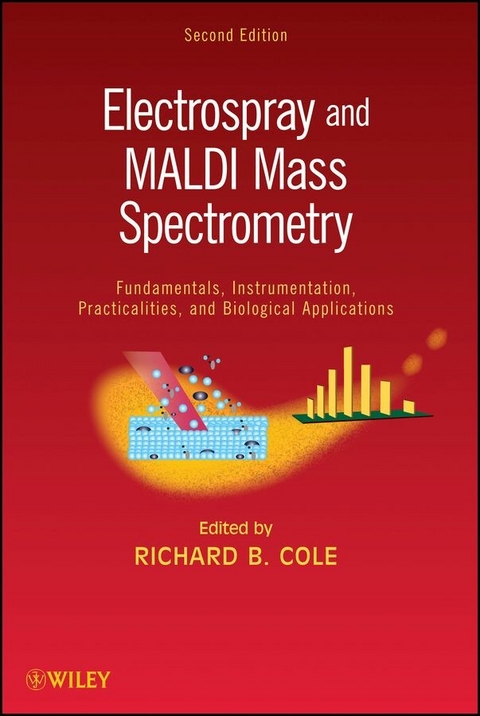
Electrospray and MALDI Mass Spectrometry (eBook)
John Wiley & Sons (Verlag)
978-1-118-21155-7 (ISBN)
Electrospray and MALDI Mass Spectrometry brings both veteran practitioners and beginning scientists up to date with the most recent trends and findings in electrospray ionization and matrix-assisted laser desorption/ionization (MALDI) mass spectrometry. In particular, this Second Edition highlights how advances in electrospray and MALDI mass spectrometry are supporting important discoveries in new and emerging fields such as proteomics and metabolomics as well as in traditional areas of chemistry and physics research.
Electrospray AND MALDI Mass Spectrometry, SECOND EDITION is divided into five parts:
Part A, Fundamentals of ES, explains the fundamental phenomena underlying the electrospray process, including selectivity in ionization and inherent electrochemistry, and concludes with a chapter offering a comparative inventory of source hardware
Part B, Fundamentals of MALDI, confronts ionization mechanisms, instrument development, and matrix selection, and includes a final chapter that explores the special application of MALDI to obtain two-dimensional images of spatial distributions of compounds on surfaces
Part C, ES and MALDI Coupling to Mass Spectrometry Instrumentation, examines the coupling of these ionization techniques to various mass analyzers, including quadrupole ion trap, time-of-flight, Fourier transform ion cyclotron resonance, and ion mobility mass spectrometers
Part D, Practical Aspects of ES and MALDI, investigates analytical issues including quantification, charge-state distributions, noncovalent interactions in solution that are preserved as gas-phase ions, and various means of ion excitation in preparation for tandem mass spectrometry, and offers a guide to the interpretation of even-electron mass spectra
Part E, Biological Applications of ES and MALDI, examines the role of mass spectrometry in such areas as peptide and protein characterization, carbohydrate analysis, lipid analysis, and drug discovery
Written by a team of leading experts, the book not only provides a critical review of the literature, but also presents key concepts in tutorial fashion to help readers take full advantage of the latest technological breakthroughs and applications. As a result, Electrospray and MALDI Mass Spectrometry will help researchers fully leverage the power of electrospray and MALDI mass spectrometry. The judicious compartmentalization of chapters, and the pedagogic presentation style throughout, render the book highly suitable for use as a text for graduate-level courses in advanced mass spectrometry.
RICHARD B. COLE, PHD, is a University Research Professor in The Department of Chemistry at The University of New Orleans. He has spent more than twenty-five years working in the field of mass spectrometry. His research interests include analytical/bio-organic chemistry as well as fundamentals and applications of mass spectrometry, with a focus on the development of novel analytical methods employing electrospray and MALDI.
Discover how advances in mass spectrometry are fueling new discoveries across a broad range of research areas Electrospray and MALDI Mass Spectrometry brings both veteran practitioners and beginning scientists up to date with the most recent trends and findings in electrospray ionization and matrix-assisted laser desorption/ionization (MALDI) mass spectrometry. In particular, this Second Edition highlights how advances in electrospray and MALDI mass spectrometry are supporting important discoveries in new and emerging fields such as proteomics and metabolomics as well as in traditional areas of chemistry and physics research. Electrospray AND MALDI Mass Spectrometry, SECOND EDITION is divided into five parts: Part A, Fundamentals of ES, explains the fundamental phenomena underlying the electrospray process, including selectivity in ionization and inherent electrochemistry, and concludes with a chapter offering a comparative inventory of source hardware Part B, Fundamentals of MALDI, confronts ionization mechanisms, instrument development, and matrix selection, and includes a final chapter that explores the special application of MALDI to obtain two-dimensional images of spatial distributions of compounds on surfaces Part C, ES and MALDI Coupling to Mass Spectrometry Instrumentation, examines the coupling of these ionization techniques to various mass analyzers, including quadrupole ion trap, time-of-flight, Fourier transform ion cyclotron resonance, and ion mobility mass spectrometers Part D, Practical Aspects of ES and MALDI, investigates analytical issues including quantification, charge-state distributions, noncovalent interactions in solution that are preserved as gas-phase ions, and various means of ion excitation in preparation for tandem mass spectrometry, and offers a guide to the interpretation of even-electron mass spectra Part E, Biological Applications of ES and MALDI, examines the role of mass spectrometry in such areas as peptide and protein characterization, carbohydrate analysis, lipid analysis, and drug discovery Written by a team of leading experts, the book not only provides a critical review of the literature, but also presents key concepts in tutorial fashion to help readers take full advantage of the latest technological breakthroughs and applications. As a result, Electrospray and MALDI Mass Spectrometry will help researchers fully leverage the power of electrospray and MALDI mass spectrometry. The judicious compartmentalization of chapters, and the pedagogic presentation style throughout, render the book highly suitable for use as a text for graduate-level courses in advanced mass spectrometry.
RICHARD B. COLE, PHD, is a University Research Professor in The Department of Chemistry at The University of New Orleans. He has spent more than twenty-five years working in the field of mass spectrometry. His research interests include analytical/bio-organic chemistry as well as fundamentals and applications of mass spectrometry, with a focus on the development of novel analytical methods employing electrospray and MALDI.
Foreword: Desorption Ionization and Spray Ionization: Connections
and Progress (R. Graham Cooks).
Foreword to the First Edition (John B. Fenn).
Preface (Richard B. Cole).
Contributors.
Part I Fundamentals of ES.
1. On the Mechanism of Electrospray Ionization Mass Spectrometry
(ESIMS) (Paul Kebarle and Udo H. Verkerk).
2. Selectivity in Electrospray Ionization Mass Spectrometry
(Nadja B. Cech and Christie G. Enke).
3. Electrochemistry of the Electrospray Ion Source (Gary J.
Van Berkel and Vilmos Kertesz).
4. ESI Source Design (Andries P. Bruins).
Part II Fundamentals of MALDI.
5. MALDI Ionization Mechanisms: an Overview (Richard
Knochenmuss).
6. The Development of Matrix-Assisted Laser
Desorption/Ionization Sources (Peter B. O'Connor).
7. A Comparison of MALDI Matrices (Mahmud Hossain and Patrick
A. Limbach).
8. MALDI Imaging Mass Spectrometry (Alain Brunelle and
Olivier Laprévote).
Part III ES and MALDI Coupling to Mass Spectrometry
Instrumentation.
9. Coupling ESI and MALDI Sources to the Quadrupole Mass Filter,
Quadrupole Ion Trap, Linear Quadrupole Ion Trap, and Orbitrap Mass
Analyzers (Mark E. Bier).
10. Time-of-Flight Mass Spectrometry (Robert J.
Cotter).
11. Fourier Transform Ion Cyclotron Resonance and Magnetic
Sector Analyzers for ESI and MALDI (Jeremy J. Wolff and I.
Jonathan Amster).
12. Ion Mobility-Mass Spectrometry (John A. McLean, J.
Albert Schultz, and Amina S. Woods).
Part IV Practical Aspects of ES and MALDI.
13. ESI, APCI, and MALDI A Comparison of the Central Analytical
Figures of Merit: Sensitivity, Reproducibility, and Speed
(Thomas R. Covey, Bradley B. Schneider, Hassan Javaheri, J.C.
Yves LeBlanc, Gordana Ivosev, Jay J. Corr, and Peter
Kovarik).
14. Charge State Distributions in Electrospray and MALDI (Yan
Li and Richard B. Cole).
15. Probing Noncovalent Interactions by Electrospray Ionization
and Matrix-Assisted Laser Desorption/Ionization (Sonal Mathur,
Alexis Nazabal, and Renato Zenobi).
16. Ion Activation Methods for Tandem Mass Spectrometry
(Kristina H& #229;akansson and John S.
Klassen).
17. Dissociation of Even-Electron Ions (Carlos Afonso,
Richard B. Cole, and Jean-Claude Tabet).
Part V Biological Applications of ES and MALDI.
18. The Role of Mass Spectrometry for Peptide, Protein, and
Proteome Characterization (A. Jimmy Ytterberg, Jason Dunsmore,
Shirley H. Lomeli, Mario Thevis, Yongming Xie, Rachel R. Ogorzalek
Loo, and Joseph A. Loo).
19. Carbohydrate Analysis by ESI and MALDI (David J.
Harvey).
20. Applications of ESI and MALDI to Lipid Analysis (Xianlin
Han).
21. In Vitro ADME Profiling and Pharmacokinetic Screening in
Drug Discovery (Daniel B. Kassel).
Index.
"Written by a team of leading experts, the book not only provides a critical review of the literature, but also presents key concepts in tutorial fashion to help readers take full advantage of the latest technological breakthroughs and applications. As a result, this volume will help researchers fully leverage the power
of electrospray and MALDI mass spectrometry. The judicious compartmentalization of chapters, and the pedagogic presentation style throughout, render the book highly suitable for use as a text for graduate-level courses in advanced mass spectrometry". (Anticancer Research, 1 August 2010)
| Erscheint lt. Verlag | 26.9.2011 |
|---|---|
| Sprache | englisch |
| Themenwelt | Naturwissenschaften ► Chemie ► Analytische Chemie |
| Naturwissenschaften ► Physik / Astronomie | |
| Technik | |
| Schlagworte | Analytical Chemistry • Analytische Chemie • Chemie • Chemistry • Fundamentals, Instrumentaton, and Applicatons, 2nd Edition: Richard Cole, electrospray mass spectrometry, quadrupole ion trap mass spectrometry, magnetic mass spectrometry, time-of-flight mass spectrometry, Fourier transform ion cyclotron resonance, proteomics, metabolomics • Massenspektrometrie • Mass Spectrometry |
| ISBN-10 | 1-118-21155-3 / 1118211553 |
| ISBN-13 | 978-1-118-21155-7 / 9781118211557 |
| Informationen gemäß Produktsicherheitsverordnung (GPSR) | |
| Haben Sie eine Frage zum Produkt? |
 EPUB (Adobe DRM)
Kopierschutz: Adobe-DRM
Adobe-DRM ist ein Kopierschutz, der das eBook vor Mißbrauch schützen soll. Dabei wird das eBook bereits beim Download auf Ihre persönliche Adobe-ID autorisiert. Lesen können Sie das eBook dann nur auf den Geräten, welche ebenfalls auf Ihre Adobe-ID registriert sind.
Details zum Adobe-DRM
Dateiformat: EPUB (Electronic Publication)
EPUB ist ein offener Standard für eBooks und eignet sich besonders zur Darstellung von Belletristik und Sachbüchern. Der Fließtext wird dynamisch an die Display- und Schriftgröße angepasst. Auch für mobile Lesegeräte ist EPUB daher gut geeignet.
Systemvoraussetzungen:
PC/Mac: Mit einem PC oder Mac können Sie dieses eBook lesen. Sie benötigen eine
eReader: Dieses eBook kann mit (fast) allen eBook-Readern gelesen werden. Mit dem amazon-Kindle ist es aber nicht kompatibel.
Smartphone/Tablet: Egal ob Apple oder Android, dieses eBook können Sie lesen. Sie benötigen eine
Geräteliste und zusätzliche Hinweise
Buying eBooks from abroad
For tax law reasons we can sell eBooks just within Germany and Switzerland. Regrettably we cannot fulfill eBook-orders from other countries.
aus dem Bereich