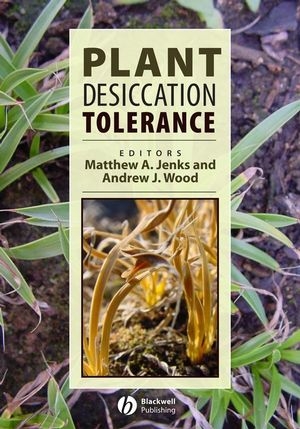
Plant Desiccation Tolerance (eBook)
John Wiley & Sons (Verlag)
978-0-470-37665-2 (ISBN)
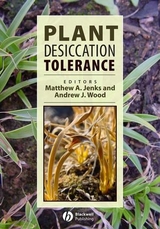
Dr. Matthew A. Jenks is at the Center for Plant Environmental Stress Physiology at Purdue University. Dr. Andrew J. Wood is Professor of Stress Physiology and Molecular Biology in the Department of Plant Biology at Southern Illinois University.
Section 1. Vegetative Desiccation Tolerance.
1. Plant desiccation tolerance: diversity, distribution, and
real-world applications - Andrew J. Wood and Matthew A. Jenks.
2. Lessons on dehydration tolerance from desiccation tolerant
plants - Melvin Oliver.
3. Mechanisms of desiccation tolerance in Angiosperm
resurrection plants - Jill M. Farrant.
4. Desiccation tolerance in lichens - Richard P. Beckett and
Farida V. Minibayeva.
5. Desiccation tolerance: gene expression, pathways and
regulation of gene expression - Dorothea Bartels, Jonathon
Phillips, and John Chandler.
Section 2. Desiccation Tolerance of Pollen, Spores and
Seeds.
6. Seed desiccation-tolerance mechanisms - Patricia Berjak, Jill
M. Farrant, and Norman W. Pammenter.
7. The glassy state in dry seeds and pollen - Olivier Leprince
and Julia Buitink.
8. DNA structure and seed desiccation tolerance - Ivan
Broubriak, Shirley McCready, and Daphne J. Osborne.
9. Structural dynamics and desiccation damage in plant
reproductive organs - Christina Walters and Karen L. Koster.
Section 3. Applications of Desiccation Tolerance
Research.
10. Desiccation tolerance genes and avenues for crop improvement
- Revel Iyer, Sagadevan G. Mundree, Mohamed Suhail Rafudeen, and
Jennifer Ann Thompson
"We recommend this publication first of all to plant-stress physiologists or plant breeders, as well as researchers who work on plant biochemistry and molecular biology, plant genetic research, and seed conservation. Agronomical sciences and, in the long term, agronomists in the field would also derive benefit from this book." (The Quarterly Review of Biology, March 2009)
| Erscheint lt. Verlag | 5.6.2008 |
|---|---|
| Sprache | englisch |
| Themenwelt | Naturwissenschaften ► Biologie ► Botanik |
| Technik | |
| Schlagworte | Ability • Adaptations • Agriculture • Animal Breeding & Genetics • Biowissenschaften • Book • Botanik • Botanik / Molekularbiologie • Climate • Component • Dehydration • dehydrationup • demands • Desiccation • desiccationtolerant plants • economically • Extreme • important • Improvement • Key • Landwirtschaft • Life • Life Sciences • Loss • Plant Molecular Biology • plants • possess • stresses • Tierzucht u. Genetik • Unique • Water |
| ISBN-10 | 0-470-37665-1 / 0470376651 |
| ISBN-13 | 978-0-470-37665-2 / 9780470376652 |
| Informationen gemäß Produktsicherheitsverordnung (GPSR) | |
| Haben Sie eine Frage zum Produkt? |
 PDF (Ohne DRM)
Digital Rights Management: ohne DRM
Dieses eBook enthält kein DRM oder Kopierschutz. Eine Weitergabe an Dritte ist jedoch rechtlich nicht zulässig, weil Sie beim Kauf nur die Rechte an der persönlichen Nutzung erwerben.
Dateiformat: PDF (Portable Document Format)
Mit einem festen Seitenlayout eignet sich die PDF besonders für Fachbücher mit Spalten, Tabellen und Abbildungen. Eine PDF kann auf fast allen Geräten angezeigt werden, ist aber für kleine Displays (Smartphone, eReader) nur eingeschränkt geeignet.
Systemvoraussetzungen:
PC/Mac: Mit einem PC oder Mac können Sie dieses eBook lesen. Sie benötigen dafür einen PDF-Viewer - z.B. den Adobe Reader oder Adobe Digital Editions.
eReader: Dieses eBook kann mit (fast) allen eBook-Readern gelesen werden. Mit dem amazon-Kindle ist es aber nicht kompatibel.
Smartphone/Tablet: Egal ob Apple oder Android, dieses eBook können Sie lesen. Sie benötigen dafür einen PDF-Viewer - z.B. die kostenlose Adobe Digital Editions-App.
Buying eBooks from abroad
For tax law reasons we can sell eBooks just within Germany and Switzerland. Regrettably we cannot fulfill eBook-orders from other countries.
aus dem Bereich