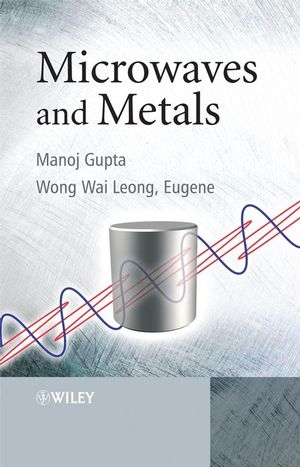
Microwaves and Metals (eBook)
240 Seiten
John Wiley & Sons (Verlag)
978-0-470-82273-9 (ISBN)
as an energy-efficient tool to interact with metals for a number of
processes such as sintering, melting, brazing, carburizing and
annealing. Microwaves can sinter a wide variety of metal compacts
with comparable or enhanced end properties, while at the same time
delivering tremendous energy savings over conventional sintering.
Microwave processes are therefore gaining increasing attention and
adoption in both academia and industry.
Gupta and Wong have written this comprehensive text to introduce
readers to the world of microwaves and the interaction of
microwaves with metals and metals-based formulations. The authors
have combined numerous research results from a wide range of
sources alongside their own work in the field. Also included are
overviews of microwave heating of other non-metal materials and the
equipment used for microwave-assisted metallurgy. With microwave
techniques poised for widespread adoption, Microwaves and
Metals is an essential text for all metallurgists and materials
engineers.
* Provides a thorough grounding in microwave fundamentals and
their application to metals processing
* Informs readers of the latest developments in the field
* Presents a convenient single source for all aspects of
microwave processing of metals and materials
* Contains liberal illustration to compare and benchmark research
results
* Introduces all the necessary equipment, preparing readers for
real-world practice
Microwaves and Metals is ideal for a post-graduate or
advanced undergraduate course in materials science or metallurgy.
Materials and metallurgical engineers in industry, who are keen on
cheaper, faster techniques, will also benefit from this book.
Manoj Gupta, Head - Materials Group, Department of Mechanical Engineering, National University of Singapore Wong Wai Leong, Eugene, Department of Mechanical Engineering, National University of Singapore
Preface
Acknowledgments
1. Introduction
1.1 Microwaves and Electromagnetic Radiation
1.2 Development of Microwaves
1.3 Applications of Microwaves
1.4 Frequencies Allocation
1.5 Microwave Generators
1.6 Summary
References
2. Microwave - Theory
2.1 Introduction
2.2 Fundamentals
2.3 Microwave-Material Interactions
2.4 Summary
References
3. Microwave Heating
3.1 Development of Microwave Heating
3.2 Characteristics of Microwave Heating
3.3 Types of Microwave Heating
3.4 Future Development
3.5 Summary
References
4. Microwave Heating of Metal Based Materials
4.1 Microwaves and Metals
4.2 Observations and Theories - Mechanisms Proposed for Microwave Heating of Metals
4.3 Microwave Sintering of Metals
4.4 Other Applications for Microwave Processing of Metals
4.5 Summary
References
5. Microwave Heating of Other Materials
5.1 Introduction
5.2 Food Processing
5.3 Ceramic Processing
5.4 Polymer Processing
5.5 Chemical and Pharmaceutical Processing
5.6 Waste Remediation and Recycling
5.7 Minerals Processing
5.8 Biomedical Applications
5.9 Other Applications
5.10 Summary
References
Appendix A: Experimental Techniques in Microwave Processing
A.1 Microwave Sintering of Cermets
A.2 Microwave Sintering of Ferrous Alloys (1)
A.3 Microwave Sintering of Ferrous Alloys (2)
A.4 Microwave Sintering of Copper (1)
A.5 Microwave Sintering of Copper (2)
A.6 Microwave Sintering of Copper Alloys
A.7 Microwave Sintering of Aluminum and Composites
A.8 Microwave Sintering of Aluminum, Magnesium, Electronic Solder and Composites
A.9 Microwave Sintering of Tungsten Alloys
A.10 Microwave Heating in Separate E and H fields
Appendix B: List of Suppliers of Microwave Processing Equipments.
B.1 Types of Microwave Furnaces Available
B.2 Manufacturers of Microwave Components and Thermal insulation Materials
B.3 Microwave Plasma Equipment
B.4 Microwave Melting.
Appendix C: List of Research Groups in Metal-Based Microwave Processing
C.1 Education and Research Institutes
Index
"This comprehensive text introduces readers to microwaves and their interaction with metals." (Materials World, October 2008)
| Erscheint lt. Verlag | 27.11.2008 |
|---|---|
| Sprache | englisch |
| Themenwelt | Naturwissenschaften ► Chemie |
| Technik ► Elektrotechnik / Energietechnik | |
| Technik ► Maschinenbau | |
| Schlagworte | Materials Science • Materialwissenschaften • Metall • Metalle u. Legierungen • Metals & Alloys |
| ISBN-10 | 0-470-82273-2 / 0470822732 |
| ISBN-13 | 978-0-470-82273-9 / 9780470822739 |
| Informationen gemäß Produktsicherheitsverordnung (GPSR) | |
| Haben Sie eine Frage zum Produkt? |
 PDF (Adobe DRM)
Kopierschutz: Adobe-DRM
Adobe-DRM ist ein Kopierschutz, der das eBook vor Mißbrauch schützen soll. Dabei wird das eBook bereits beim Download auf Ihre persönliche Adobe-ID autorisiert. Lesen können Sie das eBook dann nur auf den Geräten, welche ebenfalls auf Ihre Adobe-ID registriert sind.
Details zum Adobe-DRM
Dateiformat: PDF (Portable Document Format)
Mit einem festen Seitenlayout eignet sich die PDF besonders für Fachbücher mit Spalten, Tabellen und Abbildungen. Eine PDF kann auf fast allen Geräten angezeigt werden, ist aber für kleine Displays (Smartphone, eReader) nur eingeschränkt geeignet.
Systemvoraussetzungen:
PC/Mac: Mit einem PC oder Mac können Sie dieses eBook lesen. Sie benötigen eine
eReader: Dieses eBook kann mit (fast) allen eBook-Readern gelesen werden. Mit dem amazon-Kindle ist es aber nicht kompatibel.
Smartphone/Tablet: Egal ob Apple oder Android, dieses eBook können Sie lesen. Sie benötigen eine
Geräteliste und zusätzliche Hinweise
Buying eBooks from abroad
For tax law reasons we can sell eBooks just within Germany and Switzerland. Regrettably we cannot fulfill eBook-orders from other countries.
aus dem Bereich