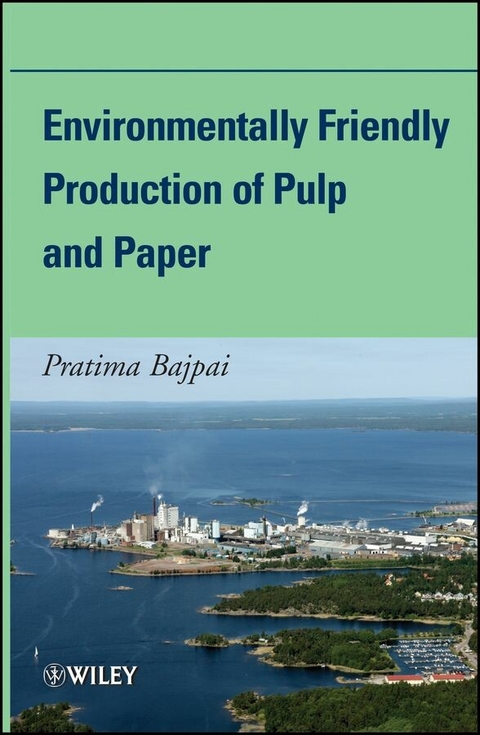
Environmentally Friendly Production of Pulp and Paper (eBook)
John Wiley & Sons (Verlag)
978-0-470-64964-0 (ISBN)
The large—and still growing—pulp and paper industry is a capital- and resource-intensive industry that contributes to many environmental problems, including global warming, human toxicity, ecotoxicity, photochemical oxidation, acidification, nutrification, and solid wastes. This important reference for professionals in the pulp and paper industry details how to improve manufacturing processes that not only cut down on the emission of pollutants but also increase productivity and decrease costs.
Environmentally Friendly Production of Pulp and Paper guides professionals in the pulp and paper industry to implement the internationally recognized process of Cleaner Production (CP). It provides updated information on CP measures in:
Raw material storage and preparation
Pulping processes (Kraft, Sulphite, and Mechanical)
Bleaching, recovery, and papermaking
Emission treatment and recycled fiber processing
In addition, the book includes a discussion on recent cleaner technologies and their implementation status and benefits in the pulp and paper industry.
Covering every aspect of pulping and papermaking essential to the subject of reducing pollution, this is a must-have for paper and bioprocess engineers, environmental engineers, and corporations in the forest products industry.
PRATIMA BAJPAI is presently a technical consultant in the pulp and paper industry. She has over thirty years of experience in research at National Sugar Institute Kanpur and Thapar Center for Industrial Research and Development in India, and University of Saskatchewan and University of Western Ontario in Canada. Her main research activities are in the areas of pulp and paper, and industrial and environmental biotechnology. Dr. Bajpai has published twelve books and contributed over seventy-five articles in peer-reviewed journals. She has also contributed chapters to a number of books and encyclopedia, obtained eleven patents, and has written several technical reports.
Implementing Cleaner Production in the pulp and paper industry The large and still growing pulp and paper industry is a capital- and resource-intensive industry that contributes to many environmental problems, including global warming, human toxicity, ecotoxicity, photochemical oxidation, acidification, nutrification, and solid wastes. This important reference for professionals in the pulp and paper industry details how to improve manufacturing processes that not only cut down on the emission of pollutants but also increase productivity and decrease costs. Environmentally Friendly Production of Pulp and Paper guides professionals in the pulp and paper industry to implement the internationally recognized process of Cleaner Production (CP). It provides updated information on CP measures in: Raw material storage and preparation Pulping processes (Kraft, Sulphite, and Mechanical) Bleaching, recovery, and papermaking Emission treatment and recycled fiber processing In addition, the book includes a discussion on recent cleaner technologies and their implementation status and benefits in the pulp and paper industry. Covering every aspect of pulping and papermaking essential to the subject of reducing pollution, this is a must-have for paper and bioprocess engineers, environmental engineers, and corporations in the forest products industry.
PRATIMA BAJPAI is presently a technical consultant in the pulp and paper industry. She has over thirty years of experience in research at National Sugar Institute Kanpur and Thapar Center for Industrial Research and Development in India, and University of Saskatchewan and University of Western Ontario in Canada. Her main research activities are in the areas of pulp and paper, and industrial and environmental biotechnology. Dr. Bajpai has published twelve books and contributed over seventy-five articles in peer-reviewed journals. She has also contributed chapters to a number of books and encyclopedia, obtained eleven patents, and has written several technical reports.
Preface.
1 Introduction.
1.1 Superior Operating Procedures.
1.2 Process Modifications.
1.3 Process Redesign.
1.4 Recycling.
References.
2 Overview of Pulp and Papermaking Processes.
2.1 Raw Material Preparation and Handling.
2.2 Pulp Manufacturing.
2.3 Pulp Washing and Screening.
2.4 Pulp Bleaching.
2.5 Stock Preparation.
2.6 Papermaking.
2.7 Chemical Recovery.
References.
3 Environmental Issues of the Pulp and Paper
Industry.
3.1 Effluent Toxicity.
3.2 Air Emissions.
References.
4 Emissions from Pulp and Papermaking.
4.1 Kraft Pulping.
4.2 Sulfite Pulping.
4.3 Mechanical Pulping.
4.4 Recycled Fiber Processing.
4.5 Papermaking.
References.
5 Cleaner Production Measures in Pulp and Paper
Making.
5.1 Kraft Pulping.
5.2 Sulfite Pulping.
5.3 Mechanical and Chemimechanical Pulping.
5.4 Recycled Paper Processing.
5.5 Papermaking.
References.
6 Recent Developments in Cleaner Production.
6.1 Use of Cooking Catalyst.
6.2 Organo Solvent Pulping.
6.3 Black Liquor Gasification.
6.4 Removal of Chelating Agents.
6.5 Energy-Efficient Thermomechanical Pulping Processes.
6.6 Recovery of Boiler Ash and Carbon Dioxide Gas to Produce
Recycled Mineral Fillers.
6.7 Impulse Technology for Dewatering of Paper.
6.8 Condebelt Process.
6.9 Internal Heat Pumps.
6.10 Total Site Integration Tools.
6.11 Wastewater Treatment for Water Recovery and Reuse.
6.12 Biotechnologies for Cleaner Paper Production.
References.
Glossary and Abbreviations.
Subject Index.
| Erscheint lt. Verlag | 21.3.2011 |
|---|---|
| Sprache | englisch |
| Themenwelt | Naturwissenschaften ► Chemie |
| Technik | |
| Wirtschaft | |
| Schlagworte | Bauingenieur- u. Bauwesen • Capital • Cellulose/Paper/Textile Chemistry • Cellulose-, Papier- u. Textilchemie • chemical engineering • Chemie • Chemische Verfahrenstechnik • Chemistry • Civil Engineering & Construction • Cleaner • Environmental Engineering • environmentally • friendly production • Global • Guides • Implementing • important • improve manufacturing • Industry • internationally recognized • largeand • paper • processes • Production • Professionals • Reference • Umwelttechnik • Zellulose |
| ISBN-10 | 0-470-64964-X / 047064964X |
| ISBN-13 | 978-0-470-64964-0 / 9780470649640 |
| Informationen gemäß Produktsicherheitsverordnung (GPSR) | |
| Haben Sie eine Frage zum Produkt? |
 EPUB (Adobe DRM)
Größe: 3,2 MB
Kopierschutz: Adobe-DRM
Adobe-DRM ist ein Kopierschutz, der das eBook vor Mißbrauch schützen soll. Dabei wird das eBook bereits beim Download auf Ihre persönliche Adobe-ID autorisiert. Lesen können Sie das eBook dann nur auf den Geräten, welche ebenfalls auf Ihre Adobe-ID registriert sind.
Details zum Adobe-DRM
Dateiformat: EPUB (Electronic Publication)
EPUB ist ein offener Standard für eBooks und eignet sich besonders zur Darstellung von Belletristik und Sachbüchern. Der Fließtext wird dynamisch an die Display- und Schriftgröße angepasst. Auch für mobile Lesegeräte ist EPUB daher gut geeignet.
Systemvoraussetzungen:
PC/Mac: Mit einem PC oder Mac können Sie dieses eBook lesen. Sie benötigen eine
eReader: Dieses eBook kann mit (fast) allen eBook-Readern gelesen werden. Mit dem amazon-Kindle ist es aber nicht kompatibel.
Smartphone/Tablet: Egal ob Apple oder Android, dieses eBook können Sie lesen. Sie benötigen eine
Geräteliste und zusätzliche Hinweise
Buying eBooks from abroad
For tax law reasons we can sell eBooks just within Germany and Switzerland. Regrettably we cannot fulfill eBook-orders from other countries.
 PDF (Adobe DRM)
Kopierschutz: Adobe-DRM
Adobe-DRM ist ein Kopierschutz, der das eBook vor Mißbrauch schützen soll. Dabei wird das eBook bereits beim Download auf Ihre persönliche Adobe-ID autorisiert. Lesen können Sie das eBook dann nur auf den Geräten, welche ebenfalls auf Ihre Adobe-ID registriert sind.
Details zum Adobe-DRM
Dateiformat: PDF (Portable Document Format)
Mit einem festen Seitenlayout eignet sich die PDF besonders für Fachbücher mit Spalten, Tabellen und Abbildungen. Eine PDF kann auf fast allen Geräten angezeigt werden, ist aber für kleine Displays (Smartphone, eReader) nur eingeschränkt geeignet.
Systemvoraussetzungen:
PC/Mac: Mit einem PC oder Mac können Sie dieses eBook lesen. Sie benötigen eine
eReader: Dieses eBook kann mit (fast) allen eBook-Readern gelesen werden. Mit dem amazon-Kindle ist es aber nicht kompatibel.
Smartphone/Tablet: Egal ob Apple oder Android, dieses eBook können Sie lesen. Sie benötigen eine
Geräteliste und zusätzliche Hinweise
Buying eBooks from abroad
For tax law reasons we can sell eBooks just within Germany and Switzerland. Regrettably we cannot fulfill eBook-orders from other countries.
aus dem Bereich