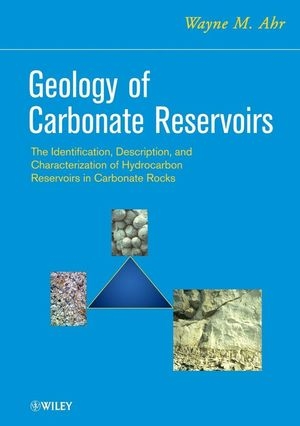
Geology of Carbonate Reservoirs (eBook)
296 Seiten
John Wiley & Sons (Verlag)
978-0-470-36925-8 (ISBN)
* Includes discussions on how, where and why carbonate are formed, plus reviews of basic sedimentological and stratigraphic principles to explain carbonate platform characteristics and stratigraphic relationships
* Offers a new, genetic classification of carbonate porosity that is especially useful in predicting spatial distribution of pore networks.
Wayne M. Ahr, PhD, is a professor in the Department of Geology and Geophysics with a joint appointment in the Department of Petroleum Engineering at Texas A&M University. Dr. Ahr has published 150 technical papers and abstracts. He is a Certified Petroleum Geologist and a member of the American Association of Petroleum Geologists, where he serves as Associate Editor. He is also a member of the Society for Sedimentary Geology and the Society of Petrophysicists and Well Log Analysts; is a lifetime member of the Fulbright Association; and serves on the editorial board of the Geological Journal.
Preface.
About This Book.
1. Introduction.
1.1 Definition of carbonate reservoirs.
1.1.1 Carbonates; reservoirs.
1.2 Finding and developing carbonate reservoirs.
1.2.1 Sources of data on reservoirs.
1.3 Unique attributes of carbonates.
Suggestions for further reading.
Review questions.
2. Carbonate Reservoir Rock Properties .
2.1 Definitions.
2.2 Fundamental Rock Properties.
2.3 Classification of Carbonate rocks.
2.4 Dependent or Derived Rock Properties.
2.5 Tertiary Rock Properties .
Suggestions for Further Reading.
Review Questions.
3. Petrophysical Properties of Carbonate Reservoirs.
3.1 Saturation, Wettability, Capillarity.
3.2 Capillary Pressure and Reservoir Performance.
3.3 Fluid Withdrawal Efficiency.
Suggestions for Further Reading.
Review Questions.
4. Stratigraphic Principles.
4.1 Carbonate Depositional Platforms.
4.2 Rock, Time, and Time-Rock Units.
4.3 Correlation.
4.4 Anatomy of Depositional Units.
4.5 Sequence Stratigraphy.
Suggestions for Further Reading.
Review Questions.
5. Depositional Carbonate Reservoirs.
5.1 Depositional Porosity.
5.2 Depositional Environments and Processes.
5.3 Paleotopography and Depositional Facies.
5.4 Diagnosis and Mapping of Depositional Reservoirs.
Suggestions for Further Reading.
Review Questions.
6. Diagenetic Carbonate Reservoirs.
6.1 Diagenesis and Diagenetic Processes.
6.2 Diagenetic Porosity.
6.3 Diagenetic Environments and Facies.
6.4 Diagenetically-Enhanced Porosity.
6.5 Porosity enhancement by replacement.
6.6 Diagnosing and Mapping Diagenetic Reservoirs.
Suggestions for Further Reading.
Review Questions.
7. Fractured Reservoirs.
7.1 Fractures and Fractured Reservoirs.
7.2 Fracture Permeability, Porosity, and Sw.
7.3 Classification of Fractured Reservoirs.
7.4 Detecting Fractured Reservoirs.
7.5 Predicting Reservoir Fracture Spacing and Intensity.
7.6 Identifying and Developing Fractured Reservoirs.
Suggestions for Further Reading.
Review Questions.
8. Summary - Geology of Carbonate Reservoirs.
8.1 Rock Properties and Diagnostic Methods.
8.2 Data Requirements .
8.3 Depositional Reservoirs.
8.4 Diagenetic Reservoirs.
8.5 Fractured Reservoirs.
8.6 Conclusions.
Review Questions.
References.
Index.
?This reference presents the information scientist's need to
explore and develop carbonate reservoirs in the most efficient and
profitable ways.? (APADE, 2009)
| Erscheint lt. Verlag | 29.8.2008 |
|---|---|
| Sprache | englisch |
| Themenwelt | Naturwissenschaften ► Chemie |
| Naturwissenschaften ► Geowissenschaften ► Geologie | |
| Technik | |
| Schlagworte | chemical engineering • Chemie • Chemische Verfahrenstechnik • Chemistry • Environmental Chemistry • Industrial Chemistry • Technische u. Industrielle Chemie • Umweltchemie |
| ISBN-10 | 0-470-36925-6 / 0470369256 |
| ISBN-13 | 978-0-470-36925-8 / 9780470369258 |
| Informationen gemäß Produktsicherheitsverordnung (GPSR) | |
| Haben Sie eine Frage zum Produkt? |
 PDF (Adobe DRM)
Kopierschutz: Adobe-DRM
Adobe-DRM ist ein Kopierschutz, der das eBook vor Mißbrauch schützen soll. Dabei wird das eBook bereits beim Download auf Ihre persönliche Adobe-ID autorisiert. Lesen können Sie das eBook dann nur auf den Geräten, welche ebenfalls auf Ihre Adobe-ID registriert sind.
Details zum Adobe-DRM
Dateiformat: PDF (Portable Document Format)
Mit einem festen Seitenlayout eignet sich die PDF besonders für Fachbücher mit Spalten, Tabellen und Abbildungen. Eine PDF kann auf fast allen Geräten angezeigt werden, ist aber für kleine Displays (Smartphone, eReader) nur eingeschränkt geeignet.
Systemvoraussetzungen:
PC/Mac: Mit einem PC oder Mac können Sie dieses eBook lesen. Sie benötigen eine
eReader: Dieses eBook kann mit (fast) allen eBook-Readern gelesen werden. Mit dem amazon-Kindle ist es aber nicht kompatibel.
Smartphone/Tablet: Egal ob Apple oder Android, dieses eBook können Sie lesen. Sie benötigen eine
Geräteliste und zusätzliche Hinweise
Buying eBooks from abroad
For tax law reasons we can sell eBooks just within Germany and Switzerland. Regrettably we cannot fulfill eBook-orders from other countries.
aus dem Bereich