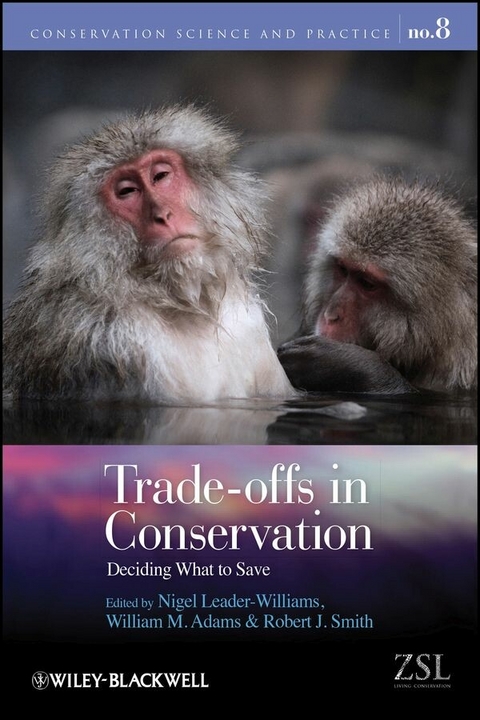
Trade-offs in Conservation (eBook)
John Wiley & Sons (Verlag)
978-1-4443-2491-4 (ISBN)
Key Features:
- Discusses the wider non-biological issues that surround making decisions about which species and biogeographic areas to prioritise for conservation
- Focuses on questions such as: What are these wider issues that are influencing the decisions we make? What factors need to be included in our assessment of trade-offs? What package of information and issues do managers need to consider in making a rational decision? Who should make such decisions?
- Part of the Conservation Science and Practice book series
This volume is of interest to policy-makers, researchers, practitioners and postgraduate students who are concerned about making decisions that include recognition of trade-offs in conservation planning.
Nigel Leader-Williams became Director of Conservation Leadership, based in the Department of Geography at the University of Cambridge, in 2009. Previously he was Director of the Durrell Institute of Conservation and Ecology at the University of Kent. His research focuses on sustainable resource use and human-wildlife conflict.
William M. Adams is Moran Professor of Conservation and Development. He is based in the Department of Geography at the University of Cambridge, where he has taught since 1984. His research focuses on the social dimensions of conservation in Africa and the UK. He is a Trustee of Fauna and Flora International.
Robert J. Smith is a Research Fellow at the Durrell Institute of Conservation and Ecology at the University of Kent. His research interests include protected area network design, conservation and corruption, and the influence of marketing in conservation.
This book demonstrates that trade-offs can be very important for conservationists. Its various chapters show how and why trade-offs are made, and why conservationists need to think very hard about what, if anything, to do about them. The book argues that conservationists must carefully weigh up, and be explicit about, the trade-offs that they make every day in deciding what to save. Key Features: Discusses the wider non-biological issues that surround making decisions about which species and biogeographic areas to prioritise for conservation Focuses on questions such as: What are these wider issues that are influencing the decisions we make? What factors need to be included in our assessment of trade-offs? What package of information and issues do managers need to consider in making a rational decision? Who should make such decisions? Part of the Conservation Science and Practice book series This volume is of interest to policy-makers, researchers, practitioners and postgraduate students who are concerned about making decisions that include recognition of trade-offs in conservation planning.
Nigel Leader-Williams became Director of Conservation Leadership, based in the Department of Geography at the University of Cambridge, in 2009. Previously he was Director of the Durrell Institute of Conservation and Ecology at the University of Kent. His research focuses on sustainable resource use and human-wildlife conflict. William M. Adams is Moran Professor of Conservation and Development. He is based in the Department of Geography at the University of Cambridge, where he has taught since 1984. His research focuses on the social dimensions of conservation in Africa and the UK. He is a Trustee of Fauna and Flora International. Robert J. Smith is a Research Fellow at the Durrell Institute of Conservation and Ecology at the University of Kent. His research interests include protected area network design, conservation and corruption, and the influence of marketing in conservation.
Contributors.
Preface and Acknowledgments.
Introduction.
1. Deciding What to Save: Trade-offs in Conservation (Nigel
Leader-Williams, William M. Adams and Robert J. Smith).
Current Approaches and Toolkits.
2. Prioritizing Trade-offs in Conservation (Kerrie A. Wilson,
Michael Bode, Hedley Grantham and Hugh P. Possingham).
3. Trade-offs in Identifying Global Conservation Priority Areas
(William Murdoch, Michael Bode, Jon Hoekstra, Peter Kareiva,
Steve Polasky, Hugh P. Possingham and Kerrie A. Wilson).
4. Trade-offs in Making Ecosystem Services and Human Well-being
Conservation Priorities (Rebecca L. Goldman, Gretchen C. Daily
and Peter Kareiva).
5. Defining and Measuring Success in Conservation (Valerie
Kapos, Andrea Manica, Rosalind Aveling, Philip Bubb, Peter Carey,
Abigail Entwistle, John Hopkins, Teresa Mulliken, Roger Safford,
Alison Stattersfield, Matthew J. Walpole and Andrew
Balmford).
Influence of Value Systems.
6. Conserving Invertebrates: How Many can be Saved, and How?
(Michael J. Samways).
7. Trade-offs between Animal Welfare and Conservation in Law and
Policy (Stuart R. Harrop).
8. Protection or Use: a Case of Nuanced Trade-offs? (Alison
M. Rosser and Nigel Leader-Williams).
9. Whose Value Counts? Trade-offs between Biodiversity
Conservation and Poverty Reduction (Dilys Roe and Matthew J.
Walpole).
10. The Power of Traditions in Conservation (Katherine M.
Homewood).
Economics and Governance.
11. Misaligned Incentives and Trade-offs in Allocating
Conservation Funding (Aaron Bruner, Eduard T. Niesten and
Richard E. Rice).
12. Marketing and Conservation: How to Lose Friends and
Influence People (Robert J. Smith, Diogo Veríssimo and
Douglas C. MacMillan).
13. Trade-offs between Conservation and Extractive Industries
(Manuel Pulgar-Vidal, Bruno Monteferri and Juan Luis
Dammert).
14. A Fighting Chance: can Conservation Create a Platform for
Peace within Cycles of Human Conflict? (Rosalind Aveling, Helen
Anthem and Annette Lanjouw).
Social and Institutional Constraints.
15. Trading-off 'Knowing' Versus 'Doing'
for Effective Conservation Planning (Andrew T. Knight and
Richard M. Cowling).
16. Path Dependence in Conservation (William M.
Adams).
17. Conservation Trade-offs and the Politics of Knowledge (J.
Peter Brosius).
Future Challenges.
18. Climatic Change and Conservation (Stephen G. Willis,
David G. Hole and Brain Huntley).
19. Drivers of Biodiversity Change (Georgina M.
Mace).
20. Another Entangled Bank: Making Conservation Trade-offs More
Explicit (Robert J. Smith, William M. Adams and Nigel
Leader-Williams).
Index.
"It will, however, find a ready market amongst top undergraduate and postgraduate students as it is a compendium of good summary facts, definitions and diagrams with some superlative introductory expositions. For the same reasons I suspect most lecturers in conservation biology will want a book on their shelves." (Biological Conservation Reviewers, 2011)
"The final chapter in this section on defining and measuring success in conservation is amust read wherever you are on the conservation spectrum . . . As a distillation of the complexities and dilemmas associated with conservation in practice it is enlightening and reassuring but, much more useful than this, its contributors bring a wealth of experience and thought to actually dealing with the problems. I suggest you buy it." (Cambridge Journals, 3 August 2011)
| Erscheint lt. Verlag | 23.9.2011 |
|---|---|
| Reihe/Serie | Conservation Science and Practice |
| Sprache | englisch |
| Themenwelt | Naturwissenschaften ► Biologie ► Ökologie / Naturschutz |
| Naturwissenschaften ► Geowissenschaften ► Geologie | |
| Technik | |
| Schlagworte | biodiversity • Biowissenschaften • commonly • conservation • Conservation action • conservationists • Conservation Science • depends • Different • draw attention • Ecosystems • Forces • Life Sciences • Naturschutzbiologie • others • People • Populations • Preservation • question • reluctant • species • States • tradeoffs • various |
| ISBN-10 | 1-4443-2491-8 / 1444324918 |
| ISBN-13 | 978-1-4443-2491-4 / 9781444324914 |
| Informationen gemäß Produktsicherheitsverordnung (GPSR) | |
| Haben Sie eine Frage zum Produkt? |
 PDF (Adobe DRM)
Kopierschutz: Adobe-DRM
Adobe-DRM ist ein Kopierschutz, der das eBook vor Mißbrauch schützen soll. Dabei wird das eBook bereits beim Download auf Ihre persönliche Adobe-ID autorisiert. Lesen können Sie das eBook dann nur auf den Geräten, welche ebenfalls auf Ihre Adobe-ID registriert sind.
Details zum Adobe-DRM
Dateiformat: PDF (Portable Document Format)
Mit einem festen Seitenlayout eignet sich die PDF besonders für Fachbücher mit Spalten, Tabellen und Abbildungen. Eine PDF kann auf fast allen Geräten angezeigt werden, ist aber für kleine Displays (Smartphone, eReader) nur eingeschränkt geeignet.
Systemvoraussetzungen:
PC/Mac: Mit einem PC oder Mac können Sie dieses eBook lesen. Sie benötigen eine
eReader: Dieses eBook kann mit (fast) allen eBook-Readern gelesen werden. Mit dem amazon-Kindle ist es aber nicht kompatibel.
Smartphone/Tablet: Egal ob Apple oder Android, dieses eBook können Sie lesen. Sie benötigen eine
Geräteliste und zusätzliche Hinweise
Buying eBooks from abroad
For tax law reasons we can sell eBooks just within Germany and Switzerland. Regrettably we cannot fulfill eBook-orders from other countries.
aus dem Bereich