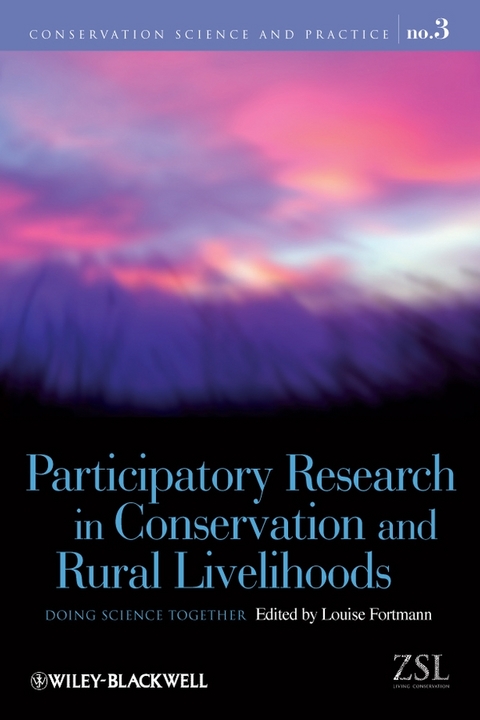
Participatory Research in Conservation and Rural Livelihoods (eBook)
316 Seiten
John Wiley & Sons (Verlag)
978-1-4443-0532-6 (ISBN)

Here local experts and professional researchers write independently about the participatory research processes through which they created new knowledge together. They demonstrate that interdependent science can produce more accurate and locally appropriate data, while frankly addressing persisting issues such as unequal power, whose knowledge and what ways of knowing count, whose voice can be heard or appear in print, and other dilemmas of this practice. Conservation scientists and practitioners will both benefit from reading this book.
* First book to examine community participatory research techniques that focuses on conservation aims
* Unique book in that it is written from the perspective of participating community volunteers and researching scientists
* Part of the prestigious Conservation Science and Practice series published in association with the Zoological Society of London
"Participatory Research in Conservation and Rural Livelihoods is brilliant, passionate, and inspiring..."
--Richa Nagar, University of Minnesota, co-author of Playing with Fire
Louise Fortmann is a Professor of Natural Resource Sociology and holds the Rudy Grah Chair in Forestry and Sustainable Development in the Department of Environmental Science, Policy and Management at the University of California at Berkeley.
Contributors.
Foreword: Marshall W. Murphree.
Acknowledgements.
Acronyms and abbreviations.
Non-English words.
Introduction: doing science together: Louise Fortmann.
1. How participatory research convinced a sceptic: Robin
Buruchara.
2. Sharing in innovation: reflections on a partnership to
improve livelihoods and resource conservation in the Honduran
hillsides: Sally Humphries, José Jiménez, Fredy Sierra
and Omar Gallardo.
3. Campesinos cientificios: farmer philosophies on participatory
research: members of the Association of CIALs of Honduras: Dionisia
Corea, Ana Rosa Estrada, Reinaldo Funez, Isidora García,
Claros Gómez, Maria Guada, Bonifacio Gutiérrez,
Ángel Hernández, José Amado Hernández, Melvin
Hernández, Nora Hernández, Wilmer Hernández,
Cayetana Herrera, Gavina Herrera, José Santos Herrera, Juan
Pedro Herrera, Toribia Herrera, Marco López, Diógenes
Matute, Hilda Mencía, Rosalío Mencía, Luís
Alonso Meza, Manuel Meza, Enrique Murillo, Heladia Murillo, Amalia
Núñez, Ubaldo Olvera, Andrea Orellana, Damiana Pérez
and Simeona Pérez with Lauren Classen.
4. Retracing the trail to wisdom: doing science together in
CibecueL Jonathan W. Long.
5. The land has wisdom: Benrita 'Mae' Burnette and
Judy DeHose.
6. What makes a scientist? studying the impacts of harvest in
the Pacific Northwest: Heidi L. Ballard.
7. 'She fell out of the sky': salal
harvesters' reflections on participatory research: Don
Collins, Juan Cruz, Bob Smith and members of the Northwest Research
and Harvester Association.
8. 'Research sounds so big ...': collaborative
inquiry with women in Drevdagen, Sweden: Seema Arora-Jonsson.
9. För oss är naturen en lisa för själen
(where peace comes dropping slow): the forests and nature for us:
Åsa Bergelin, Margareta Emretsson, Anne Lundgren Halvarsson,
Ewa Halvarsson and Anna Ryen.
10. From participation to partnership: devolution, forest
communities and CIFOR in Malinau, Indonesia: Eva Wollenberg, Ramses
Iwan, Goodwin Limberg, Moira Moeliono, Made Sudana, Asung Uluk,
Njau Anau and Miriam van Heist.
11. Malinau villagers' relationship with CIFOR: high
hopes, unmet expectations and trusted confidante: Ramses Iwan and
Steve Rhee.
12. Rediscovering participation: reflections on the Mhondoro
Tree Project: Nontokozo Nemarundwe and Louise Fortmann.
13. Unofanira Kuzvininipisa (you have to be humble): Gift
Chidari, Francisca Chirambaguwa, Patricia Matsvimbo and Wisdom
Muza.
14. New seeds, new selves, new societies: rural women's
reflections on participatory research in plant breeding: Elicelda
Guardado Martinez, Lastenia Mendez and Leonarda Ramos Mejia with
Jennifer Casolo.
15. Conclusions: Seema Arora-Jonsson, Heidi L. Ballard, Robin
Buruchara, Jennifer Casolo, Lauren Classen, Judy DeHose, Margareta
Emretsson, Louise Fortmann, Anne Lundgren Halvarsson, Ewa
Halvarsson, Sally Humphries, Jonathan W. Long, Marshall W.
Murphree, Nontokozo Nemarundwe, Anne Olssen, Steve Rhee, Anna Ryen,
Carl Wilmsen and Eva Wollenberg.
Appendix A Publications from the participatory research
projects.
Index
"I would recommend this book for all researchers and students about to undertake research that involves
local communities." (Austral Ecology and Ecological Management & Restoration, 2011)
"The true strength of the book lies in its focus on the quality of research partnerships and the power of these relationships to address social justice issues as they relate to conservation and rural livelihoods." (Ecoscience, June 2010)"Overall, the book is an engaging collection of convincing cases for participatory methods in resource commons research. The book will be especially useful for graduate students as the cases clearly address pros and cons of participatory approaches, and were written by student practitioners." (The International Journal of the Commons, October 2009)
"Participatory Research in Conservation and Rural Livelihoods is brilliant, passionate, and inspiring. Fortmann and her contributors carefully qualify and complicate the distinctions between knowing and doing, between civil science and conventional science, and between communities and researchers. In so doing, they impart new richness and complexity to discussions of participatory research and forge a model of deep collaboration that tirelessly confronts difficult questions of power, inclusion, reciprocity, voice, and expertise while successfully blurring the border between natural and social sciences."
Richa Nagar, University of Minnesota, co-author of Playing with Fire
"Reed and Warner-Rogers have made a substantial contribution to the
development of child neuropsychology, which has suffered a dearth
of comprehensive texts, in this broad-ranging, well-conceived and
authoritative volume."
-Professor J Graham Beaumont, Department of Clinical
Psychology, Royal Hospital for Neuro-disability, London
"For me, they have more than succeeded in meeting their goals
for combining science and practice, staying academically grounded
but accessible, and powerfully presenting the case for the
necessary focus on developmental variables. The text is both
fascinating and readable throughout."
-Jane Holmes Bernstein Ph. D., Department of
Psychiatry, Children's Hospital Boston / Harvard Medical
School
"A valuable addition to the libraries of pediatric/child
neuropsychologists. It takes a somewhat different and refreshing
approach as compared to existing texts, focusing on neurobehavioral
functions rather than clinical disorders. The book places a strong
emphasis on clinical translation and application that should appeal
to practitioners, but is firmly grounded in state-of-the-art theory
and research."
-Professor Keith Yeates, Department of Pediatrics,
Children's Research Institute, Ohio State University
"Here in a single volume, the reader will find material about
key concepts of child development, summaries of current theory, and
recommendations for clinical practice with most of the disorders
commonly seen by pediatric neuropsychologists. Whether read as the
textbook for a course or bought as a self-study aid, practitioners
new to the field will find this material invaluable, while
experienced professionals will surely appreciate the well-edited
chapters that will quickly bring them 'up to speed' on
recent advances. This is an immensely useful book that should be a
part of every pediatric neuropsychologist's library."
-Steve Hughes, PhD, LP, ABPdN, Director of Education
and Research, The TOVA Company
| Erscheint lt. Verlag | 12.3.2009 |
|---|---|
| Sprache | englisch |
| Themenwelt | Naturwissenschaften ► Biologie ► Ökologie / Naturschutz |
| Naturwissenschaften ► Geowissenschaften ► Geologie | |
| Technik | |
| Schlagworte | Biowissenschaften • Conservation Science • Kinderpsychologie • Kognitive Psychologie • Life Sciences • Naturschutz • Naturschutzbiologie • Neuropsychologie |
| ISBN-10 | 1-4443-0532-8 / 1444305328 |
| ISBN-13 | 978-1-4443-0532-6 / 9781444305326 |
| Informationen gemäß Produktsicherheitsverordnung (GPSR) | |
| Haben Sie eine Frage zum Produkt? |
 PDF (Adobe DRM)
Kopierschutz: Adobe-DRM
Adobe-DRM ist ein Kopierschutz, der das eBook vor Mißbrauch schützen soll. Dabei wird das eBook bereits beim Download auf Ihre persönliche Adobe-ID autorisiert. Lesen können Sie das eBook dann nur auf den Geräten, welche ebenfalls auf Ihre Adobe-ID registriert sind.
Details zum Adobe-DRM
Dateiformat: PDF (Portable Document Format)
Mit einem festen Seitenlayout eignet sich die PDF besonders für Fachbücher mit Spalten, Tabellen und Abbildungen. Eine PDF kann auf fast allen Geräten angezeigt werden, ist aber für kleine Displays (Smartphone, eReader) nur eingeschränkt geeignet.
Systemvoraussetzungen:
PC/Mac: Mit einem PC oder Mac können Sie dieses eBook lesen. Sie benötigen eine
eReader: Dieses eBook kann mit (fast) allen eBook-Readern gelesen werden. Mit dem amazon-Kindle ist es aber nicht kompatibel.
Smartphone/Tablet: Egal ob Apple oder Android, dieses eBook können Sie lesen. Sie benötigen eine
Geräteliste und zusätzliche Hinweise
Buying eBooks from abroad
For tax law reasons we can sell eBooks just within Germany and Switzerland. Regrettably we cannot fulfill eBook-orders from other countries.
aus dem Bereich