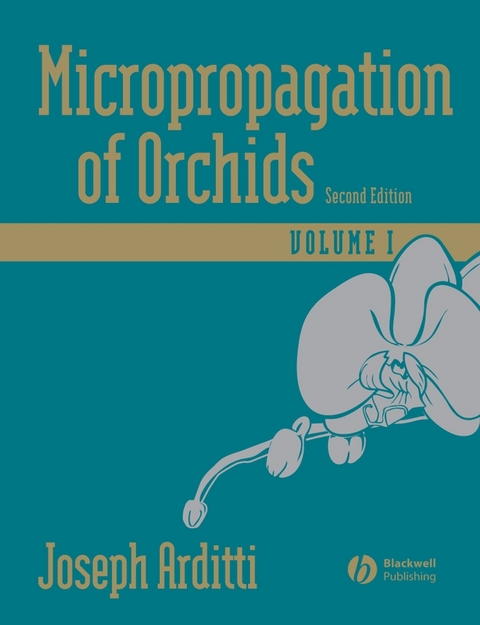
Micropropagation of Orchids (eBook)
1560 Seiten
John Wiley & Sons (Verlag)
978-1-4443-0040-6 (ISBN)
work comprises two volumes offering a compendium of methods for
multiplying orchids through micropropagation.
* A detailed collection of procedures and methods for multiplying
orchids, including organ, tissue, and cell culture techniques in
vitro
* Presents classic techniques that have been in the forefront of
orchid propagation since they were first developed in 1949
* Detailed procedures are appended with tables and complete
recipes for a large number of culture media
* Includes many illustrations, chemical formulas, historical
vignettes, and seldom seen illustrations of people, orchids,
apparatus and tools
"... an excellent resource like its predecessor,
...both informative and captivating, and served as a reminder
of why we go to such extremes in our quest to propagate these
plants." American Orchid Society, 2009
"...in the sense of its universal value and
importance, this Second Edition will undoubtedly be considered a
classic, if only because it will serve as a sole and invaluable
resource on the subject." Plant Science Bulletin,
2009
Dr Joseph Arditti majored in floriculture as an undergraduate and received his doctorate from the University of Southern California in 1965. After serving as a lecturer for one year at the University of Southern California, he accepted a faculty position at the University of California, Irvine in 1966 where he taught General Botany, Horticulture, and Plant Physiology while engaging in research on various aspects of orchid biology in the US, Indonesia, Singapore, and Malaysia. Dr Arditti retired in 2001 and is now Professor Emeritus. He continues to write and travel worldwide to lecture at scientific meetings and to orchid groups. He is acknowledged to be one of the world's leading experts on orchid biology and propagation.
Preface.
Preface to the First Edition.
1. History.
Terminology.
Origins of Orchid Micropropagation.
Culture of Tissues and Organs.
First Micropropagation of Orchids.
The Second Aseptic Culture of an Orchid Explant.
Plant Diseases and Meristems.
The Third Aseptic Culture of an Orchid Explant.
The Fourth Aseptic Culture of an Orchid Explant.
Who Pioneered Micropropagation?.
Root Cultures.
Leaf Cultures.
Stems.
Flower Buds, Flowers, Floral Segments, and ReproductiveOrgans.
Inflorescences.
A Patent.
Doubtful Claims.
Mutations.
Theft in Vitro.
Darkening of Culture Media.
Anticontaminants.
Cell and Protoplast Culture.
Flowering in Vitro.
The Future.
2. General Outline of Techniques and Procedures.
Media Components.
Stock Solutions.
State of the Medium.
Sterlization.
Surface Decontamination.
Preparation of the Medium.
Culture Vessels.
Culture Conditions.
Placing Plant Material in Culture.
Internal Contaminants.
Enzymes for Protoplast Isolation.
Work Area.
Washing Glassware.
3. Methods for Specific Genera.
Acampe.
Aeridachnis.
Aerides.
Anacamptis.
Angraecum.
Anoectochilus.
Arachnis.
Arachnostylis.
Aranda.
Aranthera.
Arundina.
Ascocenda.
Ascocentrum.
Ascofinetia.
Barlia.
Bletilla.
Brassavola.
Brassia.
Brassocattleya.
Brassolaeliocattleya.
Bulbophyllum.
Burkillara.
Caladenia.
Calanthe.
Catasetum.
Cattleya.
Cleisostoma.
Clowesia.
Cymbidium.
Cypripedium.
Cyrtopodium.
Dactylorchis.
Dactylorhiza.
Darwinara.
Dendrobium.
Disa.
Diuris.
Doriella.
Doritaenopsis.
Doritis.
Encyclia.
Epidendrum.
Epiphronitis.
Eulophia.
Gastrochilus.
Geodorum.
Goodyera.
Grammatophyllum.
Habenaria.
Hetaeria.
Holttumara.
Ipsea.
Kagawara.
Laelia.
Laeliocattleya.
Liparis.
Ludisia (Haemaria).
Luisia.
Lycaste.
Malaxis.
Maxillaria.
Miltonia.
Mokara.
Mormodes.
Neofinetia.
Neostylis.
Neottia.
Nervilia.
Nigritella.
Oberonia.
Odontioda.
Odontoglossum.
Odontonia.
Oncidium.
Ophrys.
Orchis.
Otochilus.
Pachystoma.
Paphiopedilum.
Papilionanthe.
Phaius.
Phalaenopsis.
Pholidota.
Phragmipedium.
Pleione.
Pogonia.
Potinara.
Renades.
Renanetia.
Renantanda.
Renanthera.
Restrepia.
Rhynchostele.
Rhynchostylis.
Saccolabium.
Sarcanthus.
Satyrium.
Schomburgkia.
Serapias.
Sophrolaeliocattleya.
Spathoglottis.
Spiranthes.
Thelymitra.
Thunia.
Trudelia.
Vanda.
Vandofinetia.
Vanilla.
Vascostylis.
Vuylstekeara.
Zygopetalum.
4. Summary.
Culture Conditions.
Media Components.
Applications of Orchid Tissue Culture.
Negative Aspects of Micropropagation.
References.
Appendix 1: General Information on Supplies, Equipment, Terms,and Reagents.
Appendix 2: Sources of Supplies and Equipment.
Appendix 3: Some Sites of Interest on the World Wide Web.
Appendix 4: Light.
Appendix 5: Formulary.
Appendix 6: Atomic Weights, Concentrations, Exponents, Greek andRoman Letters, Ions, Measurements, Molecular Weights, Prefixes,Valences, Units, and Solutions.
Appendix 7: Additional Information.
Appendix 8: Plant Preservative Mixture.
Glossary.
Index.
Title Page of the First Edition
"It contains a great amount of information including the most up to
date scientific results. Micropropagation of Orchids, 2nd edition,
is a valuable book of reference for people working in the area of
orchid cultivation and for all who are enthusiastic with orchids."
(Thaiszia Journal of Botany, 2010)
"This title comes as two separate hardcover volumes,
attractively housed together within a 5-sided cardboard casing that
matches the volume covers. This second edition expands and updates
material registered in the first edition, which was published in
1993 by Wiley and Sons and covered orchid micropropagation methods
published between 1974 and 1990 within 682 pages. The second
edition boasts another 878 pages, accounting for the large increase
in methods published across the years 1990 and 2000. Reviewers'
comments indicate that this publication continues to be a primary
resource for this discipline." (Journal of the Botanical
Research Institute of Texas, 2010)
"My minor worries do not stop me wholeheartedly recommending
people actively involved in orchid micropropagation and
institutional librarians to purchase the second edition of what
will, I am sure, be the standard work on the subject for years to
come." (Annals of Botany, April 2010)
"The book lives up to its billing as a useful resource strictly
dedicated to micropropagation ... .Secure a copy for your personal
library before it is out of print once and for all." (American
Orchid Society, 2009)
| Erscheint lt. Verlag | 26.1.2009 |
|---|---|
| Sprache | englisch |
| Themenwelt | Naturwissenschaften ► Biologie ► Botanik |
| Technik | |
| Schlagworte | Biowissenschaften • Botanik • Life Sciences • plant science • Zoologie |
| ISBN-10 | 1-4443-0040-7 / 1444300407 |
| ISBN-13 | 978-1-4443-0040-6 / 9781444300406 |
| Informationen gemäß Produktsicherheitsverordnung (GPSR) | |
| Haben Sie eine Frage zum Produkt? |
 PDF (Adobe DRM)
Kopierschutz: Adobe-DRM
Adobe-DRM ist ein Kopierschutz, der das eBook vor Mißbrauch schützen soll. Dabei wird das eBook bereits beim Download auf Ihre persönliche Adobe-ID autorisiert. Lesen können Sie das eBook dann nur auf den Geräten, welche ebenfalls auf Ihre Adobe-ID registriert sind.
Details zum Adobe-DRM
Dateiformat: PDF (Portable Document Format)
Mit einem festen Seitenlayout eignet sich die PDF besonders für Fachbücher mit Spalten, Tabellen und Abbildungen. Eine PDF kann auf fast allen Geräten angezeigt werden, ist aber für kleine Displays (Smartphone, eReader) nur eingeschränkt geeignet.
Systemvoraussetzungen:
PC/Mac: Mit einem PC oder Mac können Sie dieses eBook lesen. Sie benötigen eine
eReader: Dieses eBook kann mit (fast) allen eBook-Readern gelesen werden. Mit dem amazon-Kindle ist es aber nicht kompatibel.
Smartphone/Tablet: Egal ob Apple oder Android, dieses eBook können Sie lesen. Sie benötigen eine
Geräteliste und zusätzliche Hinweise
Buying eBooks from abroad
For tax law reasons we can sell eBooks just within Germany and Switzerland. Regrettably we cannot fulfill eBook-orders from other countries.
aus dem Bereich