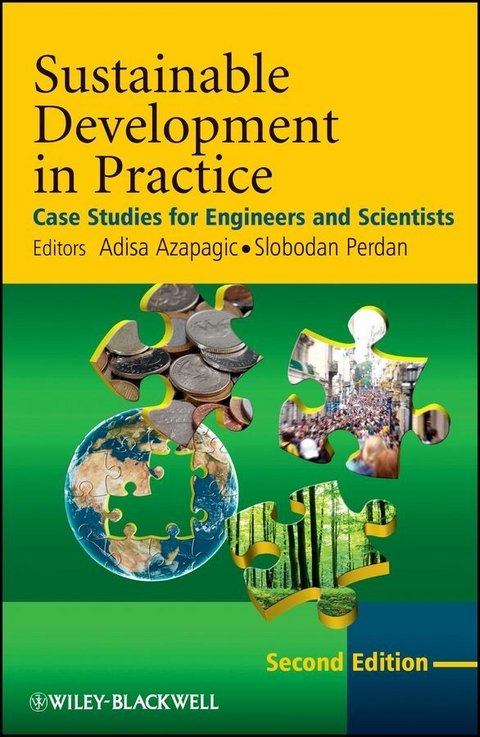
Sustainable Development in Practice (eBook)
John Wiley & Sons (Verlag)
978-0-470-97285-4 (ISBN)
Written in an accessible style, the book opens with a general introduction to the concept of sustainable development and explores its practical implications for technical experts. Recognising that practical application of sustainable development depends on the context, the second part of the book is devoted to case studies. The case studies explore scientific and technical aspects alongside relevant environmental economic and social issues.
The key features of this completely revised and updated second edition include:
- Twelve new chapters, including the case studies on nuclear energy, biofuels, aviation, buildings, urban transport, food, sanitation and health.
- Six completely revised chapters
- Coverage of a wide range of sustainability issues in both developed and developing countries
- Integration of scientific and technical aspects with economic, environmental and social considerations
- Discussion of policy implications
- Communication with the non-engaging and non-scientific audience
Considered essential reading for all engineers and scientists concerned with sustainable development, Sustainable Development in Practice: Case Studies for Engineers and Scientists, Second Edition also provides key reading and learning materials for undergraduate and postgraduate science and engineering students.
Adisa Azapagic holds a B.Sc. and M.Sc. in Environmental Chemical Engineering and a Ph.D. in Environmental Systems Analysis. She is Professor of Sustainable Chemical Engineering in the School of Chemical Engineering and Analytical Science and and Associated Professor of the Sustainable Consumption Institute. She is leading the Sustainable Industrial Systems group which comprises over 20 post-doctoral researchers and Ph.D. students.
Adisa has held a number of fellowships and honorary appointments, some of which include fellowships from the Royal Academy of Engineering, UNESCO and Japan Society for the Promotion of Science (JSPS). She was awarded the IChemE Award for Outstanding Achievements in Chemical and Process Engineering in 2010 and the GSK/CIA Innovation Award in 2011.
For more information visit: http://www.sustainable-systems.org.uk
Slobodan Perdan is a Research Fellow in the School of Chemical Engineering and Analytical Science.
Slobodan holds a BA and an MA in Philosophy from the University of Sarajevo (Bosnia), an MA (Distinction) in Politics and Security from University College London and a PhD in Environmental Strategy from the University of Surrey.
Slobodan joined the Sustainable Industrial Systems Group in CEAS as Simon Industrial and Professional Fellow in January 2008. Slobodan previously worked on the PuRE project where his role was to look into the social aspects of human activities in the urban environment. He is currently working in association with the CCaLC project and is focusing on the 'carbon economy', in particular the socio-economic consequences of the introduction of the carbon 'market' and the ethical issues associated with the treating of carbon emissions as a tradable commodity.
Sustainable Development in Practice: Case Studies for Engineers and Scientists, Second Edition explores the concept of sustainable development and its implications for science and engineering. It looks at how sustainability criteria can be combined with traditional scientific and engineering considerations to design and operate industrial systems in a more sustainable manner. Taking a life cycle approach to addressing economic, environmental and social issues, the book presents a series of new practical case studies drawn from a range of sectors, including mining, energy, food, buildings, transport, waste, and health. Written in an accessible style, the book opens with a general introduction to the concept of sustainable development and explores its practical implications for technical experts. Recognising that practical application of sustainable development depends on the context, the second part of the book is devoted to case studies. The case studies explore scientific and technical aspects alongside relevant environmental economic and social issues. The key features of this completely revised and updated second edition include: Twelve new chapters, including the case studies on nuclear energy, biofuels, aviation, buildings, urban transport, food, sanitation and health. Six completely revised chapters Coverage of a wide range of sustainability issues in both developed and developing countries Integration of scientific and technical aspects with economic, environmental and social considerations Discussion of policy implications Communication with the non-engaging and non-scientific audience Considered essential reading for all engineers and scientists concerned with sustainable development, Sustainable Development in Practice: Case Studies for Engineers and Scientists, Second Edition also provides key reading and learning materials for undergraduate and postgraduate science and engineering students.
Adisa Azapagic holds a B.Sc. and M.Sc. in Environmental Chemical Engineering and a Ph.D. in Environmental Systems Analysis. She is Professor of Sustainable Chemical Engineering in the School of Chemical Engineering and Analytical Science and and Associated Professor of the Sustainable Consumption Institute. She is leading the Sustainable Industrial Systems group which comprises over 20 post-doctoral researchers and Ph.D. students. Adisa has held a number of fellowships and honorary appointments, some of which include fellowships from the Royal Academy of Engineering, UNESCO and Japan Society for the Promotion of Science (JSPS). She was awarded the IChemE Award for Outstanding Achievements in Chemical and Process Engineering in 2010 and the GSK/CIA Innovation Award in 2011. For more information visit: www.sustainable-systems.org.uk Slobodan Perdan is a Research Fellow in the School of Chemical Engineering and Analytical Science. Slobodan holds a BA and an MA in Philosophy from the University of Sarajevo (Bosnia), an MA (Distinction) in Politics and Security from University College London and a PhD in Environmental Strategy from the University of Surrey. Slobodan joined the Sustainable Industrial Systems Group in CEAS as Simon Industrial and Professional Fellow in January 2008. Slobodan previously worked on the PuRE project where his role was to look into the social aspects of human activities in the urban environment. He is currently working in association with the CCaLC project and is focusing on the "carbon economy", in particular the socio-economic consequences of the introduction of the carbon "market" and the ethical issues associated with the treating of carbon emissions as a tradable commodity.
About the Editors ix
List of Contributors xi
Preface xiii
Part 1
1 The Concept of Sustainable Development and its Practical
Implications 3
Slobodan Perdan
2 Measuring Sustainable Development: An Overview 26
Slobodan Perdan and Adisa Azapagic
3 Assessing Environmental Sustainability: Life Cycle Thinking
and Life Cycle Assessment 56
Adisa Azapagic
Part 2
4 Translating the Principles of Sustainable Development into
Business Practice: An Application in the Mining and Minerals Sector
83
Adisa Azapagic and Slobodan Perdan
5 Climate Change and Policy: The Case of Germany 117
Wolfram Krewitt and Hans Mu¨ller-Steinhagen
6 Sustainability Assessment of Biofuels 142
Adisa Azapagic and Heinz Stichnothe
7 Scenario Building and Uncertainties: Options for Energy
Sources 170
Richard Darton
8 Fuel Cells in Stationary Applications: Energy for the Future?
189
Martin Pehnt
9 Sustainability of Nuclear Power 211
Adisa Azapagic and Slobodan Perdan
10 Municipal Solid Waste Management: Recovering Energy from
Waste 261
Adisa Azapagic
11 Sustainability Issues in Food Provisioning Systems 326
Adisa Azapagic, Heinz Stichnothe and Namy Espinoza-Orias
12 Providing Sustainable Sanitation 348
Richard Fenner and Amparo Flores
13 Sustainable Process Design: The Case of Vinyl Chloride
Monomer (VCM) 374
Adisa Azapagic
14 Urban Sustainability: The Case of Transport 420
Slobodan Perdan and Adisa Azapagic
15 Aviation and its Response to Environmental Pressure 449
Alice Bows and Kevin Anderson
16 Health Impact Assessment of Urban Pollution 467
Zaid Chalabi and Tony Fletcher
17 Social and Ethical Dimensions of Sustainable Development:
Mining in Kakadu National Park 483
Slobodan Perdan
Index 511
| Erscheint lt. Verlag | 23.11.2010 |
|---|---|
| Sprache | englisch |
| Themenwelt | Naturwissenschaften ► Biologie ► Ökologie / Naturschutz |
| Naturwissenschaften ► Geowissenschaften ► Geologie | |
| Technik | |
| Wirtschaft | |
| Schlagworte | Approach • Bauingenieur- u. Bauwesen • Biowissenschaften • CASE • Chemie • Chemistry • Civil Engineering & Construction • Concept • Conservation Science • earth sciences • Edition • Engineering • Environmental Chemistry • Environmental Engineering • Environmental Geoscience • Explores • Geowissenschaften • Implications • Industrial • Life Cycle • Life Sciences • Naturschutzbiologie • Practical • Practice • Range • Science • scientists • series • Studies • sustainability criteria • Sustainable • traditional scientific • Umweltchemie • Umweltgeowissenschaften • Umwelttechnik • Umweltwissenschaften |
| ISBN-10 | 0-470-97285-8 / 0470972858 |
| ISBN-13 | 978-0-470-97285-4 / 9780470972854 |
| Informationen gemäß Produktsicherheitsverordnung (GPSR) | |
| Haben Sie eine Frage zum Produkt? |
 PDF (Adobe DRM)
Kopierschutz: Adobe-DRM
Adobe-DRM ist ein Kopierschutz, der das eBook vor Mißbrauch schützen soll. Dabei wird das eBook bereits beim Download auf Ihre persönliche Adobe-ID autorisiert. Lesen können Sie das eBook dann nur auf den Geräten, welche ebenfalls auf Ihre Adobe-ID registriert sind.
Details zum Adobe-DRM
Dateiformat: PDF (Portable Document Format)
Mit einem festen Seitenlayout eignet sich die PDF besonders für Fachbücher mit Spalten, Tabellen und Abbildungen. Eine PDF kann auf fast allen Geräten angezeigt werden, ist aber für kleine Displays (Smartphone, eReader) nur eingeschränkt geeignet.
Systemvoraussetzungen:
PC/Mac: Mit einem PC oder Mac können Sie dieses eBook lesen. Sie benötigen eine
eReader: Dieses eBook kann mit (fast) allen eBook-Readern gelesen werden. Mit dem amazon-Kindle ist es aber nicht kompatibel.
Smartphone/Tablet: Egal ob Apple oder Android, dieses eBook können Sie lesen. Sie benötigen eine
Geräteliste und zusätzliche Hinweise
Buying eBooks from abroad
For tax law reasons we can sell eBooks just within Germany and Switzerland. Regrettably we cannot fulfill eBook-orders from other countries.
aus dem Bereich