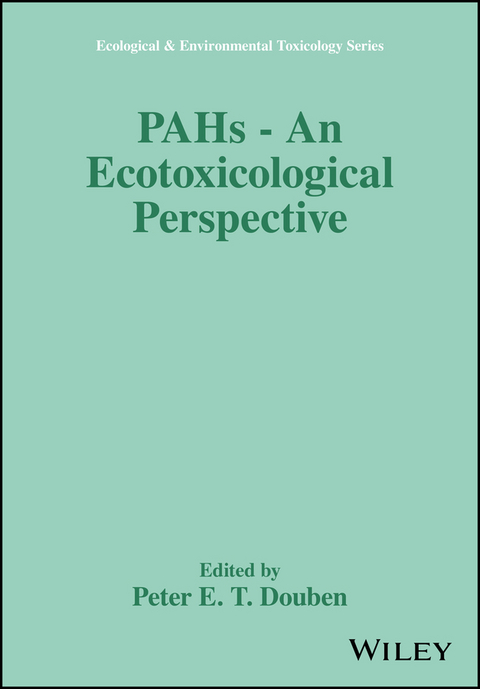
PAHs (eBook)
John Wiley & Sons (Verlag)
978-0-470-86429-6 (ISBN)
This book will review and assess our scientific understanding of the ecological exposure and effects PAHs have in different environments and habitats. It will accomplish this by taking the recipients of the pollution in the environment as starting points and working its way back through pathways to access what is required for our understanding of effects and rationale for control.
Although this book will concentrate on ecological exposure of PAHs, the general impacts of PAHs on human populations will be touched upon. It is thought to be the first book to focus on the ecological aspects of PAHs.
Nurses, Dental Hygienists, Nutritionists, Medical Technicians, and Occupational Therapists.
Polycyclic aromatic hydrocarbons (PAHs), or polyarenes, are one of the largest and most structurally diverse class of organic molecules known. High percentages of polyarenes, representing a wide range of molecular sizes and structural types, are present in coal tars and petroleum residues. The major sources of PAHs are crude oil, coal and oil shale. The fuels produced from these fossil sources constitute the primary source of energy for the industrial nations of the world, and the petrochemicals from these raw materials are the basis of the synthetic fibre and plastics industries. PAHs are however, widespread pollutants and their impact on the environment and human health must be monitored and controlled. This book will review and assess our scientific understanding of the ecological exposure and effects PAHs have in different environments and habitats. It will accomplish this by taking the recipients of the pollution in the environment as starting points and working its way back through pathways to access what is required for our understanding of effects and rationale for control. Although this book will concentrate on ecological exposure of PAHs, the general impacts of PAHs on human populations will be touched upon. It is thought to be the first book to focus on the ecological aspects of PAHs.
Nurses, Dental Hygienists, Nutritionists, Medical Technicians, and Occupational Therapists.
List of Contributors.
Series Foreword.
Part I: Introduction and Rationale.
Introduction (P. Douben).
Part II: General Characteristics of PAHs.
The Sources, Transport, and Fate of PAHs in the Marine
Environment (J. Latimer and J. Zheng).
Geochemistry of PAHs in Aquatic Environments: Source,
Persistence and Distribution (R. Burgess, et al.).
Photochemical Reactions of PAHs in the Atmosphere (J. Arey and
R. Atkinson).
Metabolic Activation of PAHs: Role of DNA Adduct Formation in
Induced Carcinogenesis (F. Akcha, et al.).
Biodegradation and General Aspects of Bioavailability (F.
Volkering and A. Breure).
Part III Bioavailability, Exposure and Effects in Environmental
Compartments.
An Overview of the Partitioning and Bioavailability of PAHs in
Sediments and Soils (R. Burgess, et al.).
Bioavailability, Uptake and Effects of PAHs in Aquatic
Invertebrates in Field Studies (P. den Besten, et al.).
Bioaccumulation of PAHs in Marine Invertebrates (J. Meador).
Uptake and Accumulation of PAHs by Terrestrial Invertebrates (R.
Achazi and C. Van Gestel).
Ecotoxicological Studies Focusing on Marine and Freshwater Fish
(J. Payne, et al.).
Effects of PAHs on Terrestrial and Freshwater Birds, Mammals and
Amphibians (H. Malcolm & R. Shore).
Effects of PAHs on Marine Birds, Mammals and Reptiles (P. Albers
and T. Loughlin).
PAH Interactions with Plants: Uptake, Toxicity and
Phytoremediation (B. Greenberg).
Assessing Risks from Photoactivated Toxicity of PAHs to Aquatic
Organisms (G. Ankley, et al.).
Biomarkers and PAHs -- Prospects for the Assessment of
Exposure and Effects in Aquatic Systems (R. Altenburger, et
al.).
Part IV Integration of Information on PAHs.
Approaches to Developing Sediment Quality Guidelines for PAHs
(D. Mount, et al.).
Managing Risks from PAHs (G. Whale, et al.).
Index.
"...the book stands as an excellent and current reference text ...." ( Ecotoxicology)
| Erscheint lt. Verlag | 25.7.2003 |
|---|---|
| Reihe/Serie | Ecological & Environmental Toxicology Series | Ecological and Environmental Toxicology Series |
| Sprache | englisch |
| Themenwelt | Naturwissenschaften ► Biologie ► Biochemie |
| Naturwissenschaften ► Biologie ► Ökologie / Naturschutz | |
| Technik | |
| Schlagworte | aromatic • Aspects • Biowissenschaften • Book • Chemie • Chemistry • Class • constituted • efforts • hundreds • Hydrocarbons • Key • Knowledge • Life Sciences • Life Sciences Special Topics • organic • PAHs • Persistent • Pollutants • polycyclic • Polycyclische aromatische Kohlenwasserstoffe • Publication • Regulatory • Research • Spezialthemen Biowissenschaften • Spotlight • starts • Timely • Toxicology • Toxikologie • Unique • Updates |
| ISBN-10 | 0-470-86429-X / 047086429X |
| ISBN-13 | 978-0-470-86429-6 / 9780470864296 |
| Informationen gemäß Produktsicherheitsverordnung (GPSR) | |
| Haben Sie eine Frage zum Produkt? |
 PDF (Adobe DRM)
Kopierschutz: Adobe-DRM
Adobe-DRM ist ein Kopierschutz, der das eBook vor Mißbrauch schützen soll. Dabei wird das eBook bereits beim Download auf Ihre persönliche Adobe-ID autorisiert. Lesen können Sie das eBook dann nur auf den Geräten, welche ebenfalls auf Ihre Adobe-ID registriert sind.
Details zum Adobe-DRM
Dateiformat: PDF (Portable Document Format)
Mit einem festen Seitenlayout eignet sich die PDF besonders für Fachbücher mit Spalten, Tabellen und Abbildungen. Eine PDF kann auf fast allen Geräten angezeigt werden, ist aber für kleine Displays (Smartphone, eReader) nur eingeschränkt geeignet.
Systemvoraussetzungen:
PC/Mac: Mit einem PC oder Mac können Sie dieses eBook lesen. Sie benötigen eine
eReader: Dieses eBook kann mit (fast) allen eBook-Readern gelesen werden. Mit dem amazon-Kindle ist es aber nicht kompatibel.
Smartphone/Tablet: Egal ob Apple oder Android, dieses eBook können Sie lesen. Sie benötigen eine
Geräteliste und zusätzliche Hinweise
Buying eBooks from abroad
For tax law reasons we can sell eBooks just within Germany and Switzerland. Regrettably we cannot fulfill eBook-orders from other countries.
aus dem Bereich