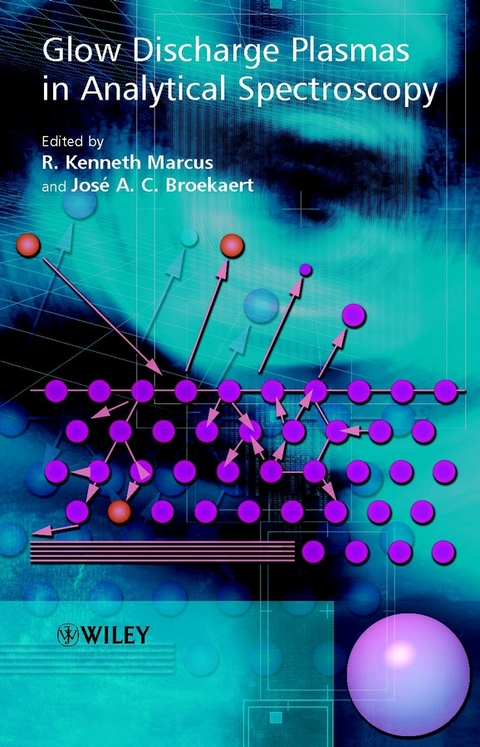
Glow Discharge Plasmas in Analytical Spectroscopy (eBook)
John Wiley & Sons (Verlag)
978-0-470-85786-1 (ISBN)
This multi-author, edited volume includes chapters which deal with both basic and highly complex applications. Glow discharge devices are now being used in very novel ways for the analysis of liquids and gases, including molecular species detection and identification, an area that was beyond the perceived scope of applicability just ten years ago. It is expected that the next decade will see a growth in the interest and application of glow discharge devices far surpassing the expectations of the last century.
Born in 1948, José Broekaert studied chemistry at the University of Gent, Belgium, graduating in 1970. After receiving his PhD from the University of Gent in 1976 and a stay in Germany as Alexander-von-Humboldt postdoctoral fellow the following year, he was a scientist at the ISAS, Dortmund from 1978 to 1991 and obtained the degree of 'Geaggregeerde voor het hoger onderwijs' from the University of Antwerp, Belgium in 1985. He became associate professor at the University of Dortmund in 1991, full professor at the University of Leipzig in 1998 and, in 2002, joined the University of Hamburg. In 1998 he was a visiting Fulbright research scholar at Indiana University, Bloomington, USA. His main research interests include the development of plasma optical emission, atomic absorption and inorganic mass spectrometry methods and their application in solving analytical problems.
Glow discharge devices have been utilized as spectrochemical sources for over one hundred years, dating back to the earliest studies of atomic structures. It has only been during the last 40 years that they have been employed in the arena of chemical analysis. Glow Discharge Plasmas in Analytical Spectroscopy presents the state of the art in the use of these devices across a wide range of applications, including materials science, environmental analysis, and bioanalytical chemistry. Glow discharge devices are well known for their application in direct solids elemental analysis of metals and alloys by optical and mass spectrometries. These basic capabilities have been extended to the analysis of non-conducting materials such as glass and ceramics and the depth resolved analysis of all kinds of technical materials. This multi-author, edited volume includes chapters which deal with both basic and highly complex applications. Glow discharge devices are now being used in very novel ways for the analysis of liquids and gases, including molecular species detection and identification, an area that was beyond the perceived scope of applicability just ten years ago. It is expected that the next decade will see a growth in the interest and application of glow discharge devices far surpassing the expectations of the last century.
Born in 1948, José Broekaert studied chemistry at the University of Gent, Belgium, graduating in 1970. After receiving his PhD from the University of Gent in 1976 and a stay in Germany as Alexander-von-Humboldt postdoctoral fellow the following year, he was a scientist at the ISAS, Dortmund from 1978 to 1991 and obtained the degree of "Geaggregeerde voor het hoger onderwijs" from the University of Antwerp, Belgium in 1985. He became associate professor at the University of Dortmund in 1991, full professor at the University of Leipzig in 1998 and, in 2002, joined the University of Hamburg. In 1998 he was a visiting Fulbright research scholar at Indiana University, Bloomington, USA. His main research interests include the development of plasma optical emission, atomic absorption and inorganic mass spectrometry methods and their application in solving analytical problems.
Introduction (R.K. Marcus and J.A. C. Broekaert)
Optical Emission Spectrometry with Glow Discharges (J.A. C. Broekaert)
Mass Spectrometry of Glow Discharges (W.W. Harrison, C. Yang and E. Oxley)
Radio Frequency Glow Dicharges (R.K. Marcus)
Depth Profile Analysis (A. Bengston)
Numerical Modelling of Analytical Glow Discharges (A. Bogaerts and R. Gijbels)
Application of Glow Discharge Optical Emission Spectrometry in the Steel Industry (K. Kakita)
Surfaces, Thin Films and Coatings (R. Payling et al)
Comparison of Glow Discharge Atomic Spectrometry to Other Surface Analysis Methods (K. Wagatsuma)
Analysis of Samples of Nuclear Concern with Glow Discharge Atomic Spectrometry (M. Betti)
Analysis of Nonconducting Materials by Glow Discharge Spectrometry (A. Bogaerts, W. Schelles and R. Van Grieken)
Standards and Reference Materials for Glow Discharge Spectroscopies (M. Winchester)
Analysis of Liquid Samples using Glow Discharge Spectroscopies (R.K. Marcus)
GC-Speciation with GDMS Detection (J.A. Caruso and L. Milstien)
Glow Discharge Atomic Emission Spectrometry for the Analysis of Gases and as an AlternativeGas Chromatographic Detector (R. Pereiro, N.G. Orellana-Velado and A. Sanz-Medel)
Low-pressure Inductively Coupled Plasmas (H. Evans)
Multidimensional Ionization Sources for Plasma-source Mass Spectrometry (J.P. Guzowski and G.M. Hieftje)
Index
"...very valuable for those interested in this rapidly expanding and diagnostically important area."
Journal of the American Chemical Society
Vol. 125, NO. 39
| Erscheint lt. Verlag | 27.5.2003 |
|---|---|
| Sprache | englisch |
| Themenwelt | Naturwissenschaften ► Chemie ► Analytische Chemie |
| Naturwissenschaften ► Physik / Astronomie ► Plasmaphysik | |
| Technik | |
| Schlagworte | across • Analysis • Analytical • Arena • ART • Atomabsorptionsanalyse • Atomic • Chemical • Chemie • Chemistry • devices • Discharge • Earliest • Elemental • Glow • Last • Massenspektrometrie • materials characterization • Materials Science • Materialwissenschaften • One • Plasmas • Sources • Spectrochemical • spectroscopy • Spektroskopie • State • Structures • Studies • use • Werkstoffprüfung • Werkstoffprüfung • years |
| ISBN-10 | 0-470-85786-2 / 0470857862 |
| ISBN-13 | 978-0-470-85786-1 / 9780470857861 |
| Informationen gemäß Produktsicherheitsverordnung (GPSR) | |
| Haben Sie eine Frage zum Produkt? |
 PDF (Adobe DRM)
Kopierschutz: Adobe-DRM
Adobe-DRM ist ein Kopierschutz, der das eBook vor Mißbrauch schützen soll. Dabei wird das eBook bereits beim Download auf Ihre persönliche Adobe-ID autorisiert. Lesen können Sie das eBook dann nur auf den Geräten, welche ebenfalls auf Ihre Adobe-ID registriert sind.
Details zum Adobe-DRM
Dateiformat: PDF (Portable Document Format)
Mit einem festen Seitenlayout eignet sich die PDF besonders für Fachbücher mit Spalten, Tabellen und Abbildungen. Eine PDF kann auf fast allen Geräten angezeigt werden, ist aber für kleine Displays (Smartphone, eReader) nur eingeschränkt geeignet.
Systemvoraussetzungen:
PC/Mac: Mit einem PC oder Mac können Sie dieses eBook lesen. Sie benötigen eine
eReader: Dieses eBook kann mit (fast) allen eBook-Readern gelesen werden. Mit dem amazon-Kindle ist es aber nicht kompatibel.
Smartphone/Tablet: Egal ob Apple oder Android, dieses eBook können Sie lesen. Sie benötigen eine
Geräteliste und zusätzliche Hinweise
Buying eBooks from abroad
For tax law reasons we can sell eBooks just within Germany and Switzerland. Regrettably we cannot fulfill eBook-orders from other countries.
aus dem Bereich