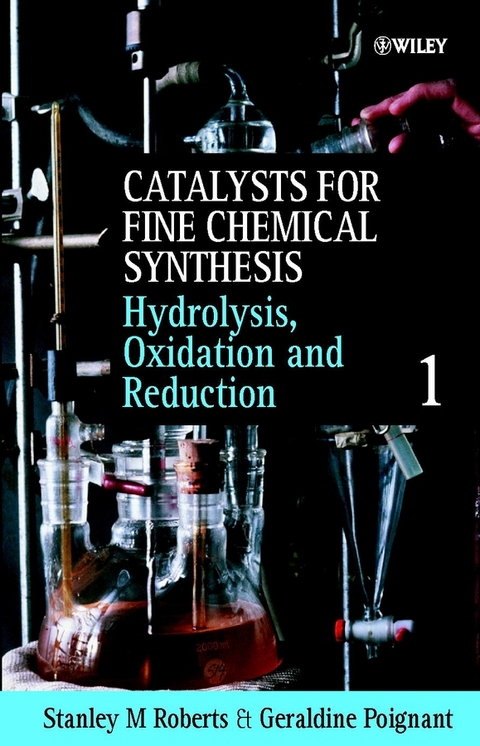
Hydrolysis, Oxidation and Reduction, Volume 1 (eBook)
John Wiley & Sons (Verlag)
978-0-470-85579-9 (ISBN)
The series features:
* Tested and validated procedures.
* Authoritative reviews on classes of catalysts.
* Assessments of all types of catalysts.
* Expertise from the Leverhulme Centre for Innovative Catalysis, Liverpool, UK.
The review section in the first volume of the series contains a report by Stanley M. Roberts on the integration of biotransformations into the catalyst portfolio.
The procedure section contains a wide variety of synthetic protocols, such as epoxidations of unsaturated ketones and esters, asymmetric reductions of carbon-oxygen double bonds, asymmetric hydrogenations of carbon-carbon double bonds and other types of reaction. The featured catalysts include a wide range of different materials such as poly-D-leucine, D-fructose-based dioxiranes, oxaborolidine borane, some important titanium and ruthenium complexes as well as baker's yeast. For each reaction there are one or several detailed protocols on how to prepare and employ the various catalysts.
Stanley M. Roberts is the editor of Hydrolysis, Oxidation and Reduction, Volume 1, published by Wiley.
Geraldine Poignant is the editor of Hydrolysis, Oxidation and Reduction, Volume 1, published by Wiley.
Catalysts are increasingly used by chemists engaged in fine chemical synthesis within both industry and academia. Today, there exists a huge choice of high-tech catalysts, which add enormously to the repertoire of synthetic possibilities. However, catalysts are occasionally capricious, sometimes difficult to use and almost always require both skill and experience in order to achieve optimal results. This series aims to be a practical help for advanced undergraduate, graduate and postgraduate students, as well as experienced chemists in industry and academia working in organic and organometallic synthesis. The series features: * Tested and validated procedures. * Authoritative reviews on classes of catalysts. * Assessments of all types of catalysts. * Expertise from the Leverhulme Centre for Innovative Catalysis, Liverpool, UK. The review section in the first volume of the series contains a report by Stanley M. Roberts on the integration of biotransformations into the catalyst portfolio. The procedure section contains a wide variety of synthetic protocols, such as epoxidations of unsaturated ketones and esters, asymmetric reductions of carbon-oxygen double bonds, asymmetric hydrogenations of carbon-carbon double bonds and other types of reaction. The featured catalysts include a wide range of different materials such as poly-D-leucine, D-fructose-based dioxiranes, oxaborolidine borane, some important titanium and ruthenium complexes as well as baker's yeast. For each reaction there are one or several detailed protocols on how to prepare and employ the various catalysts.
Stanley M. Roberts is the editor of Hydrolysis, Oxidation and Reduction, Volume 1, published by Wiley. Geraldine Poignant is the editor of Hydrolysis, Oxidation and Reduction, Volume 1, published by Wiley.
Series Preface.
Preface to Volume 1.
Abbreviations.
PART I: REVIEW.
1. The Integration of Biotransformations into the Catalyst
Portfolio.
PART II: PROCEDURES.
2. General Information.
3. Asymmetric Epoxidation.
4. Epoxidation of , -Unsaturated Carbonyl Compounds.
5. Epoxidation of Allylic Alcohols.
6. Epoxidation of Unfunctionalized Alkenes and , -Unsaturated
Esters.
7. Asymmetric Hydroxylation and Aminohydroxylation.
8. Asymmetric Sulfoxidation.
9. Asymmetric Reduction of Ketones Using Organometallic
Catalysts.
10. Asymmetric Reduction of Ketones Using Baker's Yeast.
11. Asymmetric Reduction of Ketones Using Nonmetallic
Catalysts.
12. Asymmetric Hydrogenation of Carbon-Carbon Double Bonds Using
Organometallic Cataluysts.
13. Employment of Catalysts Working in Tandem.
Index.
"Everyone who is concerned with...pure compounds will be able to
use this handy book..." (Angewandte Chemie, International
Edition, Vol. 42, 2003)
"...the book clearly fulfills its purpose to provide a practical
introduction?it will be useful..." (CATTECH, August
2003)
| Erscheint lt. Verlag | 27.6.2003 |
|---|---|
| Reihe/Serie | Catalysts For Fine Chemicals Synthesis |
| Catalysts For Fine Chemicals Synthesis | Catalysts For Fine Chemicals Synthesis |
| Sprache | englisch |
| Themenwelt | Naturwissenschaften ► Biologie ► Biochemie |
| Naturwissenschaften ► Chemie ► Analytische Chemie | |
| Naturwissenschaften ► Chemie ► Organische Chemie | |
| Technik ► Umwelttechnik / Biotechnologie | |
| Schlagworte | academia • advanced • Biochemie u. Chemische Biologie • Biochemistry (Chemical Biology) • capricious • catalysts • Chemie • Chemische Synthese • Chemistry • Chemists • difficult • enormously • Experience • Fine chemical • Hightech • huge choice • Industry • Methods - Synthesis & Techniques • Optimal • Order • Organische Chemie / Methoden, Synthesen, Verfahren • possibilities • Practical • Repertoire • series • sometimes • synthesis • Synthetic • undergraduate |
| ISBN-10 | 0-470-85579-7 / 0470855797 |
| ISBN-13 | 978-0-470-85579-9 / 9780470855799 |
| Informationen gemäß Produktsicherheitsverordnung (GPSR) | |
| Haben Sie eine Frage zum Produkt? |
 PDF (Adobe DRM)
Kopierschutz: Adobe-DRM
Adobe-DRM ist ein Kopierschutz, der das eBook vor Mißbrauch schützen soll. Dabei wird das eBook bereits beim Download auf Ihre persönliche Adobe-ID autorisiert. Lesen können Sie das eBook dann nur auf den Geräten, welche ebenfalls auf Ihre Adobe-ID registriert sind.
Details zum Adobe-DRM
Dateiformat: PDF (Portable Document Format)
Mit einem festen Seitenlayout eignet sich die PDF besonders für Fachbücher mit Spalten, Tabellen und Abbildungen. Eine PDF kann auf fast allen Geräten angezeigt werden, ist aber für kleine Displays (Smartphone, eReader) nur eingeschränkt geeignet.
Systemvoraussetzungen:
PC/Mac: Mit einem PC oder Mac können Sie dieses eBook lesen. Sie benötigen eine
eReader: Dieses eBook kann mit (fast) allen eBook-Readern gelesen werden. Mit dem amazon-Kindle ist es aber nicht kompatibel.
Smartphone/Tablet: Egal ob Apple oder Android, dieses eBook können Sie lesen. Sie benötigen eine
Geräteliste und zusätzliche Hinweise
Buying eBooks from abroad
For tax law reasons we can sell eBooks just within Germany and Switzerland. Regrettably we cannot fulfill eBook-orders from other countries.
aus dem Bereich