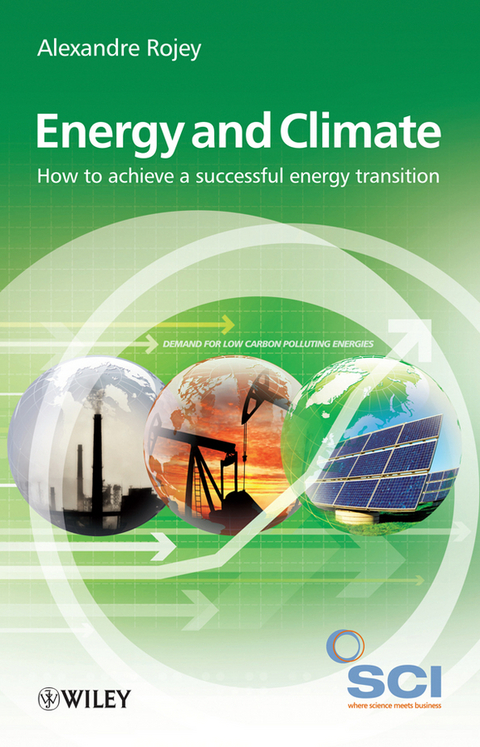
Energy and Climate (eBook)
John Wiley & Sons (Verlag)
978-0-470-74630-1 (ISBN)
Energy & Climate: How to achieve a successful energy transition covers all the technology options available and summarises key information from the International Energy Agency and other leading organisations, providing a detailed technological roadmap for this transition which aims to avoid both ecological and economic disaster. Topics that are analysed and discussed in this edition are:
- More energy efficient technologies
- New developments in fossil fuels
- Renewable energy sources such as solar and wind energy and biofuels
- Hydrogen as an energy vector
- New energy storage systems
- Hybrid vehicles
- Capture and long-term storage of carbon dioxide
Written and translated by the former Director for Sustainable Development at IFP, Energy & Climate: How to achieve a successful energy transition is an essential introductory book for scientists and researchers working in energy and climate-related topics as well as all those interested in how to manage a sustainable energy supply while still reducing harmful carbon dioxide emissions.
Dr Alexandre Rojey was, until recently, Director for Sustainable Development at IFP (Institut Français du Pétrole) in France, responsible for new developments in the energy sector such as the use of hydrogen, long term energy supply and issues related to global climate change including CO2 capture and storage. He is also the Chairman of CEDIGAZ, an international association in the area of natural gas, and an active member of IDé Es (for Innovation, Developpement durable, Energie et Société), a think tank concerned with energy and sustainable development in France. He graduated from the Ecole Centrale de Lyon, one of the most prestigious French engineering colleges and has contributed to more than 70 publications including six books. He also holds over 100 worldwide patents.
Despite global concerns over dwindling resources, climate change and carbon dioxide emissions, fossil fuels still account for more than 80% of the world s energy demands. As resources diminish and demand increases from rapidly developing nations such as China and India, the threat to both our environment and the security of our energy supply continues to grow. There is an immediate need to move towards a clean and more sustainable energy model, and this transition will require unprecedented innovation. Energy & Climate: How to achieve a successful energy transition covers all the technology options available and summarises key information from the International Energy Agency and other leading organisations, providing a detailed technological roadmap for this transition which aims to avoid both ecological and economic disaster. Topics that are analysed and discussed in this edition are: More energy efficient technologies New developments in fossil fuels Renewable energy sources such as solar and wind energy and biofuels Hydrogen as an energy vector New energy storage systems Hybrid vehicles Capture and long-term storage of carbon dioxide Written and translated by the former Director for Sustainable Development at IFP, Energy & Climate: How to achieve a successful energy transition is an essential introductory book for scientists and researchers working in energy and climate-related topics as well as all those interested in how to manage a sustainable energy supply while still reducing harmful carbon dioxide emissions.
Dr Alexandre Rojey was, until recently, Director for Sustainable Development at IFP (Institut Français du Pétrole) in France, responsible for new developments in the energy sector such as the use of hydrogen, long term energy supply and issues related to global climate change including CO2 capture and storage. He is also the Chairman of CEDIGAZ, an international association in the area of natural gas, and an active member of IDé Es (for Innovation, Developpement durable, Energie et Société), a think tank concerned with energy and sustainable development in France. He graduated from the Ecole Centrale de Lyon, one of the most prestigious French engineering colleges and has contributed to more than 70 publications including six books. He also holds over 100 worldwide patents.
SCI Preface.
Preface.
About the Author.
Introduction.
1. Energy in a Globalised World.
The fundamental role of energy in the economy.
Current predominance of fossil energies.
Uses of energy.
Restricted number of suppliers.
Energy and globalisation of the economy.
The increasing role of the emerging countries Future outlook.
2. Growing Risks Ahead.
The risks associated with energy consumption.
The growing demand.
Unequal access to energy.
Risks for the long-term energy supply.
Greater vulnerability of consumer countries.
Dependency of transport on oil.
Effects of energy consumption on the environment at local and regional levels.
Risks for the environment at world level.
Growing threats.
Interruption in the supply of hydrocarbons.
An environmental disaster.
3. The Threat of Climate Change.
A major risk for the planet.
The greenhouse effect.
The impact of greenhouse gas emissions on climate change.
Symptoms of climate change.
Positive retroaction and tipping points.
Kyoto protocol and post-Kyoto.
The factor 4 problem.
The current trend.
Urgency of the actions to be undertaken.
4. The Essential Energy Transition.
The need for change.
Threats to be removed.
Acting from a perspective of sustainable development.
The need for global regulation and governance.
Energy alternatives.
A long transition.
Making the transition.
The need to innovate.
Means of action.
Energy supply and demand axis.
Carbon balance axis.
A global transition.
5. Reducing Energy Consumption, while Protecting the Environment.
From megawatts to negawatts.
The evolution of the energy intensity.
Renewing the organisation of housing and Transport.
Towards the positive energy building.
Reduction of energy consumption in the transport sector.
Hybrid propulsion.
Energy storage.
New agricultural production modes.
More efficient industrial processes.
Waste treatment and materials recycling.
Research actions required.
6. Reducing the Energy Carbon Content.
The carbon content of the primary energy supply.
Carbon intensity.
Energy carbon content reduction pathways.
Revival of nuclear energy.
Renewable energy prospects.
Wind energy: an already mature energy.
The promise of solar energy.
Advantages and limitations of geothermal energy.
Biomass energy and biofuels: potentialities and risks.
The role of hydrogen.
Hybridisation of sources.
Research actions required.
7. Securing the Supplies of Fossil Fuels.
The role of fossil fuels.
The end of abundant and cheap oil.
Oil reserves: the present situation.
Towards a more technological oil.
Extra-heavy oils and shales.
Natural gas.
The comeback of coal.
Synthetic fuels.
Research actions required.
8. CO2 Capture and Storage.
Stakes ahead.
Carbon sinks.
CO2 capture and transport.
Geological storage.
Storage in depleted oil and gas fields.
Storage in deep saline aquifers.
Storage in unexploited coal seams.
Industrial applications of CO2 capture and storage.
Geological storage operations worldwide.
Legal and social framework for geological storage.
Longer term perspectives: mineral sequestration and CO2 recycling.
The role of CO2 geological storage.
Research actions required.
9. How to Ensure the Energy Transition?
The conditions required for a successful transition.
Implementing an acceptable evolution scenario.
Reaching the required goals.
Future outlook.
Ensuring technological progress.
A new lifestyle.
A new project for the future society.
Conclusion.
Appendices.
Appendix 1 - Energy and power.
Appendix 2 - Conversions and equivalences between units.
Appendix 3 - Abbreviations and acronyms.
References.
Web sites.
Index.
"This is an interesting concise re´sume´ of the current
situation but I am not clear why the (British) Society for Chemical
Industry has decided to support it. The references are up-to-date
but over half are in French, a fact not likely to appeal to
monoglot Anglophones." (Chromatographia, July 2010)
"One of the biggest problems faced when trying to communicate
the scale of the issues facing global energy supply in the coming
years is that there are so many of them. ... That this book
manages to cover all these issues in just over 150 pages, and
remain[s] accessible and interesting is a great compliment to
Rojey's skill as a writer." (Enagri, November 2009)
| Erscheint lt. Verlag | 30.3.2009 |
|---|---|
| Sprache | englisch |
| Themenwelt | Naturwissenschaften ► Biologie ► Ökologie / Naturschutz |
| Naturwissenschaften ► Chemie | |
| Technik | |
| Schlagworte | Account • Chemie • Chemistry • China • Climate • Continues • diminish • Energy • Energy Supply • Environment • Environmental Science • Environmental Studies • Fossil • fuels • global concerns • immediate • increases • Model • Nachhaltige u. Grüne Chemie • Nachhaltige u. Grüne Chemie • nations • Petrochemie / Brennstoffindustrie • Petrochemistry / Fuel • resources • Sustainable • Sustainable Chemistry & Green Chemistry • threat • Transition • Umweltchemie • Umweltforschung • Umweltwissenschaften • unprecedented innovation • worlds energy demands |
| ISBN-10 | 0-470-74630-0 / 0470746300 |
| ISBN-13 | 978-0-470-74630-1 / 9780470746301 |
| Informationen gemäß Produktsicherheitsverordnung (GPSR) | |
| Haben Sie eine Frage zum Produkt? |
 PDF (Adobe DRM)
Kopierschutz: Adobe-DRM
Adobe-DRM ist ein Kopierschutz, der das eBook vor Mißbrauch schützen soll. Dabei wird das eBook bereits beim Download auf Ihre persönliche Adobe-ID autorisiert. Lesen können Sie das eBook dann nur auf den Geräten, welche ebenfalls auf Ihre Adobe-ID registriert sind.
Details zum Adobe-DRM
Dateiformat: PDF (Portable Document Format)
Mit einem festen Seitenlayout eignet sich die PDF besonders für Fachbücher mit Spalten, Tabellen und Abbildungen. Eine PDF kann auf fast allen Geräten angezeigt werden, ist aber für kleine Displays (Smartphone, eReader) nur eingeschränkt geeignet.
Systemvoraussetzungen:
PC/Mac: Mit einem PC oder Mac können Sie dieses eBook lesen. Sie benötigen eine
eReader: Dieses eBook kann mit (fast) allen eBook-Readern gelesen werden. Mit dem amazon-Kindle ist es aber nicht kompatibel.
Smartphone/Tablet: Egal ob Apple oder Android, dieses eBook können Sie lesen. Sie benötigen eine
Geräteliste und zusätzliche Hinweise
Buying eBooks from abroad
For tax law reasons we can sell eBooks just within Germany and Switzerland. Regrettably we cannot fulfill eBook-orders from other countries.
aus dem Bereich