Automation in Proteomics and Genomics (eBook)
John Wiley & Sons (Verlag)
978-0-470-74117-7 (ISBN)
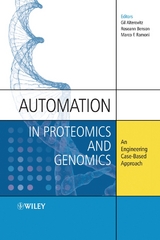
Automation in Proteomics & Genomics: An Engineering Case-Based Approach describes the automation technology currently in the areas of analysis, design, and integration, as well as providing basic biology concepts behind proteomics and genomics. The book also discusses the current technological limitations that can be viewed as an emerging market rather than a research bottleneck. Topics covered include:
- molecular biology fundamentals: from 'blueprint' (DNA) to 'task list' (RNA) to 'molecular machine' (protein); proteomics methods and technologies; modelling protein networks and interactions
- analysis via automation: DNA sequencing; microarrays and other parallelization technologies; protein characterization and identification; protein interaction and gene regulatory networks
- design via automation: DNA synthesis; RNA by design; building protein libraries; synthetic networks
- integration: multiple modalities; computational and experimental methods; trends in automation for genomics and proteomics
- new enabling technologies and future applications
Automation in Proteomics & Genomics: An Engineering Case-Based Approach is an essential guide to the current capabilities and challenges of high-throughput analysis of genes and proteins for bioinformaticians, engineers, chemists, and biologists interested in developing a cross-discipline problem-solving based approach to systems biology.
Gil Alterovitz
Dr. Alterovitz received his PhD in Electrical and biomedical Engineering at MIT through the Harvard/MIT Division of Health Sciences and Technology. He is a biomedical informatics fellow with the Harvard/MIT Division of Health Sciences and Technology (HST), Children's Hospital Informatics Program, and the Harvard Medical School-Partners Center for Genetics and Genomics. He is currently heading a new class that he initiated at Harvard University, bio.95hfa: 'Proteomics and Cellular Network Engineering'. He has served on the Harvard/MIT Division of Health Sciences and technology MD Curriculum and the Harvard/MIT Division of Health Sciences and Technology PhD Admission committees. He was a US Fulbright to Canada (University of Toronto) in 1998-1999. Dr Alterovitz has an S.M. Degree from the Massachusetts Institute of Technology (MIT) in Electrical Engineering and Computer Science, where he was a NDSEG Fellow. His B.S. is in Electrical and Computer Engineering from Carnegie Mellon University.
Dr Alterovitz has worked at Motorola (where he won the Motorola Intellectual Property Award), at IBM, and as a consultant for several national clients. As an invited contributor, he wrote the 'Proteomics' section for the Wiley Encyclopedia of Biomedical Engineering. Dr Alterovitz has appeared or has been cited for achievements in several national media outlets, including three separate editions of USA Today and National Public Radio. He was also featured in the Boston Globe. In 2001, he was selected as one of approximately 20 international delegates to the Canada 25 forum (to discuss healthcare/technology) covered by CBC radio, a national V special and Canada's Maclean's.
RoSeann Benson
For eleven years, Ms Benson was a chemical engineer, and participated in all phases of automation implementation projects in a variety of industries: nuclear, semiconductor, aluminum, specialty chemical and environmental. Her engineering experience ran the project gamut, from inception to completion, and included framing the technical problems correctly; designing bench tests to establish system specifications; setting and calculating design parameters; selecting,purchasing and installing equipment; and utilizing general equipment to meet particular applications. As part of thee engineering projects, Ms Benson acquired extensive experience with documentation. One paper, 'Shock Deionization of the K and L Basins', presented the research and outcome of a successful project where indefinite scientific principle were defined more accurately within a particular context. She won an American Institute of Chemical Engineers' (AIChE) National 'Outstanding Paper' award for the paper that she wrote and presented at an AIChE meeting. Ms Benson's formal credentials include a Clarkson University Chemical Engineering bachelor's Certificate in Administration and Management.
Ms Benson writes nonfiction outside of the engineering field, and is a contributor to three Cadogan Guides. Her first book, 101 Puppy-Buying Tips has recently been published by LifeTips.com. In addition, she serves on the City of Beverly's Library Board of Trustees.
Marco F. Ramoni
Marco F. Ramoni is Assistant Professor of Pediatrics and Medicine at Harvard Medical School and Assistant Professor of Health Sciences and Technology at the Harvard University and the Massachusetts Institute of Technology Division of Health Sciences and Technology. He is also Associate Director of Bioinformatics at the Harvard Partners center for Genetics and Genomics and the Director of the National Library of Medicine Training Fellowship in Biomedical Informatics 'Biomedical Informatics' at the Harvard-MIT Division of Health Sciences and technology, core faculty of the course Genomic Medicine at Harvard Medical School and a member of the curriculum committee of the Cellular and Molecular Medicine track of the Medical Physics and Medical Engineering graduate program at Harvard Medical School and a member of the curriculum committee of the cellular and Molecular Medicine track of the Medical Physics and Medical Engineering graduate program at Harvard-MIT Division of Health Sciences and Technology. He is cofounder of Bayesware LLC, a software company developing machine-learning programs based on Bayesian methods. He received a PhD in Biomedical Engineering and a BA in Philosophy (Epistemology) from the University of Pavia (Italy), completed his postdoctoral training at McGill University, Montreal (Canada). He has held academic and visiting positions at the University of Massachusetts, the University of London (United Kingdom), the Knowledge Media Institute (United Kingdom) and the University of Geneva (Switzerland). He is author of over 90 publications in genetics, biomedical informatics, statistics and artificial intelligence.
In the last decade DNA sequencing costs have decreased over a magnitude, largely because of increasing throughput by incremental advances in tools, technologies and process improvements. Further cost reductions in this and in related proteomics technologies are expected as a result of the development of new high-throughput techniques and the computational machinery needed to analyze data generated. Automation in Proteomics & Genomics: An Engineering Case-Based Approach describes the automation technology currently in the areas of analysis, design, and integration, as well as providing basic biology concepts behind proteomics and genomics. The book also discusses the current technological limitations that can be viewed as an emerging market rather than a research bottleneck. Topics covered include: molecular biology fundamentals: from blueprint (DNA) to task list (RNA) to molecular machine (protein); proteomics methods and technologies; modelling protein networks and interactions analysis via automation: DNA sequencing; microarrays and other parallelization technologies; protein characterization and identification; protein interaction and gene regulatory networks design via automation: DNA synthesis; RNA by design; building protein libraries; synthetic networks integration: multiple modalities; computational and experimental methods; trends in automation for genomics and proteomics new enabling technologies and future applications Automation in Proteomics & Genomics: An Engineering Case-Based Approach is an essential guide to the current capabilities and challenges of high-throughput analysis of genes and proteins for bioinformaticians, engineers, chemists, and biologists interested in developing a cross-discipline problem-solving based approach to systems biology.
Preface.
List of Contributors.
About the Editors.
SECTION 1 FUNDAMENTALS OF MOLECULAR AND CELLULAR
BIOLOGY
1 The Central Dogma: From DNA to RNA, and to Protein
(Takashi Ohtsuki, Masahiko Sisido).
2 Genomes to Proteomes (Ellen A. Panisko, Igor
Grigoriev, Don S. Daly, Bobbie-Jo Webb-Robertson and Scott E.
Baker).
SECTION 2 ANALYSIS VIA AUTOMATION.
3 High-Throughput DNA Sequencing (Tarjei S.
Mikkelsen).
4 Modeling a Regulatory Network Using Temporal Gene
Expression Data: Why and How (Sophie L`ebre and Gäelle
Lelandais)?
5 Automated Prediction of Protein Attributes and Its Impact
on Biomedicine and Drug Discovery (Kuo-Chen Chou).
6 Molecular Interaction Networks: Topological and Functional
Characterizations (Xiaogang Wu and Jake Y. Chen).
SECTION 3 DESIGN VIA AUTOMATION.
7 DNA Synthesis (Jingdong Tian).
8 Computational and Experimental RNA Nanoparticle Design
(Isil Severcan, Cody Geary, Luc Jaeger, Eckart Bindewald,
Wojciech Kasprzak and Bruce A. Shapiro).
9 New Paradigms in Droplet-Based Microfluidics and DNA
Amplification (Michael L. Samuels, John Leamon, Jonathan
Rothberg, Ronald Godiska,Thomas Schoenfeld and David
Mead).
10 Synthetic Networks (Jongmin Kim).
SECTION 4 INTEGRATION.
11 Molecular Modeling of CYP Proteins and its Implication for
Personal Drug Design (Jing-Fang Wang, Cheng-Cheng Zhang,
Jing-Yi Yan, Kuo-Chen Chou and Dong-Qing Wei).
12 Recent Progress of Bioinformatics in Membrane Protein
Structural Studies (Hong-Bin Shen, Jun-Feng Wang, Li-Xiu
Yao, Jie Yang and Kuo-Chen Chou).
13 Trends in Automation for Genomics and Proteomics
(Gil Alterovitz, Roseann Benson, Marco Ramoni and Dmitriy
Sonkin).
Index.
| Erscheint lt. Verlag | 16.3.2009 |
|---|---|
| Sprache | englisch |
| Themenwelt | Naturwissenschaften ► Biologie ► Genetik / Molekularbiologie |
| Naturwissenschaften ► Chemie | |
| Technik ► Umwelttechnik / Biotechnologie | |
| Schlagworte | Advances • Analytische Chemie / Forensik • Automation • automation dna • biomedical engineering • Biomedizintechnik • Biowissenschaften • Chemie • Chemistry • Cost • Development • DNA • Forensics • Gene • Genomforschung u. Proteomik • genomics • Genomics & Proteomics • incremental • interaction • Lab Automation & Miniaturization • Laborautomatisierung • Laborautomatisierung u. Miniaturisierung • largely • last decade • Life Sciences • Magnitude • Molecular Bioengineering • Molekulares Bioengineering • New • Proteomics • reductions • result • sequencing • sequencing costs • Technologies • Throughput • Tools |
| ISBN-10 | 0-470-74117-1 / 0470741171 |
| ISBN-13 | 978-0-470-74117-7 / 9780470741177 |
| Informationen gemäß Produktsicherheitsverordnung (GPSR) | |
| Haben Sie eine Frage zum Produkt? |
 PDF (Adobe DRM)
Kopierschutz: Adobe-DRM
Adobe-DRM ist ein Kopierschutz, der das eBook vor Mißbrauch schützen soll. Dabei wird das eBook bereits beim Download auf Ihre persönliche Adobe-ID autorisiert. Lesen können Sie das eBook dann nur auf den Geräten, welche ebenfalls auf Ihre Adobe-ID registriert sind.
Details zum Adobe-DRM
Dateiformat: PDF (Portable Document Format)
Mit einem festen Seitenlayout eignet sich die PDF besonders für Fachbücher mit Spalten, Tabellen und Abbildungen. Eine PDF kann auf fast allen Geräten angezeigt werden, ist aber für kleine Displays (Smartphone, eReader) nur eingeschränkt geeignet.
Systemvoraussetzungen:
PC/Mac: Mit einem PC oder Mac können Sie dieses eBook lesen. Sie benötigen eine
eReader: Dieses eBook kann mit (fast) allen eBook-Readern gelesen werden. Mit dem amazon-Kindle ist es aber nicht kompatibel.
Smartphone/Tablet: Egal ob Apple oder Android, dieses eBook können Sie lesen. Sie benötigen eine
Geräteliste und zusätzliche Hinweise
Buying eBooks from abroad
For tax law reasons we can sell eBooks just within Germany and Switzerland. Regrettably we cannot fulfill eBook-orders from other countries.
aus dem Bereich