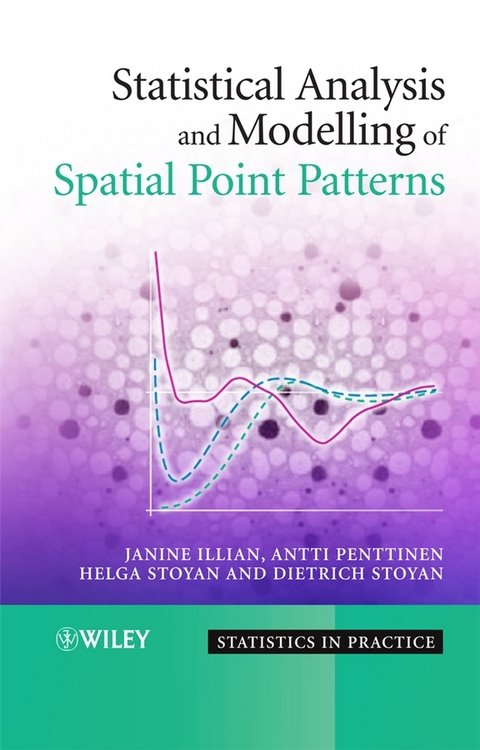
Numerous aspects of the nature of a specific spatial point pattern may be described using the appropriate statistical methods. Statistical Analysis and Modelling of Spatial Point Patterns provides a practical guide to the use of these specialised methods. The application-oriented approach helps demonstrate the benefits of this increasingly popular branch of statistics to a broad audience.
The book:
- Provides an introduction to spatial point patterns for researchers across numerous areas of application
- Adopts an extremely accessible style, allowing the non-statistician complete understanding
- Describes the process of extracting knowledge from the data, emphasising the marked point process
- Demonstrates the analysis of complex datasets, using applied examples from areas including biology, forestry, and materials science
- Features a supplementary website containing example datasets.
Statistical Analysis and Modelling of Spatial Point Patterns is ideally suited for researchers in the many areas of application, including environmental statistics, ecology, physics, materials science, geostatistics, and biology. It is also suitable for students of statistics, mathematics, computer science, biology and geoinformatics.
Janine Illian, SIMBIOS, University of Abertay, Dundee, Scotland.
Antti Pentinen, Professor in the Department of Mathematics and Statistics, University of Jyvaskyla, Finland.
Dietrich Stoyan, Professor a the Insitut für Stochastik, University of Freiberg, Germany.
Spatial point processes are mathematical models used to describe and analyse the geometrical structure of patterns formed by objects that are irregularly or randomly distributed in one-, two- or three-dimensional space. Examples include locations of trees in a forest, blood particles on a glass plate, galaxies in the universe, and particle centres in samples of material. Numerous aspects of the nature of a specific spatial point pattern may be described using the appropriate statistical methods. Statistical Analysis and Modelling of Spatial Point Patterns provides a practical guide to the use of these specialised methods. The application-oriented approach helps demonstrate the benefits of this increasingly popular branch of statistics to a broad audience. The book: Provides an introduction to spatial point patterns for researchers across numerous areas of application Adopts an extremely accessible style, allowing the non-statistician complete understanding Describes the process of extracting knowledge from the data, emphasising the marked point process Demonstrates the analysis of complex datasets, using applied examples from areas including biology, forestry, and materials science Features a supplementary website containing example datasets. Statistical Analysis and Modelling of Spatial Point Patterns is ideally suited for researchers in the many areas of application, including environmental statistics, ecology, physics, materials science, geostatistics, and biology. It is also suitable for students of statistics, mathematics, computer science, biology and geoinformatics.
Janine Illian, SIMBIOS, University of Abertay, Dundee, Scotland. Antti Pentinen, Professor in the Department of Mathematics and Statistics, University of Jyvaskyla, Finland. Dietrich Stoyan, Professor a the Insitut für Stochastik, University of Freiberg, Germany.
"It adopts an extremely accessible style, allowing the
non-statistician complete understanding, describes the process of
extracting knowledge from the data, emphasizing marked point
processes, demonstrates the analysis of complex data sets, using
applied examples from areas including biology, forestry, and
materials science, and features a supplementary website containing
example datasets. This text is ideally suited for researchers in
many areas of applications, including environmental statistics,
ecology, physics, material science, geostatistics, and biology. It
is also suitable for students of statistics, mathematics, computer
science, biology and geoinformatics." (Zentralblatt Math,
2010)
"Statistical Analysis and Modelling of Spatial Point Patterns is
an extremely well-written book and is accessible to a wide
audience, including both applied statisticians and researchers from
other fields with a reasonably sophisticated background in
statics." (Journal of the American Statistical Association,
September 2010)"The book presents statistical methods that
are relevant in practice, focusing on traditional methods, in
particular those based on summary statistics, but also more recent
models and methods are briefly discussed. "(Biometrics
, September 2009)
"The book is a useful addition to Wiley's series Statistics in
Practice." (Journal of Tropical Pediatrics, February
2009)
"The abstract flavor this brings to the subject means that
methods may have very wide applicability over different application
domains. This applicability, in turn, is reflected by the large
number of interesting examples described in the book. The book
provides a comprehensive overview of the area." (International
Statistical Review, December 2008)
| Erscheint lt. Verlag | 15.4.2008 |
|---|---|
| Reihe/Serie | Statistics in Practice |
| Statistics in Practice | Statistics in Practice |
| Sprache | englisch |
| Themenwelt | Mathematik / Informatik ► Mathematik ► Angewandte Mathematik |
| Mathematik / Informatik ► Mathematik ► Statistik | |
| Mathematik / Informatik ► Mathematik ► Wahrscheinlichkeit / Kombinatorik | |
| Technik | |
| Schlagworte | Angewandte Wahrscheinlichkeitsrechnung u. Statistik • Applied Probability & Statistics • Aspects • biometrics • Biometrie • blood particles • Forest • Galaxies • geometrical • Glass • include • Locations • Material • Mathematical • Models • Nature • numerous • objects • Pattern • Patterns • Point • processes • Samples • space • Statistical Methods • Statistics • Statistik • Statistische Analyse • Structure • Trees • Universe |
| ISBN-13 | 9780470725153 / 9780470725153 |
| Informationen gemäß Produktsicherheitsverordnung (GPSR) | |
| Haben Sie eine Frage zum Produkt? |
 PDF (Adobe DRM)
Kopierschutz: Adobe-DRM
Adobe-DRM ist ein Kopierschutz, der das eBook vor Mißbrauch schützen soll. Dabei wird das eBook bereits beim Download auf Ihre persönliche Adobe-ID autorisiert. Lesen können Sie das eBook dann nur auf den Geräten, welche ebenfalls auf Ihre Adobe-ID registriert sind.
Details zum Adobe-DRM
Dateiformat: PDF (Portable Document Format)
Mit einem festen Seitenlayout eignet sich die PDF besonders für Fachbücher mit Spalten, Tabellen und Abbildungen. Eine PDF kann auf fast allen Geräten angezeigt werden, ist aber für kleine Displays (Smartphone, eReader) nur eingeschränkt geeignet.
Systemvoraussetzungen:
PC/Mac: Mit einem PC oder Mac können Sie dieses eBook lesen. Sie benötigen eine
eReader: Dieses eBook kann mit (fast) allen eBook-Readern gelesen werden. Mit dem amazon-Kindle ist es aber nicht kompatibel.
Smartphone/Tablet: Egal ob Apple oder Android, dieses eBook können Sie lesen. Sie benötigen eine
Geräteliste und zusätzliche Hinweise
Buying eBooks from abroad
For tax law reasons we can sell eBooks just within Germany and Switzerland. Regrettably we cannot fulfill eBook-orders from other countries.
aus dem Bereich