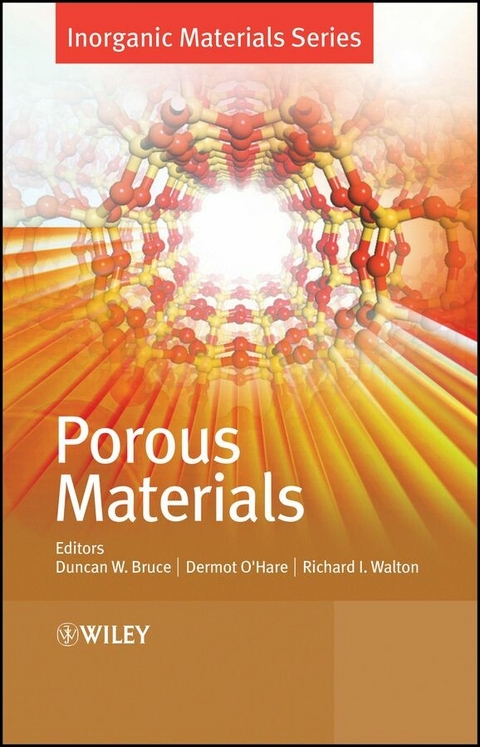
Porous Materials (eBook)
John Wiley & Sons (Verlag)
978-0-470-71137-8 (ISBN)
- Metal Organic Frameworks Materials
- Mesoporous Silicates
- Ordered Porous Crystalline Transition Metal Oxides
- Recent Developments in Templated Porous Carbon Materials
- Synthetic Silicate Zeolites: Diverse Materials Accessible Through Geoinspiration
Additional volumes in the Inorganic Materials Series:
Low-Dimensional Solids | Molecular Materials | Functional Oxides | Energy Materials
PROFESSOR DUNCAN BRUCE graduated from the University of Liverpool (UK), where he also gained his PhD. In 1984, he took up a Temporary Lectureship in Inorganic Chemistry at the University of Sheffield and was awarded a Royal Society Warren Research Fellowship. He was then appointed Lecturer in Chemistry and was promoted Senior Lecturer in 1994, in which year he became co-director of the Sheffield Centre for Molecular Materials. In 1995, he was appointed Professor of Inorganic Chemistry at the University of Exeter. Following the closure of Exeter's chemistry department in 2005, Professor Bruce took up his present position as Professor of Materials Chemistry in York. He is currently Chair of the Royal Society of Chemistry Materials Chemistry Forum. His current research interests include liquid crystals and nanoparticle-doped, nanostructured, mesoporous silicates. His work has been recognized by various awards including the British Liquid Crystal Society's first Young Scientist prize and the RSC's Sir Edward Frankland Fellowship and Corday-Morgan Medal and Prize. He has held visiting positions in Australia, France, Japan and Italy.
DR. RICHARD WALTON, who was also formerly based in the Department of Chemistry at the University of Exeter, now works in the Department of Chemistry at the University of Warwick. His research group works in the area of solid-state materials chemistry and has a number of projects focusing upon the synthesis, structural characterization and properties of inorganic materials.
DERMOT O'HARE is Professor in the Chemistry Research Laboratory at the University of Oxford. is research group has a wide range of research interests. They all involve synthetic chemistry ranging from organometallic chemistry to the synthesis of new microporous solids. Duncan Bruce and Dermot O'Hare have edited several editions of Inorganic Materials published by John Wiley & Sons Ltd.
In the past few decades, the increasingly routine use of advanced structural probes for studying the structure and dynamics of the solid state has led to some dramatic developments in the field of porous solids. These materials are fundamental in a diverse range of applications, such as shape-selective catalysts for energy-efficient organic transformations, new media for pollutant removal, and gas storage materials for energy technologies. Porosity in inorganic materials may range from the nano-scale to the macro-scale, and the drive towards particular properties remains the goal in this fast-developing area of research. Covering some of the key families of inorganic solids that are currently being studied, Porous Materials discusses: Metal Organic Frameworks Materials Mesoporous Silicates Ordered Porous Crystalline Transition Metal Oxides Recent Developments in Templated Porous Carbon Materials Synthetic Silicate Zeolites: Diverse Materials Accessible Through Geoinspiration Additional volumes in the Inorganic Materials Series: Low-Dimensional Solids | Molecular Materials | Functional Oxides | Energy Materials
PROFESSOR DUNCAN BRUCE graduated from the University of Liverpool (UK), where he also gained his PhD. In 1984, he took up a Temporary Lectureship in Inorganic Chemistry at the University of Sheffield and was awarded a Royal Society Warren Research Fellowship. He was then appointed Lecturer in Chemistry and was promoted Senior Lecturer in 1994, in which year he became co-director of the Sheffield Centre for Molecular Materials. In 1995, he was appointed Professor of Inorganic Chemistry at the University of Exeter. Following the closure of Exeter's chemistry department in 2005, Professor Bruce took up his present position as Professor of Materials Chemistry in York. He is currently Chair of the Royal Society of Chemistry Materials Chemistry Forum. His current research interests include liquid crystals and nanoparticle-doped, nanostructured, mesoporous silicates. His work has been recognized by various awards including the British Liquid Crystal Society's first Young Scientist prize and the RSC's Sir Edward Frankland Fellowship and Corday-Morgan Medal and Prize. He has held visiting positions in Australia, France, Japan and Italy. DR. RICHARD WALTON, who was also formerly based in the Department of Chemistry at the University of Exeter, now works in the Department of Chemistry at the University of Warwick. His research group works in the area of solid-state materials chemistry and has a number of projects focusing upon the synthesis, structural characterization and properties of inorganic materials. DERMOT O'HARE is Professor in the Chemistry Research Laboratory at the University of Oxford. is research group has a wide range of research interests. They all involve synthetic chemistry ranging from organometallic chemistry to the synthesis of new microporous solids. Duncan Bruce and Dermot O'Hare have edited several editions of Inorganic Materials published by John Wiley & Sons Ltd.
Inorganic Materials Series Preface
Preface
List of Contributors
1 Metal Organic Frameworks Materials
Cameron J. Kepert
1.1 Introduction
1.2 Porosity
1.3 Incorporation of other Properties
1.4 Concluding Remarks
Acknowledgements
References
2 Mesoporous Silicates
Karen J. Edler
2.1 Introduction
2.2 Nomenclature
2.3 Methods of Preparation
2.4 Surfactant Aggregation
2.5 Silica Source
2.6 Template Removal
2.7 Synthetic Routes and Formation Mechanisms
2.8 True Liquid Crystal Templating
References
3 Ordered Porous Crystallin e Transition Metal Oxides
Wataru Ueda and Masahiro Sadakane
3.1 Introduction
3.2 Scope and limitations of this review
3.3 Microporous Transition-Metal Oxide Materials
3.4 Mesoporous Transition-Metal Oxide Materials
3.5 Macroporous materials
3.6 Conclusion
References
4 Templated Porous Carbon Materials: Recent Developments
Yongde Xia, Zhuxian Yang and Robert Mokaya
4.1 Introduction
4.2 Microporous carbon materials
4.3 Mesoporous carbon materials
4.4 Macroporous carbon materials
References
5 Synthetic Silicate Zeolites: Diverse Materials Accessible Through Geoinspiration
Miguel Camblor and Suk Bong Hong
5.1 Introduction
5.2 Zeolites: Some Definitions
5.3 Zeolite Structures
5.4 Chemical Composition of Silicate Zeolites
5.5 Zeolite Properties
5.6 Zeolite Applications
5.7 Zeolite Synthesis
5.8 Concluding remarks
Acknowledgements
References
| Erscheint lt. Verlag | 12.10.2010 |
|---|---|
| Reihe/Serie | Inorganic Materials Series | Inorganic Materials Series |
| Sprache | englisch |
| Themenwelt | Naturwissenschaften ► Chemie |
| Technik ► Maschinenbau | |
| Schlagworte | Anorganische Chemie • Chemie • Chemistry • fundamentals of materials science, inorganic chemistry, properties of materials, porous materials, application of porous materials, energy conversion and porous materials, drug delivery and porous materials, photonics and porous materials, silicate zeolite chemistry • Inorganic Chemistry • Materialeigenschaften • Materials Science • Materialwissenschaften • Poröser Stoff • Poröser Stoff • properties of materials |
| ISBN-10 | 0-470-71137-X / 047071137X |
| ISBN-13 | 978-0-470-71137-8 / 9780470711378 |
| Informationen gemäß Produktsicherheitsverordnung (GPSR) | |
| Haben Sie eine Frage zum Produkt? |
 PDF (Adobe DRM)
Kopierschutz: Adobe-DRM
Adobe-DRM ist ein Kopierschutz, der das eBook vor Mißbrauch schützen soll. Dabei wird das eBook bereits beim Download auf Ihre persönliche Adobe-ID autorisiert. Lesen können Sie das eBook dann nur auf den Geräten, welche ebenfalls auf Ihre Adobe-ID registriert sind.
Details zum Adobe-DRM
Dateiformat: PDF (Portable Document Format)
Mit einem festen Seitenlayout eignet sich die PDF besonders für Fachbücher mit Spalten, Tabellen und Abbildungen. Eine PDF kann auf fast allen Geräten angezeigt werden, ist aber für kleine Displays (Smartphone, eReader) nur eingeschränkt geeignet.
Systemvoraussetzungen:
PC/Mac: Mit einem PC oder Mac können Sie dieses eBook lesen. Sie benötigen eine
eReader: Dieses eBook kann mit (fast) allen eBook-Readern gelesen werden. Mit dem amazon-Kindle ist es aber nicht kompatibel.
Smartphone/Tablet: Egal ob Apple oder Android, dieses eBook können Sie lesen. Sie benötigen eine
Geräteliste und zusätzliche Hinweise
Buying eBooks from abroad
For tax law reasons we can sell eBooks just within Germany and Switzerland. Regrettably we cannot fulfill eBook-orders from other countries.
aus dem Bereich