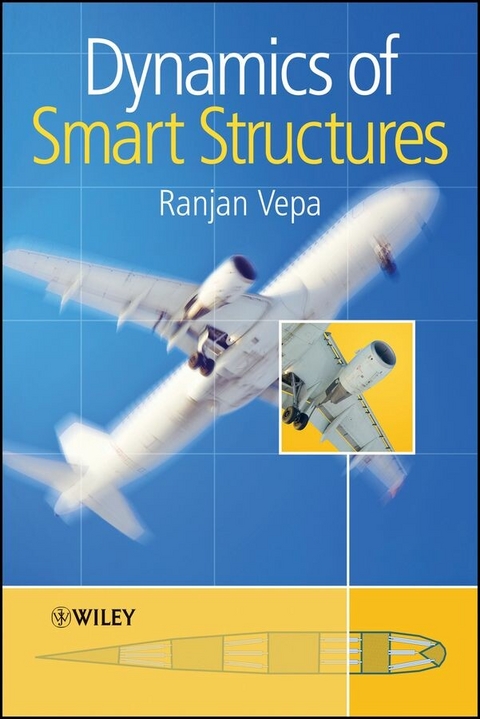
Dynamics of Smart Structures (eBook)
John Wiley & Sons (Verlag)
978-0-470-71061-6 (ISBN)
Dynamics of Smart Structures has been developed to complement the author's new interdisciplinary programme of study at Queen Mary, University of London that includes courses on emerging and new technologies such as biomimetic robotics, smart composite structures, micro-electro-mechanical systems (MEMS) and their applications and prosthetic control systems. It includes chapters on smart materials and structures, transducers for smart structures, fundamentals of structural control, dynamics of continuous structures, dynamics of plates and plate-like structures, dynamics of piezoelectric media, mechanics of electro-actuated composite structures, dynamics of thermo-elastic media: shape memory alloys, and controller designs for flexible structures.
Dr Ranjan Vepa is lecturer in avionics in the Department of Engineering at QMUL. Since joining in 1984 he has taught undergraduate avionics related courses, and conducted research into the aspects of the design, analysis, simulation, and implementation of avionics and avionics-related systems including non-linear aerospace vehicle kinematics, dynamics, vibration, control and filtering. Dr Ranjan Vepa is a Chartered Engineer and a Member of the Royal Aeronautical Society. In addition to journal and conference papers, he has contributed to the textbook Application of Artificial Intelligence in Process Control and is currently completing a research monograph on Biomimetic Robotics: Mechanisms and Control, due to be published in June 2008 by Cambridge University Press.
Dynamics of Smart Structures is a practical, concise and integrated text that provides an introduction to the fundamental principles of a field that has evolved over the recent years into an independent and identifiable subject area. Bringing together the concepts, techniques and systems associated with the dynamics and control of smart structures, it comprehensively reviews the differing smart materials that are employed in the development of the smart structures and covers several recent developments in the field of structural dynamics. Dynamics of Smart Structures has been developed to complement the author's new interdisciplinary programme of study at Queen Mary, University of London that includes courses on emerging and new technologies such as biomimetic robotics, smart composite structures, micro-electro-mechanical systems (MEMS) and their applications and prosthetic control systems. It includes chapters on smart materials and structures, transducers for smart structures, fundamentals of structural control, dynamics of continuous structures, dynamics of plates and plate-like structures, dynamics of piezoelectric media, mechanics of electro-actuated composite structures, dynamics of thermo-elastic media: shape memory alloys, and controller designs for flexible structures.
Dr Ranjan Vepa is lecturer in avionics in the Department of Engineering at QMUL. Since joining in 1984 he has taught undergraduate avionics related courses, and conducted research into the aspects of the design, analysis, simulation, and implementation of avionics and avionics-related systems including non-linear aerospace vehicle kinematics, dynamics, vibration, control and filtering. Dr Ranjan Vepa is a Chartered Engineer and a Member of the Royal Aeronautical Society. In addition to journal and conference papers, he has contributed to the textbook Application of Artificial Intelligence in Process Control and is currently completing a research monograph on Biomimetic Robotics: Mechanisms and Control, due to be published in June 2008 by Cambridge University Press.
Preface.
1 From Smart Materials to Smart Structures.
1.1 Modern Materials: A Survey.
1.2 Ceramics.
1.3 Composites.
1.4 Introduction to Features of Smart Materials.
1.6 Shape Memory Materials.
1.7 Complex Fluids and Soft Materials.
1.8 Active Fibre Composites.
1.9 Optical Fibres.
1.10 Smart Structures and Their Applications.
2 Transducers for Smart Structures.
2.1 Introduction.
2.2 Transducers for Structural Control.
2.3 Actuation of Flexible Structures.
2.4 Sensors for Flexible and Smart Structures.
2.5 Fibre-optic Sensors.
3 Fundamentals of Structural Control.
3.1 Introduction.
3.2 Analysis of Control Systems in the Time Domain.
3.3 Properties of Linear Systems.
3.4 Shaping the Dynamic Response Using Feedback Control.
3.5 Modelling of the Transverse Vibration of Thin Beams.
3.6 Externally Excited Motion of Beams.
3.7 Closed-loop Control of Flexural Vibration.
4 Dynamics of Continuous Structures.
4.1 Fundamentals of Acoustic Waves.
4.2 Propagation of Acoustic Waves in the Atmosphere.
4.3 Circuit Modelling: The Transmission Lines.
4.4 Mechanics of Pure Elastic Media.
5 Dynamics of Plates and Plate-like Structures.
5.1 Flexural Vibrations of Plates.
5.2 The Effect of Flexure.
5.3 Vibrations in Plates of Finite Extent: Rectangular
Plates.
5.4 Vibrations in Plates of Finite Extent: Circular Plates.
5.5 Vibrations of Membranes.
6 Dynamics of Piezoelectric Media.
6.1 Introduction.
6.2 Piezoelectric Crystalline Media.
6.3 Wave Propagation in Piezoelectric Crystals.
6.4 Transmission Line Model.
6.5 Discrete Element Model of Thin Piezoelectric
Transducers.
6.6 The Generation of Acoustic Waves.
7 Mechanics of Electro-actuated Composite Structures.
7.1 Mechanics of Composite Laminated Media.
7.2 Failure of Fibre Composites.
7.3 Flexural Vibrations in Laminated Composite Plates.
7.4 Dynamic Modelling of Flexible Structures.
7.5 Active Composite Laminated Structures.
8 Dynamics of Thermoelastic Media: Shape Memory
Alloys.
8.1 Fundamentals of Thermoelasticity.
8.2 The Shape Memory Effect: The Phase-transformation
Kinetics.
8.3 Non-linear Constitutive Relationships.
8.4 Thermal Control of Shape Memory Alloys.
8.5 The Analysis and Modelling of Hysteresis.
8.6 Constitutive Relationships for Non-linear and Hysteretic
Media.
8.7 Shape Memory Alloy Actuators: Architecture and Model
Structure.
9 Controller Design for Flexible Structures.
9.1 Introduction to Controller Design.
9.2 Controller Synthesis for Structural Control.
9.3 Optimal Control Synthesis: H infinity Linear Matrix
Inequalities.
9.4 Optimal Design of Structronic Systems.
9.5 Design of an Active Catheter.
9.6 Modelling and Control of Machine Tool Chatter.
Index.
"Examples of structures assembled from smart materials demonstrate
basic principles and illustrate properties of commonly used smart
structure prototypes. Extending beyond the needs of a two-semester
or one-year course, the text can be used for a senior undergraduate
or graduate course." (Book News, September 2010)
| Erscheint lt. Verlag | 10.3.2010 |
|---|---|
| Sprache | englisch |
| Themenwelt | Technik ► Elektrotechnik / Energietechnik |
| Schlagworte | comprehensively • Concepts • concise • Control • Control Systems Technology • Development • Dynamics • Electrical & Electronics Engineering • Elektrotechnik u. Elektronik • Field • fundamental • Intelligente Systeme • Intelligente Systeme u. Agenten • Intelligent Systems & Agents • Interdisciplinary • Introduction • Mary • Materials • New • Practical • Principles • Programme • Regelungstechnik • Smart • Smart Structures • Structures • Study • Werkstoff |
| ISBN-10 | 0-470-71061-6 / 0470710616 |
| ISBN-13 | 978-0-470-71061-6 / 9780470710616 |
| Informationen gemäß Produktsicherheitsverordnung (GPSR) | |
| Haben Sie eine Frage zum Produkt? |
 PDF (Adobe DRM)
Kopierschutz: Adobe-DRM
Adobe-DRM ist ein Kopierschutz, der das eBook vor Mißbrauch schützen soll. Dabei wird das eBook bereits beim Download auf Ihre persönliche Adobe-ID autorisiert. Lesen können Sie das eBook dann nur auf den Geräten, welche ebenfalls auf Ihre Adobe-ID registriert sind.
Details zum Adobe-DRM
Dateiformat: PDF (Portable Document Format)
Mit einem festen Seitenlayout eignet sich die PDF besonders für Fachbücher mit Spalten, Tabellen und Abbildungen. Eine PDF kann auf fast allen Geräten angezeigt werden, ist aber für kleine Displays (Smartphone, eReader) nur eingeschränkt geeignet.
Systemvoraussetzungen:
PC/Mac: Mit einem PC oder Mac können Sie dieses eBook lesen. Sie benötigen eine
eReader: Dieses eBook kann mit (fast) allen eBook-Readern gelesen werden. Mit dem amazon-Kindle ist es aber nicht kompatibel.
Smartphone/Tablet: Egal ob Apple oder Android, dieses eBook können Sie lesen. Sie benötigen eine
Geräteliste und zusätzliche Hinweise
Buying eBooks from abroad
For tax law reasons we can sell eBooks just within Germany and Switzerland. Regrettably we cannot fulfill eBook-orders from other countries.
aus dem Bereich