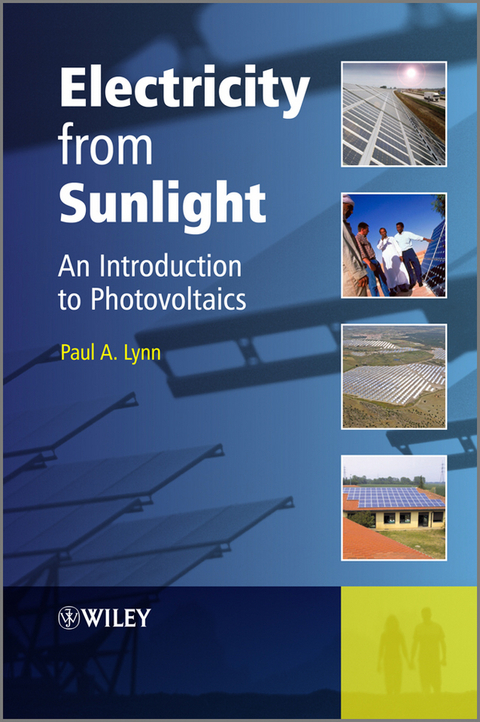
Electricity from Sunlight (eBook)
John Wiley & Sons (Verlag)
978-0-470-71012-8 (ISBN)
This book covers areas including:
- a brief history of PV, and the current international scene;
- the scientific principles of solar cells including silicon and new thin-film varieties;
- PV modules and arrays;
- grid-connected PV, from home systems up to large power plants;
- the wide diversity of stand-alone PV systems, and;
- the economic and environmental aspects of solar electricity.
Key equations and numerical examples are fully discussed, providing essential theoretical background. The text is supported by copious illustrations and more than eighty inspiring full colour photographs from around the world to demonstrate PV's huge range of practical applications.
This book is aimed at a wide readership including professionals working in related areas, and students taking introductory courses in PV and renewable energy. Its style and level will also appeal to energy planners and decision makers, members of environmental organisations, and the increasing number of people interested in generating their own electricity from sunlight.
Paul A. Lynn obtained his BSc(Eng) and PhD degrees in electrical engineering from Imperial College London. After several years in the electronics industry he lectured at Imperial College and the University Bristol. In 1993 he was appointed founding Managing Editor of the Wiley international journal Progress in Photovoltaics: Research and Applications, which he managed for 14 years. His previous publications include 5 textbooks, more than 50 technical papers and articles, and 2 short books on English country pubs. In his spare time Paul maintains a strong interest in environmental matters and is a long-time member of Friends of the Earth. He has designed and built three prize-winning solar catamarans and in 2003 he and his wife Ulrike made the first-ever solar powered voyages along the entire River Thames from Gloucestershire to London.
A lively and authoritative account of today s photovoltaic (PV) technology and its practical applications This book covers areas including: a brief history of PV, and the current international scene; the scientific principles of solar cells including silicon and new thin-film varieties; PV modules and arrays; grid-connected PV, from home systems up to large power plants; the wide diversity of stand-alone PV systems, and; the economic and environmental aspects of solar electricity. Key equations and numerical examples are fully discussed, providing essential theoretical background. The text is supported by copious illustrations and more than eighty inspiring full colour photographs from around the world to demonstrate PV s huge range of practical applications. This book is aimed at a wide readership including professionals working in related areas, and students taking introductory courses in PV and renewable energy. Its style and level will also appeal to energy planners and decision makers, members of environmental organisations, and the increasing number of people interested in generating their own electricity from sunlight.
Paul A. Lynn obtained his BSc(Eng) and PhD degrees in electrical engineering from Imperial College London. After several years in the electronics industry he lectured at Imperial College and the University Bristol. In 1993 he was appointed founding Managing Editor of the Wiley international journal Progress in Photovoltaics: Research and Applications, which he managed for 14 years. His previous publications include 5 textbooks, more than 50 technical papers and articles, and 2 short books on English country pubs. In his spare time Paul maintains a strong interest in environmental matters and is a long-time member of Friends of the Earth. He has designed and built three prize-winning solar catamarans and in 2003 he and his wife Ulrike made the first-ever solar powered voyages along the entire River Thames from Gloucestershire to London.
About the Author.
Preface.
Acknowledgements.
1. Introduction.
1.1 The Sun, Earth, and Renewable Energy.
1.2 The Solar Resource.
1.3 The Magic of Photovoltaics.
1.4 A Piece of History.
1.5 Coming up to Date.
References.
2. Solar Cells.
2.1 Setting the Scene.
2.2 Crystalline Silicon.
2.2.1 The Ideal Crystal.
2.2.2 The p-n Junction.
2.2.3 Monocrystalline Silicon.
2.2.3.1 Photons in Action.
2.2.3.2 Generating Power.
2.2.3.3 Sunlight, Silicon, and Quantum Mechanics.
2.2.3.4 Refi ning the Design.
2.2.4 Multicrystalline Silicon.
2.3 Amorphous and Thin-fi lm Silicon.
2.4 Other Cells and Materials.
2.4.1 Copper Indium Diselenide (CIS).
2.4.2 Cadmium Telluride (CdTe).
2.4.3 Specialised and Innovative Cells.
2.4.3.1 Gallium Arsenide (GaAs).
2.4.3.2 Dye-sensitised Cells.
References.
3. PV Modules and Arrays.
3.1 Introductory.
3.2 Electrical Performance.
3.2.1 Connecting Cells and Modules.
3.2.2 Module Parameters.
3.3 Capturing Sunlight.
3.3.1 Sunshine and Shadow.
3.3.2 Aligning the Array.
3.4 Concentration and Tracking.
References.
4. Grid-connected PV Systems.
4.1 Introductory.
4.2 From DC to AC.
4.3 Completing the System.
4.4 Building-integrated Photovoltaics (BIPV).
4.4.1 Engineering and Architecture.
4.4.2 PV Outside, PV Inside.
4.5 Large PV Power Plants.
References.
5. Stand-alone PV Systems.
5.1 Remote and Independent.
5.2 System Components.
5.2.1 Batteries.
5.2.2 Charge Controllers.
5.2.3 Inverters.
5.3 Hybrid Systems.
5.4 System Sizing.
5.4.1 Assessing the Problem.
5.4.2 PV Arrays and Battery Banks.
5.5 Applications.
5.5.1 PV in Space.
5.5.2 Island Electricity.
5.5.3 PV Water Pumping.
5.5.4 Solar-powered Boats.
5.5.5 Far and Wide.
References.
6. Economics and the Environment.
6.1 Paying for PV.
6.1.1 Costs and Markets.
6.1.2 Financial Incentives.
6.1.3 Rural Electrification.
6.2 Environmental Aspects.
6.2.1 Raw Materials and Land.
6.2.2 Life-cycle Analysis.
References.
Index.
"Electricity from sunlight is a very useful primer for beginningstudents of photovoltaic technology. Lynn, an expert in thefield with a broad background in industry and academia, has theability to explain complex ideas in clear language and with minimalmathematics." (CHOICE, January 2011)
"Is a must read for any housebuilder wanting to wanting to knowmore about this 'hot topic'." (Professional Housebuilder &Property Developer, 1 November 2010)
| Erscheint lt. Verlag | 22.1.2010 |
|---|---|
| Sprache | englisch |
| Themenwelt | Technik ► Elektrotechnik / Energietechnik |
| Schlagworte | Account • Applications • Aspects • authoritative • Book • Cells • Diversity • Electrical & Electronics Engineering • Elektrotechnik u. Elektronik • Energie • Energietechnik • Energy • Home • New • photovoltaic • Photovoltaik • plants • Power • Practical • Principles • Scientific • Silicon • Solar • solar electricity • Solarenergie • Solarenergie u. Photovoltaik • Solar Energy & Photovoltaics • standalone pv • Systems • Technology • Thinfilm • todays • Varieties |
| ISBN-10 | 0-470-71012-8 / 0470710128 |
| ISBN-13 | 978-0-470-71012-8 / 9780470710128 |
| Informationen gemäß Produktsicherheitsverordnung (GPSR) | |
| Haben Sie eine Frage zum Produkt? |
 PDF (Adobe DRM)
Kopierschutz: Adobe-DRM
Adobe-DRM ist ein Kopierschutz, der das eBook vor Mißbrauch schützen soll. Dabei wird das eBook bereits beim Download auf Ihre persönliche Adobe-ID autorisiert. Lesen können Sie das eBook dann nur auf den Geräten, welche ebenfalls auf Ihre Adobe-ID registriert sind.
Details zum Adobe-DRM
Dateiformat: PDF (Portable Document Format)
Mit einem festen Seitenlayout eignet sich die PDF besonders für Fachbücher mit Spalten, Tabellen und Abbildungen. Eine PDF kann auf fast allen Geräten angezeigt werden, ist aber für kleine Displays (Smartphone, eReader) nur eingeschränkt geeignet.
Systemvoraussetzungen:
PC/Mac: Mit einem PC oder Mac können Sie dieses eBook lesen. Sie benötigen eine
eReader: Dieses eBook kann mit (fast) allen eBook-Readern gelesen werden. Mit dem amazon-Kindle ist es aber nicht kompatibel.
Smartphone/Tablet: Egal ob Apple oder Android, dieses eBook können Sie lesen. Sie benötigen eine
Geräteliste und zusätzliche Hinweise
Buying eBooks from abroad
For tax law reasons we can sell eBooks just within Germany and Switzerland. Regrettably we cannot fulfill eBook-orders from other countries.
aus dem Bereich