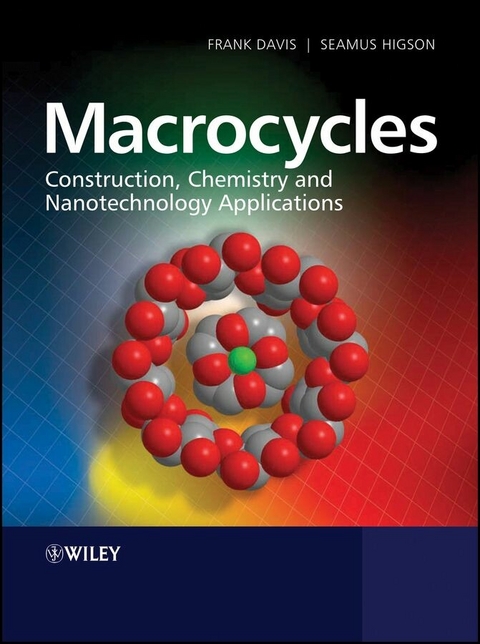
Macrocycles (eBook)
608 Seiten
John Wiley & Sons (Verlag)
978-1-119-98993-6 (ISBN)
They are interesting because they provide building blocks for
synthesizing precise two or three dimensional structures - an
important goal in nanotechnology. For example, they can be used to
develop nanosized reaction vessels, cages, switches and shuttles,
and have potential as components in molecular computers. They also
have applications as catalysts and sensors.
Macrocycles: Construction, Chemistry and
Nanotechnology Applications is an essential
introduction this important class of molecules and describes how to
synthesise them, their chemistry, how they can be used as
nanotechnology building blocks, and their applications. A wide
range of structures synthesised over the past few decades are
covered, from the simpler cyclophanes and multi-ring aromatic
structures to vases, bowls, cages and more complex multi-ring
systems and 3D architectures such as "pumpkins",
interlocking chains and knots. Topics covered include:
* principles of macrocycle synthesis
* simple ring compounds
* multi-ring aromatic structures
* porphyrins and phthalocanines
* cyclophanes
* crown ethers, cryptands and spherands
* calixarenes, resorcinarenes, cavitands, carcerands, and
heterocalixarenes
* cyclodextrins
* cucurbiturils
* cyclotriveratylenes
* rotaxanes
* catenanes
* complex 3D architectures, including trefoils and knots
Macrocycles: Construction, Chemistry and
Nanotechnology Applications distills the essence of
this important topic for undergraduate and postgraduate students,
and for researchers in other fields interested in getting a general
insight into this increasingly important class of molecules.
Dr Frank Davis Cranfield University, UK Dr Davis is a research fellow at Cranfield University, specialising in the biochemical and supramolecular aspects of electrochemistry. As well as pursuing academic research he has undertaken contract research for organisations such as Unilever Research (Port Sunlight), ITM Power Ltd (Sheffield), Timestrip (Hitchen) and DEFRA, and spent a 4-year research post within Gillette UK Professor Séamus Higson Cranfield University, UK Séamus Higson is Professor of Bio- and Electro-Analysis at Cranfield University which he joined in August 2002. His previous career spans academic departments of chemistry, medicine and materials science and this is reflected in his research. Professor Higson also serves within an advisory and / or consultative capacity for a number of public bodies and also acts as Technical Director for Microarray Ltd - a company formed upon science and patents originating from his group. His current research is primarily focussed towards practical implementation of electro analytical science and analytical biochemistry for biomedical, environmental and industrial process control applications.
Preface.
1 Introduction.
1.1 Simple Ring Compounds.
1.2 Three-Dimensional Aliphatic Carbon Structures.
1.3 Annulenes.
1.4 Multi-Ring Aromatic Structures.
1.5 Porpyrins and Phthalocanines.
1.6 Conclusions.
References.
2 Cyclophanes.
2.1 Introduction.
2.2 Cyclophanes with One Aromatic System and AliphaticChain.
2.3 Cyclophanes with More than One Aromatic Ring.
2.4 Napthalenophanes and Other Aromatic Systems.
2.5 Cyclophanes Containing Heteroaromatic Systems.
2.6 Ferrocenophanes.
2.7 Conclusions.
Bibliography.
References.
3 Crown Ethers, Cryptands and Other Compounds.
3.1 Introduction.
3.2 Crown Ethers.
3.3 Simple Complexes with Crown Ethers.
3.4 Azacrowns, Cyclens and Cyclams.
3.5 Crowns Containing Other Heteroatoms.
3.6 Lariat and Bibracchial Crown Ethers.
3.7 Cryptands.
3.8 Spherands.
3.9 Combined and Multiple Systems.
3.10 Applications of Crown Ethers and Related Compounds.
3.11 Conclusions.
Bibliography.
References.
4 Calixarenes.
4.1 Introduction.
4.2 History.
4.3 Structures of Calixarenes.
4.4 Chemical Modification of Calixarenes.
4.5 Complexes with Calixarenes.
4.6 Bis and Multicalixarenes.
4.7 Oxacalixarenes, Azacalixarenes and Thiacalixarenes.
4.8 Resorcinarenes: Synthesis and Structure.
4.9 Cavitands and Carcerands.
4.10 Conclusions.
Bibliography.
References.
5 Heterocalixarenes and Calixnaphthalenes.
5.1 Introduction.
5.2 Calixnaphthalenes.
5.3 Tropolone-Based Macrocycles.
5.4 Calixfurans.
5.5 Calixpyrroles.
5.6 Calixindoles, Calixpyridines and Calixthiophenes.
5.7 Conclusions.
Bibliography.
References.
6 Cyclodextrins.
6.1 Introduction.
6.2 Complex Formation by Cyclodextrins.
6.3 Cyclodextrins of Other Sizes.
6.4 Modification Reactions of Cyclodextrins.
6.5 Selectivity of Cyclodextrins.
6.6 Multiple Cyclodextrin Systems.
6.7 Polymeric Cyclodextrins.
6.8 Cyclodextrins Combined with Other Macrocyclic Systems.
6.9 Therapeutic Uses of Cyclodextrins.
6.10 Other Uses of Cyclodextrins.
6.11 Conclusions.
Bibliography.
References.
7 Cyclotriveratylenes and Cryptophanes.
7.1 Introduction.
7.2 Synthesis of Cyclotriveratrylenes.
7.3 Modification of Cyclotriveratrylenes.
7.4 Synthesis of Optically Active Cyclotriveratrylenes.
7.5 Modification of the Bridging Groups.
7.6 Modification of the Aromatic Rings with OrganometallicGroups.
7.7 Selective Binding Applications of Cyclotriveratrylenes.
7.8 Analogues of CTV.
7.9 Synthesis and Structure of Cryptophanes.
7.10 Modification of Cryptophanes.
7.11 Complexes with Cryptophanes.
7.12 Cryptophane-Xenon Complexes.
7.13 Other Uses of Cryptophanes.
7.14 Hemicryptophanes.
7.15 Conclusions.
Bibliography.
References.
8 Cucurbiturils.
8.1 Introduction.
8.2 Complexation Behaviour of Simple Cucurbiturils.
8.3 Modification of Cucurbiturils.
8.4 Uses of Cucurbiturils.
8.5 Hemicucurbiturils.
8.6 Conclusions.
Bibliography.
References.
9 Rotaxanes and Catenanes.
9.1 Introduction.
9.2 Rotaxanes.
9.3 Catenanes.
9.4 Conclusions.
Bibliography.
References.
10 Other Supramolecular Systems, Molecular Motors, Machinesand Nanotechnological Applications.
10.1 Introduction.
10.2 Other Molecular Systems.
10.3 Molecular Devices, Motors and Machines.
10.4 Conclusions.
Bibliography.
References.
Index.
"Macrocycles : Construction, Chemistry and Nanotechnology
Applications distils the essence of this important topic for
undergraduate and postgraduate students, and for researchers in
other fields who are interested in getting a general insight into
this increasingly important class of molecules."
(Chimie Nouvelle, 1 March 2013)
"Figures aside, the book provides a good introduction to
novices in the field and points readers to the key references in
the macrocyclic chemistry." (Chemistry World,
2012)
| Erscheint lt. Verlag | 8.2.2011 |
|---|---|
| Sprache | englisch |
| Themenwelt | Naturwissenschaften ► Chemie ► Organische Chemie |
| Technik ► Maschinenbau | |
| Schlagworte | Anorganische Chemie • Chemie • Chemistry • Inorganic Chemistry • Nanochemie • nanochemistry • Nanomaterial • Nanostrukturiertes Material • Nanotechnologie • nanotechnology • Organische Chemie • supramolecular chemistry • Supramolekulare Chemie |
| ISBN-10 | 1-119-98993-0 / 1119989930 |
| ISBN-13 | 978-1-119-98993-6 / 9781119989936 |
| Informationen gemäß Produktsicherheitsverordnung (GPSR) | |
| Haben Sie eine Frage zum Produkt? |
 PDF (Adobe DRM)
Kopierschutz: Adobe-DRM
Adobe-DRM ist ein Kopierschutz, der das eBook vor Mißbrauch schützen soll. Dabei wird das eBook bereits beim Download auf Ihre persönliche Adobe-ID autorisiert. Lesen können Sie das eBook dann nur auf den Geräten, welche ebenfalls auf Ihre Adobe-ID registriert sind.
Details zum Adobe-DRM
Dateiformat: PDF (Portable Document Format)
Mit einem festen Seitenlayout eignet sich die PDF besonders für Fachbücher mit Spalten, Tabellen und Abbildungen. Eine PDF kann auf fast allen Geräten angezeigt werden, ist aber für kleine Displays (Smartphone, eReader) nur eingeschränkt geeignet.
Systemvoraussetzungen:
PC/Mac: Mit einem PC oder Mac können Sie dieses eBook lesen. Sie benötigen eine
eReader: Dieses eBook kann mit (fast) allen eBook-Readern gelesen werden. Mit dem amazon-Kindle ist es aber nicht kompatibel.
Smartphone/Tablet: Egal ob Apple oder Android, dieses eBook können Sie lesen. Sie benötigen eine
Geräteliste und zusätzliche Hinweise
Buying eBooks from abroad
For tax law reasons we can sell eBooks just within Germany and Switzerland. Regrettably we cannot fulfill eBook-orders from other countries.
aus dem Bereich