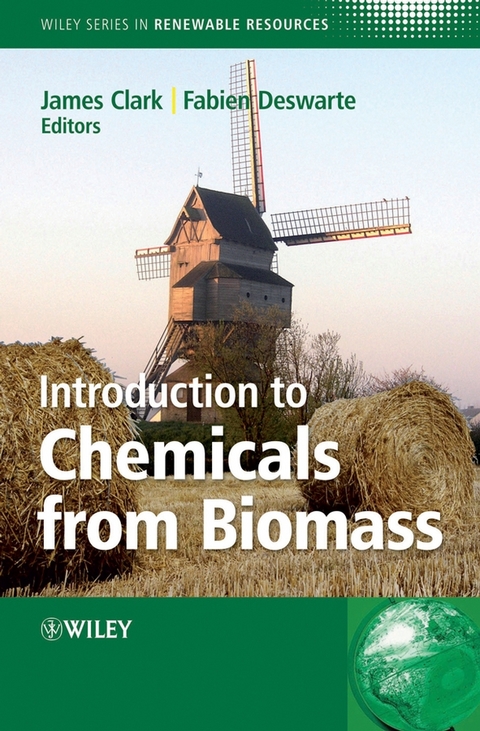
Introduction to Chemicals from Biomass (eBook)
John Wiley & Sons (Verlag)
978-0-470-69746-7 (ISBN)
Professor James Clark, Head of the Clean Technology Centre, University of York, UK
James Clark has an international reputation for his work in green chemistry and is a founding director of the Green Chemistry Network. He was also the founding Scientific Editor for the leading journal in the field, Green Chemistry, and is also an author of numerous books on the subject. He holds the Chair of Industrial & Applied Chemistry at the University of York and heads the Clean Technology Centre which integrates green chemistry research, industrial collaboration and educational developments and issues relevant to the public understanding of science. He is also the Director of the Greenchemistry Centre of Industrial Collaboration. His research interests include heterogeneous catalysis and supported reagents and the exploitation of renewable resources.
Fabien Deswarte, Green Chemistry Education Associate, Clean Technology Centre, University of York, UK
Fabien Deswarte's research interests lie mainly in the exploitation of renewable resources (crops, forestry residue, food waste, etc) as a source of bioproducts and bioenergy. Further to this, his interest lies in the development of teaching material for all level of education in the areas of renewable resources and sustainable development. He is also involved in developing 'Green' practical experiments for undergraduate and postgraduate students with the potential to extend the scope of these experiments to students of all levels.
Nature provides us with an abundance of chemical potential. Presenting an overview of the use of bioresources in the 21st century, Introduction to Chemicals from Biomass covers resources, chemical composition of biomass, key factors affecting composition, utilization of wastes, extraction technologies, controlled pyrolysis, fermentation, platform molecules, and green chemical technologies for their conversion to valuable chemicals. The text shows how smaller volume chemicals could become bulk chemicals as a result of a greater exploitation of biomass products, making it an important resource for academic and industrial scientists and researchers.
Professor James Clark, Head of the Clean Technology Centre, University of York, UK James Clark has an international reputation for his work in green chemistry and is a founding director of the Green Chemistry Network. He was also the founding Scientific Editor for the leading journal in the field, Green Chemistry, and is also an author of numerous books on the subject. He holds the Chair of Industrial & Applied Chemistry at the University of York and heads the Clean Technology Centre which integrates green chemistry research, industrial collaboration and educational developments and issues relevant to the public understanding of science. He is also the Director of the Greenchemistry Centre of Industrial Collaboration. His research interests include heterogeneous catalysis and supported reagents and the exploitation of renewable resources. Fabien Deswarte, Green Chemistry Education Associate, Clean Technology Centre, University of York, UK Fabien Deswarte's research interests lie mainly in the exploitation of renewable resources (crops, forestry residue, food waste, etc) as a source of bioproducts and bioenergy. Further to this, his interest lies in the development of teaching material for all level of education in the areas of renewable resources and sustainable development. He is also involved in developing "Green" practical experiments for undergraduate and postgraduate students with the potential to extend the scope of these experiments to students of all levels.
Series Preface.
Preface.
List of Contributors.
1. The Biorefinery Concept-An Integrated Approach (James H.Clark and Fabien E. I. Deswarte).
1.1. The Challenge of Sustainable Development.
1.2. Renewable Resources - Nature and Availability.
1.3. Impact on Ecosystem Services.
1.4. The Biorefinery Concept.
1.5. Conclusions.
2. The Chemical Value of Biomass (David B. Turley).
2.1. Introduction.
2.2. Plant Oils.
2.3. Carbohydrates.
2.4. Lignin.
2.5. Proteins.
2.6. Waxes.
2.7. Secondary Metabolites.
2.8. Prospects Arising from Developments in PlantBiotechnology and Biorefining.
2.9. Concluding Comments.
3. Green Chemical Technologies (Francesca M. Kerton).
3.1. Introduction.
3.2. What are Green Chemistry and Green Engineering?
3.3. Evaluating the Environmental Effects of Chemistry and GreenMetrics.
3.4. Alternative Solvents.
3.5. Energy Considerations: Microwaves, Ultrasound, Electricityand Light.
3.6. Catalysts.
3.7. Conclusions.
4. Production of Chemicals from Biomass (Apostolis A.Koutinas, C. Du, R.H. Wang and Colin Webb).
4.1. Introduction.
4.2. Carbohydrates.
4.3. Vegetable Oils.
4.4. Chemical Production from Proteins.
4.5. Chemical Production through Green Chemical.
5. Biomaterials (Carlos Vaca-Garcia).
5.1. Introduction.
5.2. Wood and Natural Fibres.
5.3. Isolated and modified Biopolymers ads Biomaterials.
5.4. Agromaterials, Blends and Composites.
5.5. Biodegradable Plastics.
5.6. Conclusion.
6. Production of Energy from Biomass (Mehrdad Arshadi andAnita Sellstedt).
6.1. Introduction.
6.2. Physical Upgrading Processes.
6.3. Microbiological Processes.
6.4. Thermochemical Processes.
6.5. Chemical Processes.
6.6. Power Generation from Biomass.
Index.
"[The book] provides a thorough introduction to this fast moving sector. The authors include a wide variety of accesible definitions.... Overall I found the book very readable and would recommend it to anyone wishing to learn about the benefits of microreactor technology." (Chemistry World, March 2009)
| Erscheint lt. Verlag | 15.9.2008 |
|---|---|
| Reihe/Serie | Wiley Series in Renewable Resource | Wiley Series in Renewable Resources |
| Sprache | englisch |
| Themenwelt | Naturwissenschaften ► Biologie ► Ökologie / Naturschutz |
| Naturwissenschaften ► Chemie | |
| Technik | |
| Schlagworte | biological • biomass • Biomasse • Bioresources • Biotechnologie i. d. Biowissenschaften • Biotechnology • Biowissenschaften • Book • Century • chemicals • Chemie • Chemistry • Conversion • Direct • Environmental Science • Environmental Studies • important • Industrial Chemistry • Industrielle Chemie • Introduction • Life Sciences • Manufacture • Methods • Molecules • Overview • platform • rich mixture • ST • Technische u. Industrielle Chemie • Technologies • Umweltforschung • Umweltwissenschaften • use • valuable |
| ISBN-10 | 0-470-69746-6 / 0470697466 |
| ISBN-13 | 978-0-470-69746-7 / 9780470697467 |
| Informationen gemäß Produktsicherheitsverordnung (GPSR) | |
| Haben Sie eine Frage zum Produkt? |
 PDF (Adobe DRM)
Kopierschutz: Adobe-DRM
Adobe-DRM ist ein Kopierschutz, der das eBook vor Mißbrauch schützen soll. Dabei wird das eBook bereits beim Download auf Ihre persönliche Adobe-ID autorisiert. Lesen können Sie das eBook dann nur auf den Geräten, welche ebenfalls auf Ihre Adobe-ID registriert sind.
Details zum Adobe-DRM
Dateiformat: PDF (Portable Document Format)
Mit einem festen Seitenlayout eignet sich die PDF besonders für Fachbücher mit Spalten, Tabellen und Abbildungen. Eine PDF kann auf fast allen Geräten angezeigt werden, ist aber für kleine Displays (Smartphone, eReader) nur eingeschränkt geeignet.
Systemvoraussetzungen:
PC/Mac: Mit einem PC oder Mac können Sie dieses eBook lesen. Sie benötigen eine
eReader: Dieses eBook kann mit (fast) allen eBook-Readern gelesen werden. Mit dem amazon-Kindle ist es aber nicht kompatibel.
Smartphone/Tablet: Egal ob Apple oder Android, dieses eBook können Sie lesen. Sie benötigen eine
Geräteliste und zusätzliche Hinweise
Buying eBooks from abroad
For tax law reasons we can sell eBooks just within Germany and Switzerland. Regrettably we cannot fulfill eBook-orders from other countries.
aus dem Bereich