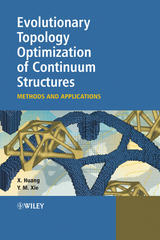
Evolutionary Topology Optimization of Continuum Structures (eBook)
John Wiley & Sons (Verlag)
978-0-470-68947-9 (ISBN)
- Presents latest developments and applications in this increasingly popular & maturing optimization approach for engineers and architects;
- Authored by leading researchers in the field who have been working in the area of ESO and BESO developments since their conception;
- Includes a number of test problems for students as well as a chapter of case studies that includes several recent practical projects in which the authors have been involved;
- Accompanied by a website housing ESO/BESO computer programs at http://www.wiley.com/go/huang and test examples, as well as a chapter within the book giving a description and step-by-step instruction on how to use the software package BESO2D.
Evolutionary Topology Optimization of Continuum Structures will appeal to researchers and graduate students working in structural design and optimization, and will also be of interest to civil and structural engineers, architects and mechanical engineers involved in creating innovative and efficient structures.
Yi Min (Mike) Xie, RMIT University, Melbourne, Australia.
Yi Min (Mike) Xie is Professor and Discipline Head, Civil and Environmental Engineering within the School of Civil, Environmental and Chemical Engineering at RMIT University. He has been awarded the Vice-Chancellor's Medal for Excellence in Research in 2000 at Victoria University and has authored over 100 papers in refereed journals. He has also authored or edited 5 books including Evolutionary Structural Optimization (Xie & Steven, 1997, Springer).
Xiaodong Huang is a Postdoctoral Fellow within the Department of Mechanical Engineering at RMIT, Australia. He has authored over 20 papers in research journals.
Evolutionary Topology Optimization of Continuum Structures treads new ground with a comprehensive study on the techniques and applications of evolutionary structural optimization (ESO) and its later version bi-directional ESO (BESO) methods. Since the ESO method was first introduced by Xie and Steven in 1992 and the publication of their well-known book Evolutionary Structural Optimization in 1997, there have been significant improvements in the techniques as well as important practical applications. The authors present these developments, illustrated by numerous interesting and detailed examples. They clearly demonstrate that the evolutionary structural optimization method is an effective approach capable of solving a wide range of topology optimization problems, including structures with geometrical and material nonlinearities, energy absorbing devices, periodical structures, bridges and buildings. Presents latest developments and applications in this increasingly popular & maturing optimization approach for engineers and architects; Authored by leading researchers in the field who have been working in the area of ESO and BESO developments since their conception; Includes a number of test problems for students as well as a chapter of case studies that includes several recent practical projects in which the authors have been involved; Accompanied by a website housing ESO/BESO computer programs at www.wileyeurope.com and test examples, as well as a chapter within the book giving a description and step-by-step instruction on how to use the software package BESO2D. Evolutionary Topology Optimization of Continuum Structures will appeal to researchers and graduate students working in structural design and optimization, and will also be of interest to civil and structural engineers, architects and mechanical engineers involved in creating innovative and efficient structures.
Yi Min (Mike) Xie, RMIT University, Melbourne, Australia. Yi Min (Mike) Xie is Professor and Discipline Head, Civil and Environmental Engineering within the School of Civil, Environmental and Chemical Engineering at RMIT University. He has been awarded the Vice-Chancellor's Medal for Excellence in Research in 2000 at Victoria University and has authored over 100 papers in refereed journals. He has also authored or edited 5 books including Evolutionary Structural Optimization (Xie & Steven, 1997, Springer). Xiaodong Huang is a Postdoctoral Fellow within the Department of Mechanical Engineering at RMIT, Australia. He has authored over 20 papers in research journals.
Preface
1 Introduction
1.1 Structural Optimization
1.2 Topology Optimization of Continuum Structures
1.3 ESO/BESO and the Layout of the Book
References
2 Evolutionary Structural Optimization Method
2.1 Introduction
2.2 ESO Based on Stress Level
2.3 ESO for Stiffness or Displacement Optimization
2.4 Conclusion
References
3 Bi-directional Evolutionary Structural OptimizationMethod
3.1 Introduction
3.2 Problem Statement and Sensitivity Number
3.3 Filter Scheme and Improved Sensitivity Number
3.4 Element Removal/Addition and Convergence Criterion
3.5 Basic BESO Procedure
3.6 Examples of BESO Starting from Initial Full Design
3.7 Examples of BESO Starting from Initial Guess Design
3.8 Example of a 3D Structure
3.9 Mesh-independence Studies
3.10 Conclusion
References
4 BESO Utilizing Material Interpolation Scheme withPenalization
4.1 Introduction
4.2 Problem Statement and Material Interpolation Scheme
4.3 Sensitivity Analysis and Sensitivity Number
4.4 Examples
4.5 Conclusion
References
Appendix 4.1
5 Comparing BESO with Other Topology OptimizationMethods
5.1 Introduction
5.2 The SIMP Method
5.3 Comparing BESO with SIMP
5.4 Discussion on Zhou and Rozvany (2001) Example
5.5 Conclusion
References
6 BESO for Extended Topology Optimization Problems
6.1 Introduction
6.2 Minimizing Structural Volume with a Displacement orCompliance Constraint
6.3 Stiffness Optimization with an Additional DisplacementConstraint
6.4 Stiffness Optimization of Structures with MultipleMaterials
6.5 Topology Optimization of Periodic Structures
6.6 Topology Optimization of Structures with Design-dependentGravity Load
6.7 Topology Optimization for Natural Frequency
6.8 Topology Optimization for Multiple Load Cases
6.9 BESO Based on von Mises Stress
6.10 Conclusion
References
7 Topology Optimization of Nonlinear ContinuumStructures
7.1 Introduction
7.2 Objective Functions and Nonlinear Analysis
7.3 Sensitivity Analysis and Sensitivity Number for ForceControl
7.4 Sensitivity Analysis and Sensitivity Number for DisplacementControl
7.5 BESO Procedure for Nonlinear Structures
7.6 Examples of Nonlinear Structures under Force Control
7.7 Examples of Nonlinear Structures under DisplacementControl
7.8 Conclusion
References
8 Optimal Design of Energy Absorption Structures
8.1 Introduction
8.2 Problem Statement for Optimization of Energy AbsorptionStructures
8.3 Sensitivity Number
8.4 Evolutionary Procedure for Removing and Adding Material
8.5 Numerical Examples and Discussions
8.6 Conclusion
References
9 Practical Applications
9.1 Introduction
9.2 Akutagwa River Side Project in Japan
9.3 Florence New Station Project in Italy
9.4 Sagrada Familia Church in Spain
9.5 Pedestrian Bridge Project in Australia
9.6 Conclusion
References
10 Computer Program BESO2D
10.1 Introduction
10.2 System Requirements and Program Installation
10.3 Windows Interface of BESO2D
10.4 Running BESO2D from Graphic User Interface
10.5 The Command Line Usage of BESO2D
10.6 Running BESO2D from the Command Line
10.7 Files Produced by BESO2D
10.8 Error messages
Index
| Erscheint lt. Verlag | 11.3.2010 |
|---|---|
| Sprache | englisch |
| Themenwelt | Technik ► Bauwesen |
| Schlagworte | Applications • Bauingenieur- u. Bauwesen • Baustatik u. Baumechanik • Civil Engineering & Construction • Comprehensive • Continuum • ESO • Evolutionary • First • Ground • important • Maschinenbau • Maschinenbau - Entwurf • mechanical engineering • Mechanical Engineering - Design • Method • New • Optimization • Practical • Publication • significant • Structural Theory & Structural Mechanics • Structures • Study • techniques • Topologieoptimierung • Topology • treads • wellknown book evolutionary • XIe |
| ISBN-10 | 0-470-68947-1 / 0470689471 |
| ISBN-13 | 978-0-470-68947-9 / 9780470689479 |
| Informationen gemäß Produktsicherheitsverordnung (GPSR) | |
| Haben Sie eine Frage zum Produkt? |
 PDF (Adobe DRM)
Kopierschutz: Adobe-DRM
Adobe-DRM ist ein Kopierschutz, der das eBook vor Mißbrauch schützen soll. Dabei wird das eBook bereits beim Download auf Ihre persönliche Adobe-ID autorisiert. Lesen können Sie das eBook dann nur auf den Geräten, welche ebenfalls auf Ihre Adobe-ID registriert sind.
Details zum Adobe-DRM
Dateiformat: PDF (Portable Document Format)
Mit einem festen Seitenlayout eignet sich die PDF besonders für Fachbücher mit Spalten, Tabellen und Abbildungen. Eine PDF kann auf fast allen Geräten angezeigt werden, ist aber für kleine Displays (Smartphone, eReader) nur eingeschränkt geeignet.
Systemvoraussetzungen:
PC/Mac: Mit einem PC oder Mac können Sie dieses eBook lesen. Sie benötigen eine
eReader: Dieses eBook kann mit (fast) allen eBook-Readern gelesen werden. Mit dem amazon-Kindle ist es aber nicht kompatibel.
Smartphone/Tablet: Egal ob Apple oder Android, dieses eBook können Sie lesen. Sie benötigen eine
Geräteliste und zusätzliche Hinweise
Buying eBooks from abroad
For tax law reasons we can sell eBooks just within Germany and Switzerland. Regrettably we cannot fulfill eBook-orders from other countries.
aus dem Bereich