Sediment Cascades (eBook)
John Wiley & Sons (Verlag)
978-0-470-68286-9 (ISBN)
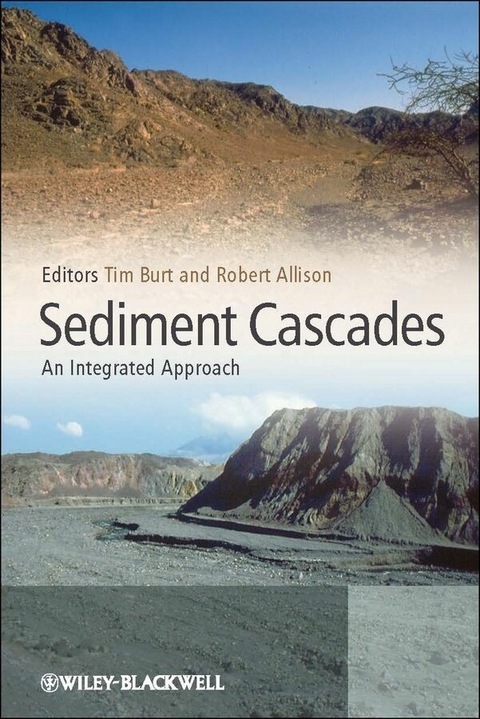
Sediment Cascades: An Integrated Approach begins with an explanation of the need for an integrated approach to sediment delivery systems and introduces the main themes of sediment production, delivery, storage and transfer. Further chapters then focus on specific environments from mountains, through floodplains, to estuaries and the continental shelf.
- Focuses on contemporary sediment system dynamics and current research
- Covers a sequence of environments from steep mountains to the continental shelf
- Highlights the continuity of the subject by linking each component area with its adjacent elements
Tim Burt is Professor of Physical Geography and Master of Hatfield College at the University of Durham. His research interests are hillslope hydrology, nitrate and phosphate pollution, soil erosion, and long instrumental records of climate change. Current research is focused on nitrate leaching from agricultural land, riparian buffer zones, and the hydrology of upland peat. Professor Burt teaches on undergraduate programmes in Geography and the Masters course in Geomorphology & Environmental Change. He has edited Nitrate Processes, Patterns and Management (with Louise Heathwaite and Stephen Trudgill) and is presently chief editor for Volume 4 of the History of the Study of Landforms (to be published in 2008 by the Geological Society of London).
Robert Allison is Professor in Physical Geography and Pro-Vice-Chancellor at the University of Sussex. His research interests are in slopes, weathering & geotechnics and the geomorphology of arid environments. Current research is focused on sediment generation and transfer in arid environments, modelling failure in fractured rock masses and the geotechnical behaviour of soft sediments. Professor Allison teaches on undergraduate programmes in Geography and Masters courses in Geomorphology & Environmental Change and Engineering Geology. He edited Landscape Sensitivity (with David S.G. Thomas) and Applied Geomorphology, both published by Wiley.
Sediment Cascades: An Integrated Approach provides a comprehensive overview that addresses the transport of sediment through the landscape. Suitable for academic researchers, industry practitioners, research students and advanced level undergraduates, seeking detailed knowledge and an up-to-date review of the recent research literature. The emphasis is on contemporary sediment system dynamics with relevance both to landscape management and landform development. Sediment Cascades: An Integrated Approach begins with an explanation of the need for an integrated approach to sediment delivery systems and introduces the main themes of sediment production, delivery, storage and transfer. Further chapters then focus on specific environments from mountains, through floodplains, to estuaries and the continental shelf. Focuses on contemporary sediment system dynamics and current research Covers a sequence of environments from steep mountains to the continental shelf Highlights the continuity of the subject by linking each component area with its adjacent elements
Tim Burt is Professor of Physical Geography and Master of Hatfield College at the University of Durham. His research interests are hillslope hydrology, nitrate and phosphate pollution, soil erosion, and long instrumental records of climate change. Current research is focused on nitrate leaching from agricultural land, riparian buffer zones, and the hydrology of upland peat. Professor Burt teaches on undergraduate programmes in Geography and the Masters course in Geomorphology & Environmental Change. He has edited Nitrate Processes, Patterns and Management (with Louise Heathwaite and Stephen Trudgill) and is presently chief editor for Volume 4 of the History of the Study of Landforms (to be published in 2008 by the Geological Society of London). Robert Allison is Professor in Physical Geography and Pro-Vice-Chancellor at the University of Sussex. His research interests are in slopes, weathering & geotechnics and the geomorphology of arid environments. Current research is focused on sediment generation and transfer in arid environments, modelling failure in fractured rock masses and the geotechnical behaviour of soft sediments. Professor Allison teaches on undergraduate programmes in Geography and Masters courses in Geomorphology & Environmental Change and Engineering Geology. He edited Landscape Sensitivity (with David S.G. Thomas) and Applied Geomorphology, both published by Wiley.
Contributors.
Preface.
1 Sediment Cascades in the Environment: An Integrated Approach
(Timothy P. Burt, Durham University, UK and Robert J. Allison,
University of Sussex, UK).
2 Mountains and Montane Channels (Michael Church, University
of British Columbia, Canada).
3 Landslides and Rockfalls (Nick J. Rosser, Durham
University, UK).
4 Sediment Cascades in Active Landscapes (Tim R. H. Davies,
University of Canterbury, New Zealand and Oliver Korup, Swiss
Federal Institute for Forest, Snow and Landscape Research).
5 Pacific Rim Steeplands (Basil Gomez, Indiana State
University, USA; Michael J. Page, GNS Science, New Zealand; Noel A.
Trustrum, GNS Science, New Zealand).
6 Local Buffers to the Sediment Cascade: Debris Cones and
Alluvial Fans (Adrian M. Harvey, University of Liverpool,
UK).
7 Overland Flow and Soil Erosion (Louise J. Bracken, Durham
University, UK).
8 Erosional Processes and Sediment Transport in Upland Mires
(Martin G. Evans, University of Manchester, UK and Timothy P.
Burt, Durham University, UK).
9 Gravel-Bed Rivers (Michael Church, University of British
Columbia, Canada).
10 The Fine-Sediment Cascade (Pamela S. Naden, Centre for
Ecology and Hydrology, UK).
11 Streams, Valleys and Floodplains in the Sediment Cascade
(Stanley W. Trimble, University of California at Los Angeles,
USA).
12 Lakes and Reservoirs in the Sediment Cascade (Ian D.L.
Foster, University of Westminster, UK).
13 Continental-Scale River Basins (David L. Higgitt, National
University of Singapore).
14 Estuaries (Tom Spencer, Cambridge University, UK and
Denise J. Reed, University of New Orleans, USA).
15 The Continental Shelf and Continental Slope (David N.
Petley, Durham University, UK).
Index.
| Erscheint lt. Verlag | 7.1.2010 |
|---|---|
| Sprache | englisch |
| Themenwelt | Naturwissenschaften ► Geowissenschaften ► Geologie |
| Technik ► Bauwesen | |
| Schlagworte | academic • comprehensive overview • Contemporary • earth sciences • emphasis • Geologie • Geologie u. Geophysik • Geology & Geophysics • Geomorphologie • geomorphology • Geophysik • Geowissenschaften • integrated approach • Knowledge • Landscape • Level • Literature • Research • Researchers • Review • Sediment • Seeking • suitable • System Dynamics • Transport • undergraduates • uptodate |
| ISBN-10 | 0-470-68286-8 / 0470682868 |
| ISBN-13 | 978-0-470-68286-9 / 9780470682869 |
| Informationen gemäß Produktsicherheitsverordnung (GPSR) | |
| Haben Sie eine Frage zum Produkt? |
 PDF (Adobe DRM)
Kopierschutz: Adobe-DRM
Adobe-DRM ist ein Kopierschutz, der das eBook vor Mißbrauch schützen soll. Dabei wird das eBook bereits beim Download auf Ihre persönliche Adobe-ID autorisiert. Lesen können Sie das eBook dann nur auf den Geräten, welche ebenfalls auf Ihre Adobe-ID registriert sind.
Details zum Adobe-DRM
Dateiformat: PDF (Portable Document Format)
Mit einem festen Seitenlayout eignet sich die PDF besonders für Fachbücher mit Spalten, Tabellen und Abbildungen. Eine PDF kann auf fast allen Geräten angezeigt werden, ist aber für kleine Displays (Smartphone, eReader) nur eingeschränkt geeignet.
Systemvoraussetzungen:
PC/Mac: Mit einem PC oder Mac können Sie dieses eBook lesen. Sie benötigen eine
eReader: Dieses eBook kann mit (fast) allen eBook-Readern gelesen werden. Mit dem amazon-Kindle ist es aber nicht kompatibel.
Smartphone/Tablet: Egal ob Apple oder Android, dieses eBook können Sie lesen. Sie benötigen eine
Geräteliste und zusätzliche Hinweise
Buying eBooks from abroad
For tax law reasons we can sell eBooks just within Germany and Switzerland. Regrettably we cannot fulfill eBook-orders from other countries.
aus dem Bereich