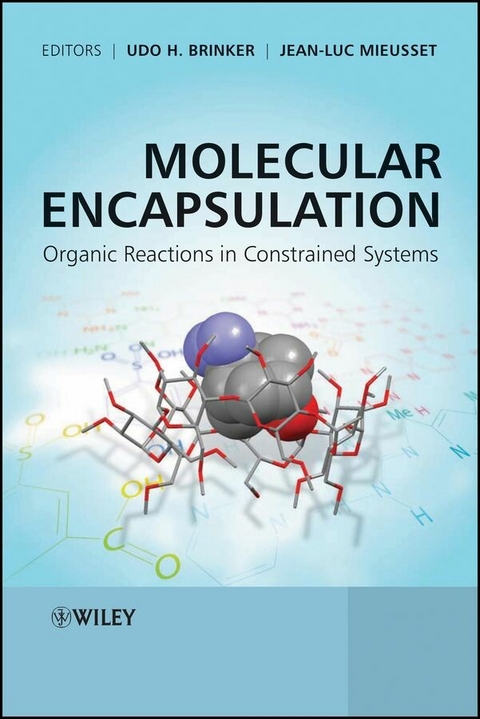
Molecular Encapsulation (eBook)
John Wiley & Sons (Verlag)
978-0-470-66488-9 (ISBN)
The following topics are covered in detail:
- general concepts governing the assembly of the substrate with the reaction vessel
- preparation of molecular reactors
- stabilization of reactive intermediates
- reactions in water, in organic solvents, and in the solid state
- photochemical reactions
- reactions with unusual regioselectivity
Molecular Encapsulation: Organic Reactions in Constrained Systems is an essential guide to the art of changing the outcome and the selectivity of a chemical reaction using nano-sized reaction vessels. It will find a place on the bookshelves of students and researchers working in the areas of supramolecular chemistry, nanotechnology, organic and pharmaceutical chemistry, and materials science as well.
Dr. Udo H. Brinker, University Professor; Head of Research Group for Physical Organic Chemistry and Structural Chemistry, Institute of Organic Chemistry, University of Vienna; and Research Professor of Chemistry at State University of New York at Binghamton, NY, USA.
Dr. Jean-Luc Mieusset, University Assistant, Institute of Organic Chemistry, University of Vienna.
The inclusion of small guest molecules within suitable host compounds results in constrained systems that imbue novel properties upon the incarcerated organic substrates. Supramolecular tactics are becoming widely employed and this treatise spotlights them. Often, the impact of encapsulation on product formation is substantial. The use of constrained systems offers the means to steer reactions along desired pathways. A broad overview of various supramolecular approaches aimed to manipulate chemical reactions are featured. The following topics are covered in detail: - general concepts governing the assembly of the substrate with the reaction vessel - preparation of molecular reactors - stabilization of reactive intermediates - reactions in water, in organic solvents, and in the solid state - photochemical reactions - reactions with unusual regioselectivity Molecular Encapsulation: Organic Reactions in Constrained Systems is an essential guide to the art of changing the outcome and the selectivity of a chemical reaction using nano-sized reaction vessels. It will find a place on the bookshelves of students and researchers working in the areas of supramolecular chemistry, nanotechnology, organic and pharmaceutical chemistry, and materials science as well.
Dr. Udo H. Brinker, University Professor; Head of Research Group for Physical Organic Chemistry and Structural Chemistry, Institute of Organic Chemistry, University of Vienna; and Research Professor of Chemistry at State University of New York at Binghamton, NY, USA. Dr. Jean-Luc Mieusset, University Assistant, Institute of Organic Chemistry, University of Vienna.
"The book has a broad scope and serves its purpose very well for
everyone who is interested in the preparation of molecular
reactors, the stabilization of reactive intermediates, reactions of
unusual regioselectivity, confined photochemical reactions, or
supramolecularly enhanced reactions in water, organic solvents, or
the solid state. Thus, the book is well suited both for beginners
and for experts, and it is an essential addition to the bookshelf
of a supramolecular chemist." (Angewandte Chemie, 1 February 2011)
| Erscheint lt. Verlag | 8.6.2010 |
|---|---|
| Sprache | englisch |
| Themenwelt | Naturwissenschaften ► Chemie ► Organische Chemie |
| Technik | |
| Schlagworte | Chemie • Chemistry • compounds • constrained • encapsulation • Formation • Guest Molecules • Host • imbue • Impact • Inclusion • Nanomaterial • Nanomaterialien • nanomaterials • Nanostrukturiertes Material • Nanotechnologie • nanotechnology • Novel • Offers • Organische Chemie • Pathways • Product • Properties • Reactions • Spotlights • substantial • suitable • Supramolecular • supramolecular chemistry • Supramolekulare Chemie • Systems • Tactics • use |
| ISBN-10 | 0-470-66488-6 / 0470664886 |
| ISBN-13 | 978-0-470-66488-9 / 9780470664889 |
| Informationen gemäß Produktsicherheitsverordnung (GPSR) | |
| Haben Sie eine Frage zum Produkt? |
 PDF (Adobe DRM)
Kopierschutz: Adobe-DRM
Adobe-DRM ist ein Kopierschutz, der das eBook vor Mißbrauch schützen soll. Dabei wird das eBook bereits beim Download auf Ihre persönliche Adobe-ID autorisiert. Lesen können Sie das eBook dann nur auf den Geräten, welche ebenfalls auf Ihre Adobe-ID registriert sind.
Details zum Adobe-DRM
Dateiformat: PDF (Portable Document Format)
Mit einem festen Seitenlayout eignet sich die PDF besonders für Fachbücher mit Spalten, Tabellen und Abbildungen. Eine PDF kann auf fast allen Geräten angezeigt werden, ist aber für kleine Displays (Smartphone, eReader) nur eingeschränkt geeignet.
Systemvoraussetzungen:
PC/Mac: Mit einem PC oder Mac können Sie dieses eBook lesen. Sie benötigen eine
eReader: Dieses eBook kann mit (fast) allen eBook-Readern gelesen werden. Mit dem amazon-Kindle ist es aber nicht kompatibel.
Smartphone/Tablet: Egal ob Apple oder Android, dieses eBook können Sie lesen. Sie benötigen eine
Geräteliste und zusätzliche Hinweise
Buying eBooks from abroad
For tax law reasons we can sell eBooks just within Germany and Switzerland. Regrettably we cannot fulfill eBook-orders from other countries.
aus dem Bereich