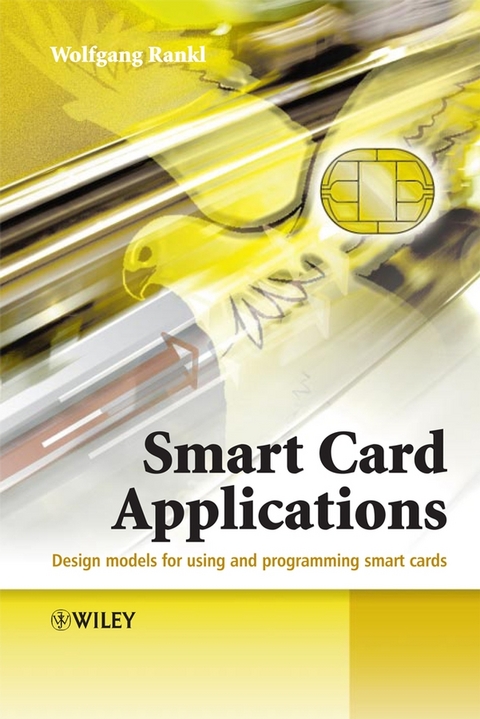
Smart Card Applications (eBook)
John Wiley & Sons (Verlag)
978-0-470-51194-7 (ISBN)
More than 3 billion smartcards are produced every year. Generally defined as any pocket-sized card with embedded integrated circuits or chips, they have a huge number of applications including travel cards, chip and pin cards, pet tags, mobile phone SIMs and pallet trackers. Now with modern Smart Card technology such as Java Card and Basic Card it is possible for everyone to create his or her own applications on a smart card.
This book provides generic solutions for programming smart cards, enabling the creation of working applications and systems.
Key features:
- Presents a comprehensive introduction to the topic of smart cards, explaining component elements and the smart card microcontrollers.
- Sets out information on operating systems with case studies of a range of applications including credit card security, mobile phones and transport payment cards.
- Gives detailed advice on the monitoring of smart card applications, recognizing potential attacks on security and improving system integrity.
- Provides modules and examples so that all types of systems can be built up from a small number of individual components.
- Offers guidelines on avoiding and overcoming design errors.
Ideal for practising engineers and designers looking to implement smart cards in their business, it is also a valuable reference for postgraduate students taking courses on embedded system and smart card design.
Wolfgang Rankl is currently Head of Telecom and Research and Development at Giesecke & Devrient, Germany. He is an experienced author, having written three editions of the book Smart Card Handbook for Wiley (3rd Edition published 2003), and the German version of this book for Hanser Chipkarten Anwendungen: Entwurfsmuster fur Einsatz und Programmierung con Chipkarten which is due to publish in March this year. He has been dedicated to the development and research of smart card systems since 1990.
A practical guide to the specification, design, and programming of smart card systems for working applications. More than 3 billion smartcards are produced every year. Generally defined as any pocket-sized card with embedded integrated circuits or chips, they have a huge number of applications including travel cards, chip and pin cards, pet tags, mobile phone SIMs and pallet trackers. Now with modern Smart Card technology such as Java Card and Basic Card it is possible for everyone to create his or her own applications on a smart card. This book provides generic solutions for programming smart cards, enabling the creation of working applications and systems. Key features: Presents a comprehensive introduction to the topic of smart cards, explaining component elements and the smart card microcontrollers. Sets out information on operating systems with case studies of a range of applications including credit card security, mobile phones and transport payment cards. Gives detailed advice on the monitoring of smart card applications, recognizing potential attacks on security and improving system integrity. Provides modules and examples so that all types of systems can be built up from a small number of individual components. Offers guidelines on avoiding and overcoming design errors. Ideal for practising engineers and designers looking to implement smart cards in their business, it is also a valuable reference for postgraduate students taking courses on embedded system and smart card design.
Wolfgang Rankl is currently Head of Telecom and Research and Development at Giesecke & Devrient, Germany. He is an experienced author, having written three editions of the book Smart Card Handbook for Wiley (3rd Edition published 2003), and the German version of this book for Hanser Chipkarten Anwendungen: Entwurfsmuster fur Einsatz und Programmierung con Chipkarten which is due to publish in March this year. He has been dedicated to the development and research of smart card systems since 1990.
"This book was a interesting read, and certainly provided as much information as is necessary to understand the inner workings of most smart-cards--as well as their world application." (Computing Reviews, February 1, 2008)
| Erscheint lt. Verlag | 30.4.2007 |
|---|---|
| Übersetzer | Kenneth Cox |
| Sprache | englisch |
| Themenwelt | Technik ► Elektrotechnik / Energietechnik |
| Technik ► Nachrichtentechnik | |
| Schlagworte | Applications • Card • Cards • Circuits • Electrical & Electronics Engineering • Elektrotechnik u. Elektronik • Embedded Systems & Smart Cards • Embedded Systems u. Smart Cards • every • everyone • Guide • huge number • Integrated • Java • Mikrowellen- u. Hochfrequenztechnik u. Theorie • Modern • pocketsized • possible • Practical • RF / Microwave Theory & Techniques • Smart • Smart card • Smartcards • Specification • Systems • Technology • trackers • Travel • working • year |
| ISBN-10 | 0-470-51194-X / 047051194X |
| ISBN-13 | 978-0-470-51194-7 / 9780470511947 |
| Informationen gemäß Produktsicherheitsverordnung (GPSR) | |
| Haben Sie eine Frage zum Produkt? |
 PDF (Adobe DRM)
Kopierschutz: Adobe-DRM
Adobe-DRM ist ein Kopierschutz, der das eBook vor Mißbrauch schützen soll. Dabei wird das eBook bereits beim Download auf Ihre persönliche Adobe-ID autorisiert. Lesen können Sie das eBook dann nur auf den Geräten, welche ebenfalls auf Ihre Adobe-ID registriert sind.
Details zum Adobe-DRM
Dateiformat: PDF (Portable Document Format)
Mit einem festen Seitenlayout eignet sich die PDF besonders für Fachbücher mit Spalten, Tabellen und Abbildungen. Eine PDF kann auf fast allen Geräten angezeigt werden, ist aber für kleine Displays (Smartphone, eReader) nur eingeschränkt geeignet.
Systemvoraussetzungen:
PC/Mac: Mit einem PC oder Mac können Sie dieses eBook lesen. Sie benötigen eine
eReader: Dieses eBook kann mit (fast) allen eBook-Readern gelesen werden. Mit dem amazon-Kindle ist es aber nicht kompatibel.
Smartphone/Tablet: Egal ob Apple oder Android, dieses eBook können Sie lesen. Sie benötigen eine
Geräteliste und zusätzliche Hinweise
Buying eBooks from abroad
For tax law reasons we can sell eBooks just within Germany and Switzerland. Regrettably we cannot fulfill eBook-orders from other countries.
aus dem Bereich