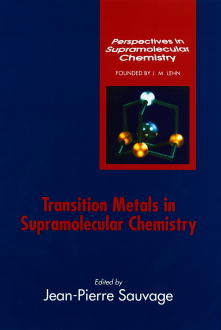
Transition Metals in Supramolecular Chemistry (eBook)
John Wiley & Sons (Verlag)
978-0-470-51150-3 (ISBN)
* Ligand and Metal Control of Self-Assembly in Supramolecular Chemistry
* Bistability in Iron (II) Spin-Crossover Systems: A Supramolecular Function
* Luminescent Sensors with and for Transition Metals
* The Chirality of Polynuclear Transition Metal Complexes
* Design and Serendipity in the Synthesis of Polynuclear Compounds of the 3d-metals
* Rotaxanes: From Random to Transition Metal-Templated Threading of Rings at the Molecular Level
* Metallomesogens - Supramolecular Organisation of Metal Complexes in Fluid Phases
* Self-Assembly of Interlocked Structures with Cucurbituril Metal Ions and Metal Complexes
Reflecting contemporary science, Transition Metals in Supramolecular Chemistry will inspire scientists and students interested in coordination chemistry, magnetochemistry, molecular sensors and switches, liquid crystals and artificial systems.
Jean-Pierre Sauvage performed his studies at the Ecole Nationale Superieure de Chimie de Strasbourg where he obtained his PhD under the supervision of Prof. J.M. Lehn in 1971. After post-doctoral research with Prof. M.L.H. Green in Oxford, UK, he went back to Strasbourg as a CNRS researcher. He founded his research group in 1980, became University Professor in 1981 and also CNRS Director of Research in 1988. Professor Sauvage is a member of the French Academy of Science, Professor emeritus of the University of Strasbourg and currently a Distinguished Visiting Scholar at Northwestern University. His research interest spans from artificial photosynthesis and electron transfer to porphyrin chemistry, molecular topology, and transition metal-based molecular machines.
Perspectives in Supramolecular Chemistry will relate recent developments and new exciting approaches in supramolecular chemistry. In supramolecular chemistry, our aim is to understand molecular chemistry beyond the covalent bond - the series will concentrate on goal-orientated supramolecular chemistry. Perspectives in Supramolecular Chemistry will reflect research which develops supramolecular structures with specific new properties, such as recognition, transport and simulation of biosystems or new materials. The series will cover all areas from theoretical and modelling aspects through organic and inorganic chemistry and biochemistry to materials, solid-state and polymer sciences reflecting the many and varied applications of supramolecular structures in modern chemistry. Transition Metals in Supramolecular Chemistry Edited by Jean-Pierre Sauvage, Universit Louis Pasteur, Strasbourg, France The chemistry of weak forces and non-covalent interactions as pioneered by Pedersen, Lehn and Cram is considered to be the origin of modern supramolecular chemistry. 30 years ago transition metals and their complexes were not regarded as important to this science. Transition Metals in Supramolecular Chemistry clearly demonstrates that today, transition metal complexes are routinely used to build large multicomponent architectures which display new and exciting applications including molecular switches, liquid crystals, and molecular magnets. Contents * Ligand and Metal Control of Self-Assembly in Supramolecular Chemistry * Bistability in Iron (II) Spin-Crossover Systems: A Supramolecular Function * Luminescent Sensors with and for Transition Metals * The Chirality of Polynuclear Transition Metal Complexes * Design and Serendipity in the Synthesis of Polynuclear Compounds of the 3d-metals * Rotaxanes: From Random to Transition Metal-Templated Threading of Rings at the Molecular Level * Metallomesogens - Supramolecular Organisation of Metal Complexes in Fluid Phases * Self-Assembly of Interlocked Structures with Cucurbituril Metal Ions and Metal Complexes Reflecting contemporary science, Transition Metals in Supramolecular Chemistry will inspire scientists and students interested in coordination chemistry, magnetochemistry, molecular sensors and switches, liquid crystals and artificial systems.
Jean-Pierre Sauvage performed his studies at the Ecole Nationale Superieure de Chimie de Strasbourg where he obtained his PhD under the supervision of Prof. J.M. Lehn in 1971. After post-doctoral research with Prof. M.L.H. Green in Oxford, UK, he went back to Strasbourg as a CNRS researcher. He founded his research group in 1980, became University Professor in 1981 and also CNRS Director of Research in 1988. Professor Sauvage is a member of the French Academy of Science, Professor emeritus of the University of Strasbourg and currently a Distinguished Visiting Scholar at Northwestern University. His research interest spans from artificial photosynthesis and electron transfer to porphyrin chemistry, molecular topology, and transition metal-based molecular machines.
Contributors vii
Preface ix
1 Ligand and Metal Control of Self-Assembly in Supramolecular Chemistry
Rolf W. Saalfrank and Bernhard Demleitner 1
2 Bistability in Iron (II) Spin-Crossover Systems: A Supramolecular Function
José Antonio Real 53
3 Fluorescent Sensors for and with Transition Metals
Luigi Fabbrizzi, Maurizio Licchelli, Piersandro Pallavicini, Luisa Parodi and Angelo Taglietti 93
4 The Chirality of Polynuclear Transition Metal Complexes
Christophe Provent and Alan F. Williams 135
5 Design and Serendipity in the Synthesis of Polymetallic Complexes of the 3d-Metals
Richard E. P. Winpenny 193
6 Rotaxanes: From Random to Transition Metal-Templated Threading of Rings at the Molecular Level
Jean-Claude Chambron 225
7 Metallomesogens--Supramolecular Organization of Metal Complexes in Fluid Phases
Simon Collinson and Duncan W. Bruce 285
8 Self-Assembly of Interlocked Structures with Cucurbituril, Metal Ions and Metal Complexes
Kimoon Kim 371
Cumulative Author Index 403
Cumulative Title Index 407
Index 409
"....a well constructed and stimulating guide to the ever-growing area of metallic supramolecular chemistry....",(The Alchemist) "...the book is essential for every chemistry library...",(Angewandte Chemie)
| Erscheint lt. Verlag | 30.4.2008 |
|---|---|
| Reihe/Serie | Perspectives in Supramolecular Chemistry |
| Perspectives in Supramolecular Chemistry | Perspectives in Supramolecular Chemistry |
| Sprache | englisch |
| Themenwelt | Naturwissenschaften ► Chemie ► Organische Chemie |
| Naturwissenschaften ► Geowissenschaften ► Mineralogie / Paläontologie | |
| Technik | |
| Schlagworte | Ãbergangsmetalle • AIM • APPROACHES • Chemie • Chemistry • Covalent • develops • goalorientated • Molecular Chemistry • New • Perspectives • Properties • Research • series • specific • Structures • Supramolecular • supramolecular chemistry • Supramolekulare Chemie • Übergangsmetalle |
| ISBN-10 | 0-470-51150-8 / 0470511508 |
| ISBN-13 | 978-0-470-51150-3 / 9780470511503 |
| Informationen gemäß Produktsicherheitsverordnung (GPSR) | |
| Haben Sie eine Frage zum Produkt? |
 PDF (Adobe DRM)
Kopierschutz: Adobe-DRM
Adobe-DRM ist ein Kopierschutz, der das eBook vor Mißbrauch schützen soll. Dabei wird das eBook bereits beim Download auf Ihre persönliche Adobe-ID autorisiert. Lesen können Sie das eBook dann nur auf den Geräten, welche ebenfalls auf Ihre Adobe-ID registriert sind.
Details zum Adobe-DRM
Dateiformat: PDF (Portable Document Format)
Mit einem festen Seitenlayout eignet sich die PDF besonders für Fachbücher mit Spalten, Tabellen und Abbildungen. Eine PDF kann auf fast allen Geräten angezeigt werden, ist aber für kleine Displays (Smartphone, eReader) nur eingeschränkt geeignet.
Systemvoraussetzungen:
PC/Mac: Mit einem PC oder Mac können Sie dieses eBook lesen. Sie benötigen eine
eReader: Dieses eBook kann mit (fast) allen eBook-Readern gelesen werden. Mit dem amazon-Kindle ist es aber nicht kompatibel.
Smartphone/Tablet: Egal ob Apple oder Android, dieses eBook können Sie lesen. Sie benötigen eine
Geräteliste und zusätzliche Hinweise
Buying eBooks from abroad
For tax law reasons we can sell eBooks just within Germany and Switzerland. Regrettably we cannot fulfill eBook-orders from other countries.
aus dem Bereich