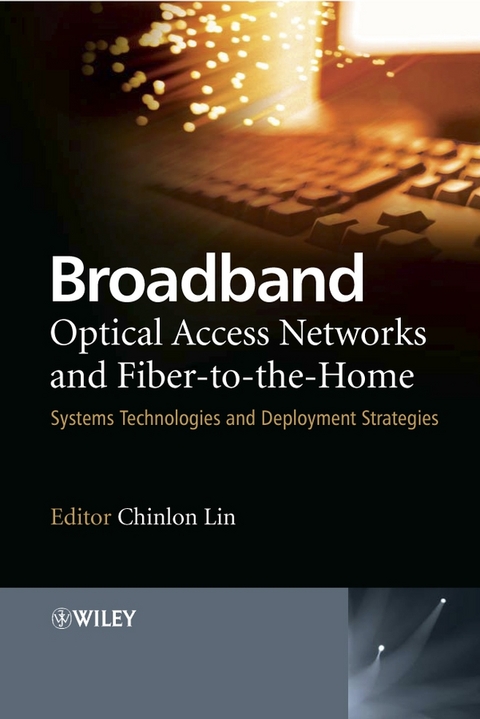
Broadband Optical Access Networks and Fiber-to-the-Home (eBook)
Compared with the currently well-deployed broadband access technologies of ADSL (Asymmetric Digital Subscriber Line) and Cable Modems, optical broadband access with Fiber-to-the-User's home will cater for much higher speed access for new services.
Broadband Optical Access Networks and Fiber-to-the-Home presents a comprehensive technical overview of key technologies and deployment strategies for optical broadband access networks and emerging new broadband services. The authors discuss network design considerations, new services, deployment trends and operational experiences, while explaining the current situation and providing insights into future broadband access technologies and services.
Broadband Optical Access Networks and Fiber-to-the-Home:
- Offers a comprehensive, up-to-date introduction to new developments in broadband access network technologies and services.
- Examines the impact of research and development in photonics technologies on broadband access and FTTH.
- Covers ADSL, VDSL with FTTC (Fiber-to-the-Curb), Cable Modem over HFC (Hybrid-Fiber Coax) and Gigabit Ethernet.
- Discusses the roles of Broadband Wireless LAN and integrated FTTH/Wireless Broadband Access as well as Broadband Home Networks.
- Provides a global view of broadband network development, presenting different technical and system deployment approaches and strategic considerations for comparison.
- Gives insight into the worldwide broadband competition and the future of this technology.
Broadband Optical Access Networks and Fiber-to-the-Home will be an invaluable resource for engineers in research and development, network planners, business managers, consultants as well as analysts and educators for a better understanding of the future of broadband in the field of telecommunications, data communications, and broadband multimedia service industries.
Chinlon Lin,Professor of Photonics and Director, Center for Advanced Research in Photonics, Institute of Optical Science and Technology, Departments of Electronic Engineering and Information Engineering, Chinese University of Hong Kong, Hong Kong.
Chinlon Lin received his Ph.D. from the Univ. of California, Berkeley. He joined AT&T Bell Labs' Laser Sciences Research Department, Communication Sciences Research Division, researchin nonlinear optics in fibers, self-phase-modulation, tunable infrared fiber Raman lasers, fiber Raman amplifiers and four-wave-mixing for optical-frequency-conversion, as well as high-speed semiconductor laser dynamic modulation studies and high-bit-rate fiber transmission system technologies. In 1984 he was on leave from Bell Labs as a Visiting Guest Professor at the Tech. Univ. of Denmark's Center for Broadband Communications (now COM Center).
He joined Bellcore in 1986 where he was Director of Broadband Lightwave systems Research. He led a group working on FTTH, FTTC, HFC architectures, DWDM tunable filters and EDFAs for high-capacity digital and analog video systems, dispersion compensation for high-speed DWDM systems, an experimental Bellcore Research Network, lightwave systems for multi-channel hybrid AM/QAM-digital video distribution for HFC networks, and Hybrid DWDM systems. He also provided technical consultation to Ameritech, Bell Atlantic, BellSouth and SBC Comm. on issues related to EDFA, DWDM and OC-192 systems, and analog/digital lightwave video distribution systems for FTTH/FTTC/HFC networks. He joined Tyco Submarine Sys. R & D Labs (formerly AT&T Submarine Systems) in September 1997, to work on lightwave technologies for DWDM systems in advanced next-generation global long-haul undersea fiber networks.
In May 2000 he founded Jedai Broadband Networks, a startup to work on Fiber-to-the Business high-speed access solutions for cable TV industry. He was Chairman, President and CTO. In 2002 he co-founded BeLight, a startup on GbE based optical wireless system and broadband FTTH optical access. He joined CUHK as Professor of Photonics and Director of IOSAT (Institute of Optical Science and Technology) in January 2003.
Broadband Optical Access and Fiber-to-the-Home (FTTH) will provide the ultimate broadband service capabilities. Compared with the currently well-deployed broadband access technologies of ADSL (Asymmetric Digital Subscriber Line) and Cable Modems, optical broadband access with Fiber-to-the-User s home will cater for much higher speed access for new services. Broadband Optical Access Networks and Fiber-to-the-Home presents a comprehensive technical overview of key technologies and deployment strategies for optical broadband access networks and emerging new broadband services. The authors discuss network design considerations, new services, deployment trends and operational experiences, while explaining the current situation and providing insights into future broadband access technologies and services. Broadband Optical Access Networks and Fiber-to-the-Home: Offers a comprehensive, up-to-date introduction to new developments in broadband access network technologies and services. Examines the impact of research and development in photonics technologies on broadband access and FTTH. Covers ADSL, VDSL with FTTC (Fiber-to-the-Curb), Cable Modem over HFC (Hybrid-Fiber Coax) and Gigabit Ethernet. Discusses the roles of Broadband Wireless LAN and integrated FTTH/Wireless Broadband Access as well as Broadband Home Networks. Provides a global view of broadband network development, presenting different technical and system deployment approaches and strategic considerations for comparison. Gives insight into the worldwide broadband competition and the future of this technology. Broadband Optical Access Networks and Fiber-to-the-Home will be an invaluable resource for engineers in research and development, network planners, business managers, consultants as well as analysts and educators for a better understanding of the future of broadband in the field of telecommunications, data communications, and broadband multimedia service industries.
Chinlon Lin,Professor of Photonics and Director, Center for Advanced Research in Photonics, Institute of Optical Science and Technology, Departments of Electronic Engineering and Information Engineering, Chinese University of Hong Kong, Hong Kong. Chinlon Lin received his Ph.D. from the Univ. of California, Berkeley. He joined AT&T Bell Labs' Laser Sciences Research Department, Communication Sciences Research Division, researchin nonlinear optics in fibers, self-phase-modulation, tunable infrared fiber Raman lasers, fiber Raman amplifiers and four-wave-mixing for optical-frequency-conversion, as well as high-speed semiconductor laser dynamic modulation studies and high-bit-rate fiber transmission system technologies. In 1984 he was on leave from Bell Labs as a Visiting Guest Professor at the Tech. Univ. of Denmark's Center for Broadband Communications (now COM Center). He joined Bellcore in 1986 where he was Director of Broadband Lightwave systems Research. He led a group working on FTTH, FTTC, HFC architectures, DWDM tunable filters and EDFAs for high-capacity digital and analog video systems, dispersion compensation for high-speed DWDM systems, an experimental Bellcore Research Network, lightwave systems for multi-channel hybrid AM/QAM-digital video distribution for HFC networks, and Hybrid DWDM systems. He also provided technical consultation to Ameritech, Bell Atlantic, BellSouth and SBC Comm. on issues related to EDFA, DWDM and OC-192 systems, and analog/digital lightwave video distribution systems for FTTH/FTTC/HFC networks. He joined Tyco Submarine Sys. R & D Labs (formerly AT&T Submarine Systems) in September 1997, to work on lightwave technologies for DWDM systems in advanced next-generation global long-haul undersea fiber networks. In May 2000 he founded Jedai Broadband Networks, a startup to work on Fiber-to-the Business high-speed access solutions for cable TV industry. He was Chairman, President and CTO. In 2002 he co-founded BeLight, a startup on GbE based optical wireless system and broadband FTTH optical access. He joined CUHK as Professor of Photonics and Director of IOSAT (Institute of Optical Science and Technology) in January 2003.
| Erscheint lt. Verlag | 11.7.2006 |
|---|---|
| Sprache | englisch |
| Themenwelt | Technik ► Elektrotechnik / Energietechnik |
| Technik ► Nachrichtentechnik | |
| Schlagworte | ACCESS • ADSL • Asymmetric • Broadband • broadband optical • capabilities • currently • digital • Drahtlose Kommunikation • Electrical & Electronics Engineering • Elektrotechnik u. Elektronik • fibertotheusers • higher • Home • Mobile & Wireless Communications • New • Optical • Optical Communications • Optische Nachrichtentechnik • Speed • subscriber line • Technologies • Ultimate • welldeployed |
| ISBN-13 | 9780470094792 / 9780470094792 |
| Informationen gemäß Produktsicherheitsverordnung (GPSR) | |
| Haben Sie eine Frage zum Produkt? |
 PDF (Adobe DRM)
Kopierschutz: Adobe-DRM
Adobe-DRM ist ein Kopierschutz, der das eBook vor Mißbrauch schützen soll. Dabei wird das eBook bereits beim Download auf Ihre persönliche Adobe-ID autorisiert. Lesen können Sie das eBook dann nur auf den Geräten, welche ebenfalls auf Ihre Adobe-ID registriert sind.
Details zum Adobe-DRM
Dateiformat: PDF (Portable Document Format)
Mit einem festen Seitenlayout eignet sich die PDF besonders für Fachbücher mit Spalten, Tabellen und Abbildungen. Eine PDF kann auf fast allen Geräten angezeigt werden, ist aber für kleine Displays (Smartphone, eReader) nur eingeschränkt geeignet.
Systemvoraussetzungen:
PC/Mac: Mit einem PC oder Mac können Sie dieses eBook lesen. Sie benötigen eine
eReader: Dieses eBook kann mit (fast) allen eBook-Readern gelesen werden. Mit dem amazon-Kindle ist es aber nicht kompatibel.
Smartphone/Tablet: Egal ob Apple oder Android, dieses eBook können Sie lesen. Sie benötigen eine
Geräteliste und zusätzliche Hinweise
Buying eBooks from abroad
For tax law reasons we can sell eBooks just within Germany and Switzerland. Regrettably we cannot fulfill eBook-orders from other countries.
aus dem Bereich