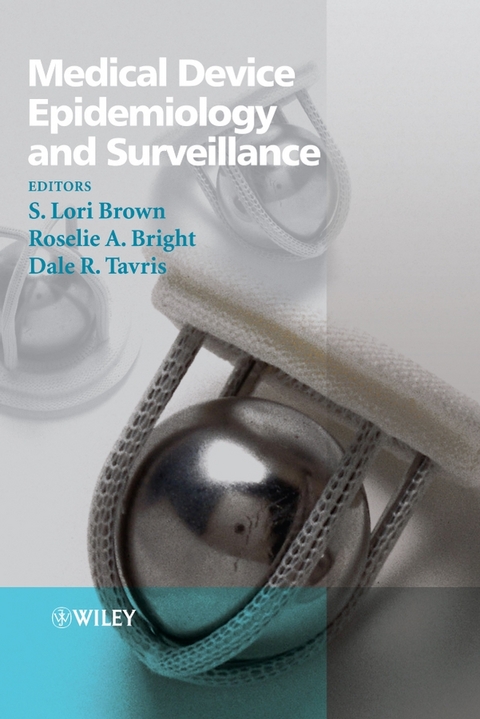
Medical Device Epidemiology and Surveillance (eBook)
John Wiley & Sons (Verlag)
978-0-470-06086-5 (ISBN)
Medical Device Epidemiology and Surveillance is an essential reference for epidemiologists, pharmacoepidemiologists, academics, graduate students, and everybody working in the medical device industry.
S. Lori Brown, PhD, MPH. Epidemiologist. Epidemiology Branch. Division of Postmarket Surveillance. Center for Devices and Radiological Health. U.S. Food and Drug Administration. Rockville, MD, USA.
Roselie A. Bright, ScD. Epidemiologist. Epidemiology Branch. Division of Postmarket Surveillance. Center for Devices and Radiological Health. U.S. Food and Drug Administration. Rockville, MD, USA
Dale R. Tavris, MD, MPH. Epidemiologist. Epidemiology Branch. Division of Postmarket Surveillance. Center for Devices and Radiological Health. U.S. Food and Drug Administration. Rockville, MD, USA
Medical devices are crucial in medical care today and device technology advances at a dizzying pace. Medical Device Epidemiology and Surveillance is the first book to provide an overview of medical device epidemiology and surveillance as well as perspectives from regulatory agencies, the medical device industry, the health insurance industry and academia. The book is edited by experts from the US Food and Drug Administration with contributions from experienced specialists working in this field in the US and around the world. It features chapters describing broad themes in medical device epidemiology and surveillance, as well as chapters that describe specific medical devices. Medical Device Epidemiology and Surveillance is an essential reference for epidemiologists, pharmacoepidemiologists, academics, graduate students, and everybody working in the medical device industry.
S. Lori Brown, PhD, MPH. Epidemiologist. Epidemiology Branch. Division of Postmarket Surveillance. Center for Devices and Radiological Health. U.S. Food and Drug Administration. Rockville, MD, USA. Roselie A. Bright, ScD. Epidemiologist. Epidemiology Branch. Division of Postmarket Surveillance. Center for Devices and Radiological Health. U.S. Food and Drug Administration. Rockville, MD, USA Dale R. Tavris, MD, MPH. Epidemiologist. Epidemiology Branch. Division of Postmarket Surveillance. Center for Devices and Radiological Health. U.S. Food and Drug Administration. Rockville, MD, USA
Medical Device Epidemiology and Surveillance 3
Contents 7
Foreword 15
Preface 19
Contributors 21
Acknowledgments 27
1 Introduction 29
2 Medical device regulation in the USA 33
Introduction 33
Premarket review 34
Marketing applications 36
Postmarket oversight 38
Conclusion 46
3 Medical device epidemiology 49
Introduction 49
Features of medical devices that are relevant to epidemiology study design 54
Study designs for medical device epidemiology 63
Summary and recommendations 65
4 Surveillance of adverse medical device events 71
Introduction 71
Rationale for surveillance 72
Surveillance based on adverse event reports 75
Surveillance based on registries 80
Active surveillance 81
Necessary conditions for effective surveillance 82
Ideal AMDE surveillance program 83
Summary 86
5 The Medical Product Surveillance Network (MedSun) 91
Historical motivation 91
Initial considerations for the design of DeviceNet 92
MedSun basic design 97
Current status 99
Is MedSun successful in promoting the safe use of medical devices? 102
Epidemiologic considerations 103
Summary 104
6 The National Electronic Injury Surveillance System (NEISS) and medical devices 107
Description and history of NEISS 107
Potential uses and limitations of NEISS 108
Utilization of NEISS to produce national medical device-associated adverse event estimates 109
Potential for long-term utilization of NEISS for medical device surveillance 111
7 Medical device nomenclature 115
Technical elements 115
Current terminologies 119
Applications of nomenclature 121
Future developments 123
8 Data sources for medical device epidemiology studies and data mining 127
Introduction 127
Data sources 128
Surveillance databases 129
Registries 133
Automated large administrative databases 140
National surveys 143
Data mining 147
Future use databases for medical device epidemiology 148
9 Ethical requirements and guidelines for epidemiological studiesof medical devices 155
Introduction 155
Bioethics foundations 156
US government human subjects protection regulations 156
HHS human subjects protection regulatory requirements 158
FDA human subjects protection regulations 159
Other professional ethical guidelines 161
Ethical requirements for medical devices epidemiologic studies 164
Future ethical requirements for epidemiologic studies 170
10 An industry perspective: medical device epidemiology and surveillance 173
Introduction 173
The product’s life cycle: premarket (preclinical and clinical) and postmarket (PM) studies 176
Postmarket studies 181
Summary 184
11 Perspective from an academic on postmarket surveillance 187
Introduction 187
Adverse event reporting 188
Postmarket condition of approval studies and Section 522 studies 191
Industry use of information from adverse event reports 193
Academic opportunities 195
Summary 196
12 Perspective from a pharmacoepidemiologist 199
Introduction 199
Review of literature 199
Contrasts with pharmacopeidemiology 201
Conclusions 203
13 Medical device regulation and surveillance: perspective from the EU 205
Introduction 205
Medical devices: the European directives and definitions 206
New approach 207
Classification of medical devices in Europe 210
Market surveillance 211
Traceability of medical devices in Europe 212
The vigilance system 212
14 A consumer advocate’s perspective on medical device epidemiology and surveillance 215
Examples of widely publicized problems with selected medical devices 217
Consumer concerns 221
Regulatory mechanism recommendations 225
Consumer group accomplishments: mixed results 227
15 Pediatric Medical Device Use 231
Introduction 231
Medical device use in children 232
Special device risks and safety concerns for children 239
Regulatory framework 240
The future for pediatric medical device surveillance and epidemiology 242
16 Selected medical devices used to manage diabetes mellitus 247
Introduction 247
Insulin delivery devices 249
Continuous glucose monitoring devices 253
Future medical devices for the management of diabetes 256
17 Medical device-related outbreaks 265
Introduction 265
Endoscopes: bronchoscopes and gastrointestinal (GI) endoscopes 267
Hemodialysis-related outbreaks 272
Neonatal and pediatric intensive care units 275
Miscellaneous device-related outbreaks 278
Summary 279
18 Risk of transmission of prions with medical devices 287
Iatrogenic transmission of prion disease via neurological or surgical instruments 288
Surgical instruments used to transplant tissues known to have transmitted prion disease (corneal transplant) 289
Surgical instruments in contact with lower risk peripheral tissues 290
Decontaminating surgical instruments to reduce risk of TSE transmission 291
FDA measures to minimize risk of transmission of BSE by medical products 295
Summary 296
19 Surveillance and epidemiology as tools for evaluating the materials used in medical devices 301
Introduction 301
General considerations that affect the design of epidemiologic studies of materials used in medical devices 301
Example: natural rubber and latex allergy 307
Summary 314
20 Exploring methods for analyzing surveillance reports on electromagnetic interference with medical devices 319
Electromagnetic interference with medical devices 320
The MAUDE database 320
Adverse event reports to FDA (December 1984–October 1995):EMI with cardiovascular devices 321
Adverse events reported to FDA (January 1994–March 2005):a recent epidemiological analysis 325
Discussion 339
21 Alternative and complementary medical devices 347
Introduction 347
Acupuncture needles 350
Ear candles 354
Magnets 356
Adverse events associated with alternative or complementary devices 359
22 Drug-eluting coronary stents 363
History and evolution of coronary stents: clinical perspective 363
Novel drug-eluting stent programs 368
Comparative trials of drug-eluting stents 370
Application of drug-eluting stents in complex coronary lesion subsets 373
Drug-eluting stents: regulatory perspective 374
23 The treatment of abdominal aortic aneurysms 383
Natural history and indications for treatment 383
FDA experience with the postmarket assessment of an endovascular graft 386
Advances in stent-graft design and performance 389
Conclusion 391
24 Cardiovascular devices: aortic valves 395
Introduction 395
Operative mortality 398
The FDA guidance for replacement valves and the objective performance criteria (OPC) 400
Adverse event reports 401
The need for epidemiological studies 401
Conclusions 404
25 Hemostasis Devices 404
The ideal vascular hemostasis device 408
Origin of FDA concern with the postmarket performance of hemostasis devices 410
FDA study to evaluate the risk associated with hemostasis device use 415
Possible reasons for FDA findings of apparent protective effects of hemostasis devices 417
Follow-up FDA study to assess the safety of hemostasis devices 417
Conclusion 418
26 ENT devices: cochlear implants 423
Cochlear implant description 423
Epidemiological investigations involving meningitis associated with cochlear implants 424
Conclusions 433
27 Silicone gel-filled breast implants: surveillance and epidemiology 435
Breast implant types 435
A brief regulatory history of breast implants 437
FDA surveillance studies on breast implants 439
Summary 449
28 Ophthalmic devices and clinical epidemiology 455
Introduction 455
Epidemiological contributions to IOL evaluation 455
Epidemiology of contact lens ulcers and public policy 458
Conclusion 465
29 Orthopedic devices: epidemiologic considerations 469
Introduction 469
Selected orthopedic materials 469
Artificial hips 472
Intervertebral disc replacement 480
Data sources and selected methodological issues to consider in epidemiologic studies of orthopedic medical devices 484
Summary 486
30 Clinical epidemiology of intrapartum fetal monitoring devices 491
Introduction 491
Electronic fetal monitoring 492
Scalp and umbilical cord blood gases analyses 498
Fetal pulse oximetry 499
Fetal ECG waveform monitoring 501
Challenges of intrapartum fetal monitoring modalities 504
Conclusion 506
31 The postmarket surveillance of medical devices: meeting the challenge 511
Index 515
"The first book to provide an overview of medical device
epidemiology and surveillance ... a very good exposition of how
epidemiology can be used." (BMA Medical Book Competition -
Programme and Award Winners, September 2008)
"This book is unique, providing a comprehensive view of device
surveillance and monitoring." (Doody's, March 2008)
| Erscheint lt. Verlag | 13.3.2007 |
|---|---|
| Sprache | englisch |
| Themenwelt | Medizin / Pharmazie ► Medizinische Fachgebiete |
| Technik ► Medizintechnik | |
| Schlagworte | Ãffentlicher Gesundheitsdienst u. Gesundheitspolitik • Device • device events • Electronic • Epidemiologie • epidemiology • Gesundheits- u. Sozialwesen • Health & Social Care • Injury • International Public Health • Introduction • Lori • Medical • medical product • Medical Science • Medical Sciences Special Topics • Medizin • medsun • national • Network • Öffentlicher Gesundheitsdienst u. Gesundheitspolitik • P • Pharmacology & Pharmaceutical Medicine • Pharmakologie u. Pharmazeutische Medizin • Public Health / International • Public Health Services & Policy • Regulation • Spezialthemen Medizin • Surveillance • System • USA |
| ISBN-10 | 0-470-06086-7 / 0470060867 |
| ISBN-13 | 978-0-470-06086-5 / 9780470060865 |
| Informationen gemäß Produktsicherheitsverordnung (GPSR) | |
| Haben Sie eine Frage zum Produkt? |
 PDF (Adobe DRM)
Kopierschutz: Adobe-DRM
Adobe-DRM ist ein Kopierschutz, der das eBook vor Mißbrauch schützen soll. Dabei wird das eBook bereits beim Download auf Ihre persönliche Adobe-ID autorisiert. Lesen können Sie das eBook dann nur auf den Geräten, welche ebenfalls auf Ihre Adobe-ID registriert sind.
Details zum Adobe-DRM
Dateiformat: PDF (Portable Document Format)
Mit einem festen Seitenlayout eignet sich die PDF besonders für Fachbücher mit Spalten, Tabellen und Abbildungen. Eine PDF kann auf fast allen Geräten angezeigt werden, ist aber für kleine Displays (Smartphone, eReader) nur eingeschränkt geeignet.
Systemvoraussetzungen:
PC/Mac: Mit einem PC oder Mac können Sie dieses eBook lesen. Sie benötigen eine
eReader: Dieses eBook kann mit (fast) allen eBook-Readern gelesen werden. Mit dem amazon-Kindle ist es aber nicht kompatibel.
Smartphone/Tablet: Egal ob Apple oder Android, dieses eBook können Sie lesen. Sie benötigen eine
Geräteliste und zusätzliche Hinweise
Buying eBooks from abroad
For tax law reasons we can sell eBooks just within Germany and Switzerland. Regrettably we cannot fulfill eBook-orders from other countries.
aus dem Bereich