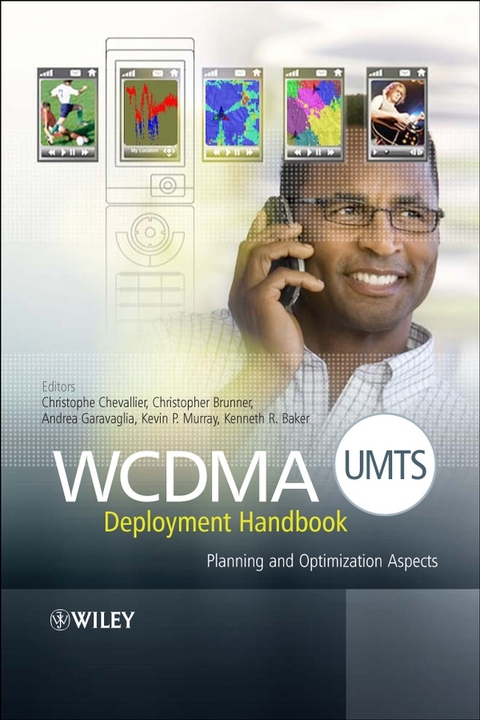
WCDMA (UMTS) Deployment Handbook (eBook)
John Wiley & Sons (Verlag)
978-0-470-03573-3 (ISBN)
After introducing the network architecture of such a system, the WCDMA (UMTS) Deployment Handbook defines the coverage and capacity concepts associated with the dimensioning and design phases. Progressing to a discussion of the main system parameters associated with network optimization and detailing optimization techniques for the main services supported by UMTS, and includes the specifics of indoor deployment and HSDPA networks evolution.
- Covers all stages from planning to optimization with sufficient details as required on a day-to-day basis, and thorough reference information for the reader who wants to understand the concepts in more detail
- Relevant for daily tasks: The approach taken in this book is similar to the work flow of network planner and optimization engineers, allowing such personnel to easily find the relevant information
- Written by the company which made CDMA a household name: QUALCOMM was the first company to use CDMA technology for cellular application and is a technical leader in this domain
- Based on industry feedback: All the contributors to this book have been working in direct interaction with WCDMA operators, throughout the world, since the early days of WCDMA commercial deployment
- Looking to the future: This book addresses the next level of challenge that WCDMA operators will face - deployment of indoor systems and HSDPA
Providing a complete introduction and reference guide to everything associated with the life cycle of a WCDMA/UMTS cellular network, from initial dimensioning through to the successful deployment of indoor solutions, or migration to HSDPA, this book is a must-have for network planners and optimization engineers as well as Telecommunication Engineering students.
Christophe Chevallier is Senior Staff Engineer at QUALCOMM Inc. He is a radio frequency engineer with over 10 years' experience in telecommunications, mainly in CDMA technologies. Christophe has proven experience in the field, optimizing cdma0ne (IS95) network, planning and optimizing WCDMA network and supporting CDMA2000 deployment.
A complete and practical guide to WCDMA/UMTS cellular network deployment. After introducing the network architecture of such a system, the WCDMA (UMTS) Deployment Handbook defines the coverage and capacity concepts associated with the dimensioning and design phases. Progressing to a discussion of the main system parameters associated with network optimization and detailing optimization techniques for the main services supported by UMTS, and includes the specifics of indoor deployment and HSDPA networks evolution. Covers all stages from planning to optimization with sufficient details as required on a day-to-day basis, and thorough reference information for the reader who wants to understand the concepts in more detail Relevant for daily tasks: The approach taken in this book is similar to the work flow of network planner and optimization engineers, allowing such personnel to easily find the relevant information Written by the company which made CDMA a household name: QUALCOMM was the first company to use CDMA technology for cellular application and is a technical leader in this domain Based on industry feedback: All the contributors to this book have been working in direct interaction with WCDMA operators, throughout the world, since the early days of WCDMA commercial deployment Looking to the future: This book addresses the next level of challenge that WCDMA operators will face - deployment of indoor systems and HSDPA Providing a complete introduction and reference guide to everything associated with the life cycle of a WCDMA/UMTS cellular network, from initial dimensioning through to the successful deployment of indoor solutions, or migration to HSDPA, this book is a must-have for network planners and optimization engineers as well as Telecommunication Engineering students.
Christophe Chevallier is Senior Staff Engineer at QUALCOMM Inc. He is a radio frequency engineer with over 10 years' experience in telecommunications, mainly in CDMA technologies. Christophe has proven experience in the field, optimizing cdma0ne (IS95) network, planning and optimizing WCDMA network and supporting CDMA2000 deployment.
List of Contributors xi
Foreword xiii
Preface xv
Acknowledgments xvii
Acronyms xix
1 Introduction to UMTS Networks 1
Patrick Chan, Andrea Garavaglia and Christophe
Chevallier
1.1 UMTS Network Topology 2
1.2 WCDMA Concepts 5
1.3 WCDMA Network Deployment Options 17
1.4 The Effects of Vendor Implementation 19
2 RF Planning and Optimization 21
Christophe Chevallier
2.1 Introduction 21
2.2 Overview of the Network Deployment Process 21
2.3 Link Budgets 25
2.4 Network Planning Tools 51
2.5 Interference Considerations during Network Planning 60
2.6 Topology Planning 61
2.7 Parameter Settings and Optimization during Network Planning
62
2.8 RF Optimization 63
3 Capacity Planning and Optimization 73
Christophe Chevallier
3.1 Basic UMTS Traffic Engineering 73
3.2 Effect of Video-Telephony and PS Data on Traffic Engineering
85
3.3 Multiservice Traffic Engineering 90
3.4 Capacity Planning 97
3.5 Optimizing for Capacity 108
4 Initial Parameter Settings 115
Christopher Brunner, Andrea Garavaglia and Christophe
Chevallier
4.1 Introduction 115
4.2 Physical Layer Parameters 120
4.3 Intra-frequency Cell Reselection Parameters 124
4.4 Access Parameter Recommendations 136
4.5 Intra-frequency Handover Parameters 137
5 Service Optimization 153
Andrea Forte, Patrick Chan and Christophe Chevallier
5.1 KPI and Layered Optimization Approach 153
5.2 Voice Service Optimization 156
5.3 Video-Telephony Service Optimization 185
5.4 PS Data Service Optimization 196
6 Inter-System Planning and Optimization 211
Andrea Garavaglia, Christopher Brunner and Christophe
Chevallier
6.1 Introduction 211
6.2 Inter-System Boundary Planning 212
6.3 Inter-System Transitions in Connected Mode 216
6.4 Inter-System Transitions in Idle Mode 235
6.5 Test Setup for Inter-System Handover and Cell Reselection
Performance Assessment 242
6.6 Optimizing Inter-System Parameters 243
6.7 Additional Inter-System Planning and Optimization Issues
254
7 HSDPA 257
Kevin P. Murray and Sunil Patil
7.1 Motivations for High Speed Downlink Packet Access (HSDPA)
257
7.2 HSDPA Concepts 260
7.3 HSDPA Planning 268
7.4 HSDPA Operation and Optimization 291
7.5 HSDPA Key Performance Indicators (KPI) 309
7.6 Test Setup 311
8 Indoor Coverage 315
Patrick Chan, Kenneth R. Baker and Christophe
Chevallier
8.1 Introduction 315
8.2 Design Approach and Economic Considerations 315
8.3 Coverage Planning and Impact on Capacity 323
8.4 Optimizing Indoor Systems 352
References 366
Index 369
| Erscheint lt. Verlag | 11.7.2006 |
|---|---|
| Sprache | englisch |
| Themenwelt | Technik ► Elektrotechnik / Energietechnik |
| Technik ► Nachrichtentechnik | |
| Schlagworte | Architecture • Basis • Capacity • cellular • Concepts • Deployment • Design • Dimensioning • discussion • Drahtlose Kommunikation • Electrical & Electronics Engineering • Elektrotechnik u. Elektronik • Evolution • Handbook • indoor deployment • Main • Mobile & Wireless Communications • Network • Optimization • parameters • Practical • specifics • System • techniques • UMTS • wcdma umts |
| ISBN-10 | 0-470-03573-0 / 0470035730 |
| ISBN-13 | 978-0-470-03573-3 / 9780470035733 |
| Informationen gemäß Produktsicherheitsverordnung (GPSR) | |
| Haben Sie eine Frage zum Produkt? |
 PDF (Adobe DRM)
Kopierschutz: Adobe-DRM
Adobe-DRM ist ein Kopierschutz, der das eBook vor Mißbrauch schützen soll. Dabei wird das eBook bereits beim Download auf Ihre persönliche Adobe-ID autorisiert. Lesen können Sie das eBook dann nur auf den Geräten, welche ebenfalls auf Ihre Adobe-ID registriert sind.
Details zum Adobe-DRM
Dateiformat: PDF (Portable Document Format)
Mit einem festen Seitenlayout eignet sich die PDF besonders für Fachbücher mit Spalten, Tabellen und Abbildungen. Eine PDF kann auf fast allen Geräten angezeigt werden, ist aber für kleine Displays (Smartphone, eReader) nur eingeschränkt geeignet.
Systemvoraussetzungen:
PC/Mac: Mit einem PC oder Mac können Sie dieses eBook lesen. Sie benötigen eine
eReader: Dieses eBook kann mit (fast) allen eBook-Readern gelesen werden. Mit dem amazon-Kindle ist es aber nicht kompatibel.
Smartphone/Tablet: Egal ob Apple oder Android, dieses eBook können Sie lesen. Sie benötigen eine
Geräteliste und zusätzliche Hinweise
Buying eBooks from abroad
For tax law reasons we can sell eBooks just within Germany and Switzerland. Regrettably we cannot fulfill eBook-orders from other countries.
aus dem Bereich