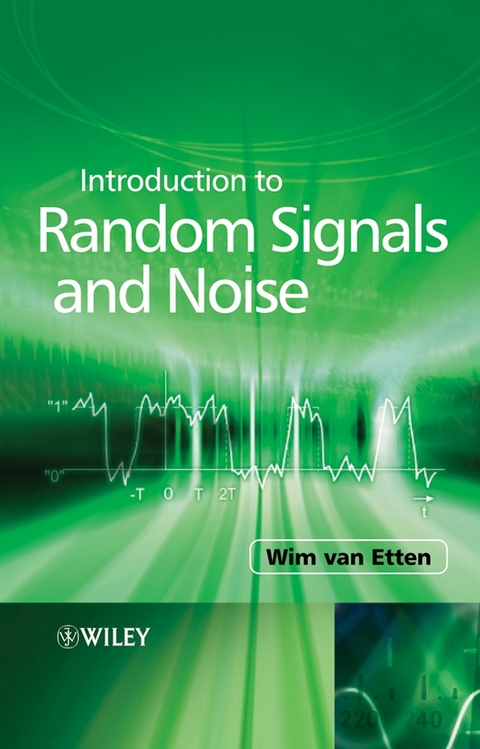
Introduction to Random Signals and Noise (eBook)
John Wiley & Sons (Verlag)
978-0-470-02412-6 (ISBN)
With a strong mathematical grounding, this text provides a clear introduction to the fundamentals of stochastic processes and their practical applications to random signals and noise. With worked examples, problems, and detailed appendices, Introduction to Random Signals and Noise gives the reader the knowledge to design optimum systems for effectively coping with unwanted signals.
Key features:
- Considers a wide range of signals and noise, including analogue, discrete-time and bandpass signals in both time and frequency domains.
- Analyses the basics of digital signal detection using matched filtering, signal space representation and correlation receiver.
- Examines optimal filtering methods and their consequences.
- Presents a detailed discussion of the topic of Poisson processes and shot noise.
An excellent resource for professional engineers developing communication systems, semiconductor devices, and audio and video equipment, this book is also ideal for senior undergraduate and graduate students in Electronic and Electrical Engineering.
Wim C. van Etten, University of Twente, Department of Electrical Engineering, Enschede, Netherlands
Wim Van Etten was appointed as a Full Professor of Telecommunications at the University of Twente, Enschede, the Netherlands, in 1994, where he heads a group on telecommunication engineering.
He is author or co-author of over eighty papers in international journals, conferences and symposia and his current interests comprise of optical communications, mobile communications, communication networks, detection, and simulation of communication systems.
He is also past-president of the NERG (Dutch Institute of Electronic and Radio Engineers) and Chairman of the executive committee of the IEEE Benelux joint Chapter on Communications and Vehicular Technology.
Random signals and noise are present in many engineering systems and networks. Signal processing techniques allow engineers to distinguish between useful signals in audio, video or communication equipment, and interference, which disturbs the desired signal. With a strong mathematical grounding, this text provides a clear introduction to the fundamentals of stochastic processes and their practical applications to random signals and noise. With worked examples, problems, and detailed appendices, Introduction to Random Signals and Noise gives the reader the knowledge to design optimum systems for effectively coping with unwanted signals. Key features: Considers a wide range of signals and noise, including analogue, discrete-time and bandpass signals in both time and frequency domains. Analyses the basics of digital signal detection using matched filtering, signal space representation and correlation receiver. Examines optimal filtering methods and their consequences. Presents a detailed discussion of the topic of Poisson processes and shot noise. An excellent resource for professional engineers developing communication systems, semiconductor devices, and audio and video equipment, this book is also ideal for senior undergraduate and graduate students in Electronic and Electrical Engineering.
Wim C. van Etten, University of Twente, Department of Electrical Engineering, Enschede, Netherlands Wim Van Etten was appointed as a Full Professor of Telecommunications at the University of Twente, Enschede, the Netherlands, in 1994, where he heads a group on telecommunication engineering. He is author or co-author of over eighty papers in international journals, conferences and symposia and his current interests comprise of optical communications, mobile communications, communication networks, detection, and simulation of communication systems. He is also past-president of the NERG (Dutch Institute of Electronic and Radio Engineers) and Chairman of the executive committee of the IEEE Benelux joint Chapter on Communications and Vehicular Technology.
Preface.
1 Introduction.
1.1 Random Signals and Noise.
1.2 Modelling.
1.3 The Concept of a Stochastic Process.
1.4 Summary.
2 Stochastic Processes.
2.1 Stationary Processes.
2.2 Correlation Functions.
2.3 Gaussian Processes.
2.4 Complex Processes.
2.5 Discrete-Time Processes.
2.6 Summary.
2.7 Problems.
3 Spectra of Stochastic Processes.
3.1 The Power Spectrum.
3.2 The Bandwidth of a Stochastic Process.
3.3 The Cross-Power Spectrum.
3.4 Modulation of Stochastic Processes.
3.5 Sampling and Analogue-To-Digital Conversion.
3.6 Spectrum of Discrete-Time Processes.
3.7 Summary.
3.8 Problems.
4. Linear Filtering of Stochastic Processes.
4.1 Basics of Linear Time-Invariant Filtering.
4.2 Time Domain Description of Filtering of Stochastic
Processes.
4.3 Spectra of the Filter Output.
4.4 Noise Bandwidth.
4.5 Spectrum of a Random Data Signal.
4.6 Principles of Discrete-Time Signals and Systems.
4.7 Discrete-Time Filtering of Random Sequences.
4.8 Summary.
4.9 Problems.
5 Bandpass Processes.
5.1 Description of Deterministic Bandpass Signals.
5.2 Quadrature Components of Bandpass Processes.
5.3 Probability Density Functions of the Envelope and Phase of
Bandpass Noise.
5.4 Measurement of Spectra.
5.5 Sampling of Bandpass Processes.
5.6 Summary.
5.7 Problems.
6 Noise in Networks and Systems.
6.1 White and Coloured Noise.
6.2 Thermal Noise in Resistors.
6.3 Thermal Noise in Passive Networks.
6.4 System Noise.
6.5 Summary.
6.6 Problems.
7 Detection and Optimal Filtering.
7.1 Signal Detection.
7.2 Filters that Maximize the Signal-to-Noise Ratio.
7.3 The Correlation Receiver.
7.4 Filters that Minimize the Mean-Squared Error.
7.5 Summary.
7.6 Problems.
8 Poisson Processes and Shot Noise.
8.1 Introduction.
8.2 The Poisson Distribution.
8.3 The Homogeneous Poisson Process.
8.4 Inhomogeneous Poisson Processes.
8.5 The Random-Pulse Process.
8.6 Summary.
8.7 Problems.
References.
Further Reading.
Appendices.
A. Representation of Signals in a Signal Space.
A.1 Linear Vector Spaces.
A.2 The Signal Space Concept.
A.3 Gram-Schmidt Orthogonalization.
A.4 The Representation of Noise in Signal Space.
A.5 Signal Constellations.
A.6 Problems.
B. Attenuation, Phase Shift and Decibels.
C. Mathematical Relations.
C.1 Trigonometric Relations.
C.2 Derivatives.
C.3 Indefinite Integrals.
C.4 Definite Integrals.
C.5 Series.
C.6 Logarithms.
D. Summary of Probability Theory.
E. Definition of a Few Special Functions.
F. The Q(.) and erfc Function.
G. Fourier Transforms.
H. Mathematical and Physical Constants.
Index.
| Erscheint lt. Verlag | 3.2.2006 |
|---|---|
| Sprache | englisch |
| Themenwelt | Technik ► Elektrotechnik / Energietechnik |
| Technik ► Nachrichtentechnik | |
| Schlagworte | Applications • Audio • Between • clear • Electrical & Electronics Engineering • Elektrotechnik u. Elektronik • Engineering • engineers • fundamentals • Introduction • many • Practical • present • processes • Processing • Random • Signal • Signal Processing • Signals • Signalverarbeitung • stochastic • strong mathematical • techniques allow • useful signals |
| ISBN-10 | 0-470-02412-7 / 0470024127 |
| ISBN-13 | 978-0-470-02412-6 / 9780470024126 |
| Informationen gemäß Produktsicherheitsverordnung (GPSR) | |
| Haben Sie eine Frage zum Produkt? |
 PDF (Adobe DRM)
Kopierschutz: Adobe-DRM
Adobe-DRM ist ein Kopierschutz, der das eBook vor Mißbrauch schützen soll. Dabei wird das eBook bereits beim Download auf Ihre persönliche Adobe-ID autorisiert. Lesen können Sie das eBook dann nur auf den Geräten, welche ebenfalls auf Ihre Adobe-ID registriert sind.
Details zum Adobe-DRM
Dateiformat: PDF (Portable Document Format)
Mit einem festen Seitenlayout eignet sich die PDF besonders für Fachbücher mit Spalten, Tabellen und Abbildungen. Eine PDF kann auf fast allen Geräten angezeigt werden, ist aber für kleine Displays (Smartphone, eReader) nur eingeschränkt geeignet.
Systemvoraussetzungen:
PC/Mac: Mit einem PC oder Mac können Sie dieses eBook lesen. Sie benötigen eine
eReader: Dieses eBook kann mit (fast) allen eBook-Readern gelesen werden. Mit dem amazon-Kindle ist es aber nicht kompatibel.
Smartphone/Tablet: Egal ob Apple oder Android, dieses eBook können Sie lesen. Sie benötigen eine
Geräteliste und zusätzliche Hinweise
Buying eBooks from abroad
For tax law reasons we can sell eBooks just within Germany and Switzerland. Regrettably we cannot fulfill eBook-orders from other countries.
aus dem Bereich