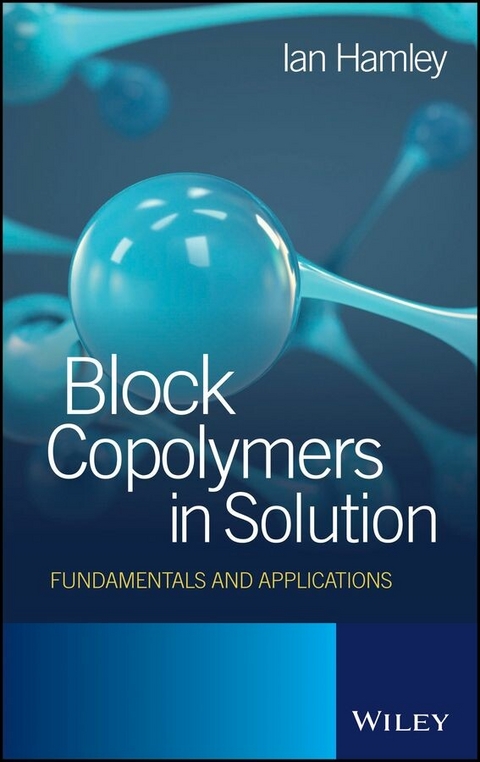
Block Copolymers in Solution (eBook)
John Wiley & Sons (Verlag)
978-0-470-01697-8 (ISBN)
The present text covers the principles of self-assembly in both dilute and concentrated solution, for example micellization and mesophase formation, etc., in chapters 2 and 3 respectively. Chapter 4 covers polyelectrolyte block copolymers - these materials are attracting significant attention from researchers and a solid basis for understanding their physical chemistry is emerging, and this is discussed. The next chapter discusses adsorption of block copolymers from solution at liquid and solid interfaces. The concluding chapter presents a discussion of selected applications, focussing on several important new concepts.
The book is aimed at researchers in polymer science as well as industrial scientists involved in the polymer and coatings industries. It will also be of interest to scientists working in soft matter self-assembly and self-organizing polymers.
Ian W. Hamley is the author of Block Copolymers in Solution: Fundamentals and Applications, published by Wiley.
This unique text discusses the solution self-assembly of block copolymers and covers all aspects from basic physical chemistry to applications in soft nanotechnology. Recent advances have enabled the preparation of new materials with novel self-assembling structures, functionality and responsiveness and there have also been concomitant advances in theory and modelling. The present text covers the principles of self-assembly in both dilute and concentrated solution, for example micellization and mesophase formation, etc., in chapters 2 and 3 respectively. Chapter 4 covers polyelectrolyte block copolymers - these materials are attracting significant attention from researchers and a solid basis for understanding their physical chemistry is emerging, and this is discussed. The next chapter discusses adsorption of block copolymers from solution at liquid and solid interfaces. The concluding chapter presents a discussion of selected applications, focussing on several important new concepts. The book is aimed at researchers in polymer science as well as industrial scientists involved in the polymer and coatings industries. It will also be of interest to scientists working in soft matter self-assembly and self-organizing polymers.
Ian W. Hamley is the author of Block Copolymers in Solution: Fundamentals and Applications, published by Wiley.
Preface.
1. Introduction.
References.
2. Neutral Block Copolymers in Dilute Solution.
2.1 Introduction.
2.2 Techniques for Studying Micellization.
2.3 Micellization in PEO-based Block Copolymers.
2.4 Micellization in Styrenic Block Copolymers.
2.5 Determination of cmc.
2.6 Thermodynamics of Micellization.
2.7 Micellization and Micelle Dimensions: Theory andSimulation.
2.8 Micelle Dimensions: Comparison Between Experiment andTheory.
2.9 Interaction between Micelles.
2.10 Dynamics of Micellization.
2.11 Dynamic Modes.
2.12 Specific Types of Micelles.
2.13 Micellization in Mixed solvents.
2.14 Mixed micelles.
2.15 Block Copolymer/Surfactant complexes.
2.16 Complex Morphologies.
2.17 Vesicles.
2.18 Crystallization in Micelles.
References.
3. Concentrated Solutions.
3.1 Understanding Phase Diagrams.
3.2 Phase Behaviour of PEO-containing BlockCopolymers.
3.3 Gelation.
3.4 Order-Disorder Phase Transition.
3.5 Order-order Phase Transitions.
3.6 Domain Spacing Scaling, and Solvent Distributionprofiles.
3.7 Semidilute Block Copolymer Solution Theory.
3.8 Theoretical understanding of Phase Diagrams.
3.9 Flow Alignment.
3.10 Dynamics.
References.
4. Polyelectrolyte Block Copolymers.
4.1 Micellization.
4.2 Chain Conformation.
4.3 Theory.
4.4 Polyion Complexes.
4.5 Copolymer-surfactant complexes.
4.6 Complexation with other Molecules.
4.7 Gelation.
4.8 Hierarchical Order in Peptide Block CopolyelectrolyteSolutions.
References.
5. Adsorption.
5.1 Introduction.
5.2 Adsorption at the Air-Water Interface.
5.3 Adsorption on Solid Substrates.
5.4 Surface Forces Experiments.
5.5 Modelling Adsorption.
References.
6. Applications
6.1 Surfactancy/Detergency.
6.2 Solubilisation,Emusification and Stabilization.
6.3 Drug Delivery.
6.4 Biodegradable Block Copolymer Micelles.
6.5 Thermoresponsive Micellar Systems.
6.6 Metal-Containing Copolymer Micelles andNanoreactors.
6.7 Vesicles.
6.8 Separation Media.
6.9 Templating.
6.10 Membranes.
6.11 Other Applications.
References.
Index.
"...this book nicely summarizes the field, touching on all the important subjects...vital to scientists and engineering working with these materials." (Journal of the American Chemical Society, February 1, 2006)
| Erscheint lt. Verlag | 13.12.2005 |
|---|---|
| Sprache | englisch |
| Themenwelt | Naturwissenschaften ► Chemie ► Organische Chemie |
| Technik | |
| Schlagworte | Advances • Applications • Aspects • BASIC • Biopolymere • biopolymers • block • Blockcopolymere • Chemie • Chemistry • concomitant • copolymers • Materials • New • Novel • Oberflächen- u. Kolloidchemie • Oberflächen- u. Kolloidchemie • Physical • Polymer Science & Technology • Polymerwissenschaft u. -technologie • Preparation • present • Principles • Recent Advances • selfassembling • selfassembly • Solution • Structures • Surface & Colloid Chemistry • theory • Unique |
| ISBN-10 | 0-470-01697-3 / 0470016973 |
| ISBN-13 | 978-0-470-01697-8 / 9780470016978 |
| Informationen gemäß Produktsicherheitsverordnung (GPSR) | |
| Haben Sie eine Frage zum Produkt? |
 PDF (Adobe DRM)
Kopierschutz: Adobe-DRM
Adobe-DRM ist ein Kopierschutz, der das eBook vor Mißbrauch schützen soll. Dabei wird das eBook bereits beim Download auf Ihre persönliche Adobe-ID autorisiert. Lesen können Sie das eBook dann nur auf den Geräten, welche ebenfalls auf Ihre Adobe-ID registriert sind.
Details zum Adobe-DRM
Dateiformat: PDF (Portable Document Format)
Mit einem festen Seitenlayout eignet sich die PDF besonders für Fachbücher mit Spalten, Tabellen und Abbildungen. Eine PDF kann auf fast allen Geräten angezeigt werden, ist aber für kleine Displays (Smartphone, eReader) nur eingeschränkt geeignet.
Systemvoraussetzungen:
PC/Mac: Mit einem PC oder Mac können Sie dieses eBook lesen. Sie benötigen eine
eReader: Dieses eBook kann mit (fast) allen eBook-Readern gelesen werden. Mit dem amazon-Kindle ist es aber nicht kompatibel.
Smartphone/Tablet: Egal ob Apple oder Android, dieses eBook können Sie lesen. Sie benötigen eine
Geräteliste und zusätzliche Hinweise
Buying eBooks from abroad
For tax law reasons we can sell eBooks just within Germany and Switzerland. Regrettably we cannot fulfill eBook-orders from other countries.
aus dem Bereich