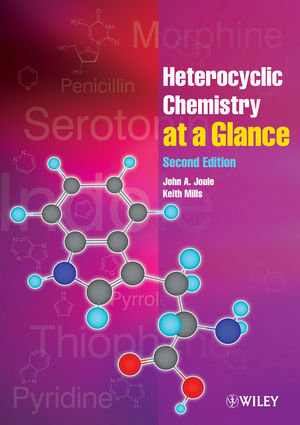
Heterocyclic Chemistry At A Glance (eBook)
John Wiley & Sons (Verlag)
978-1-118-38019-2 (ISBN)
Heterocyclic chemistry is a central part of organic chemistry and biochemistry, dealing with a particular set of chemical structures; organic compounds with a ring structure containing at least one heteroatom (commonly nitrogen, oxygen or sulfur).
Heterocyclic Chemistry at a Glance, Second Edition provides both an introduction and summary of the main principles and reactions of heterocyclic chemistry, for students studying chemistry and related courses at undergraduate level.
This second edition has been much expanded, allowing for a more thorough treatment of key principles and the inclusion of extra examples and illustrations, including heterocycles used in electronics, explosives, polymers, dyestuffs, pigments and that occur in food. All chapters have been revised and updated, including references to books and reviews, and student exercises, with answers on line at http://booksupport.wiley.com. New to this edition is the use of colour in schemes and diagrams highlighting parts of products (or intermediates) where a change in structure or bonding has taken place.
Based on the highly successful and student-friendly “at a glance” approach, the material developed in this book has been chosen to help the student grasp the essence of heterocyclic chemistry, ensuring that they can confidently use that knowledge when required. The structure of the book allows for quick assimilation, understanding and recall of key concepts, facts and definitions, providing an invaluable aid to revision for students preparing for examinations.
Reviews for the first edition:
“This book can be recommended to students looking for a textbook on heterocyclic chemistry. The organization of the material is oriented towards the needs of undergraduate students, but nevertheless the book is comprehensive and will also be of value for more advanced readers.' Heterocycles
'Joule and Mills have succeeded here in condensing the essence of introductory undergraduate heterocyclic chemistry into a slim volume, presented (as is the way in this series) in an A4 page format and in a very easy-to-grasp style with many structures and reactions. All of the key areas are covered.” Chemistry WorldThis expanded second edition provides a concise overview of the main principles and reactions of heterocyclic chemistry for undergraduate students studying chemistry and related courses. Using a successful and student-friendly "e;at a glance"e; approach, this book helps the student grasp the essence of heterocyclic chemistry, ensuring that they can confidently use that knowledge when required. The chapters are thoroughly revised and updated with references to books and reviews; extra examples and student exercises with answers online; and color diagrams that emphasize exactly what is happening in the reaction chemistry depicted.
Professor Emeritus John Joule, Chemistry Department, The University of Manchester, UK Professor Joule worked for 41 years at the University of Manchester before being appointed Professor Emeritus in 2004. Sabbatical periods were spent at the University of Ibadan, Nigeria, Johns Hopkins Medical School, Department of Pharmacology and Experimental Therapeutics, and the University of Maryland, Baltimore County. He was William Evans Visiting Fellow at Otago University, New Zealand. He has taught many courses on heterocyclic chemistry to industry and academe in the UK and elsewhere. He is currently Associate Editor for Tetrahedron Letters, Scientific Editor for Arkivoc, and Co-Editor of the annual Progress in Heterocyclic Chemistry. He is co-author with Keith Mills of the leading textbook in the field, Heterocyclic Chemistry (Wiley, 5th Edition 2010). Dr Keith Mills, Independent Consultant, UK Dr Mills worked in Medicinal Chemistry and Development Chemistry departments of GlaxoSmithKline for a total of 25 years. Since leaving GSK he has been an independent consultant to small pharmaceutical companies. Dr. Mills has worked in several areas of medicine and many areas of organic chemistry, but with particular emphasis on heterocyclic chemistry and the applications of transition metal-catalysed reactions. With John Joule he is co-author of the leading textbook in the field, Heterocyclic Chemistry (Wiley, 5th Edition 2010).
"Joule and Mills have succeeded here in condensing the essence of introductory undergraduate heterocyclic chemistry into a slim volume, presented (as is the way in this series) in an A4 page format and in a very easy-to-grasp style with many structures and reactions. All of the key areas are covered. ...the price and the concise nature of the text make it a feasible purchase and easy read for all those working in the area. I shall certainly be recommending it to my own classes." Chemistry World, June 2007
"The book delivers on its stated purpose to present the key concepts of heterocyclic chemistry to the nonspecialist and will likely find good application in the hands of molecular modelers, pharmacologists and undergraduates." Journal of Medicinal Chemistry, 2007, Vol.50, No.4, p6289
Introduction to Second Edition
The material in this book comprises an introduction to, and summary of, the most important ideas and principles of heterocyclic chemistry. We have attempted to encapsulate everything that a non-specialist, or beginning student, would need to know of the subject. At the same time, we believe that this book will serve as a good starting point for further, more extensive study of the subject.
This Second Edition has been expanded by 50% compared with the First Edition (2007), allowing us to include more examples and illustrations, and exercises at the ends of the chapters (with answers available online at http://booksupport.wiley.com). The other significant difference to the First Edition is the use of colour in the schemes (for details, see below).
We now have three supplementary chapters dealing with the occurrence and significance of heterocycles in the world at large: Chapters 17 and 18 deal with ‘Heterocycles in Nature’ and ‘Heterocycles in Medicine’; Chapter 19 discusses major significant heterocyclic involvements in dyes and pigments, polymers, pesticides, explosives, food and drink, and electronics.
The book is mainly concerned with aromatic heterocycles though we also include a short discussion of non-aromatic heterocycles (Chapter 16). We deal with the characteristic reactivities of the most important heteroaromatic systems and the principal routes for their ring synthesis from non-heterocyclic precursors. Thus the chemistry of pyridines, pyridazines, pyrimidines, pyrazines, quinolines, isoquinolines, pyrylium and benzopyrylium cations, pyrroles, indoles, thiophenes, furans, imidazoles, oxazoles, thiazoles, pyrazoles, isoxazoles, isothiazoles, purines, heterocycles with more than two heteroatoms in the ring (for example triazoles and triazines) and heterocycles in which a heteroatom is located at a ring junction (for example pyrrolizines and indolizines) is covered (Chapters 5–15). The book starts with a discussion of nomenclature and structures of aromatic heterocycles (Chapters 1 and 2); then follows Chapter 3, which examines in detail the typical reactions of heterocycles, except for those involving palladium-catalysis, since these are considered separately in the following Chapter 4.
The book assumes a basic knowledge of organic chemistry such as one would expect of a student at the second year level of a UK Honours Chemistry course and thus would be suitable for second/third/fourth year undergraduate and post-graduate courses in UK Universities. It is also relevant that much Inorganic Chemistry relies on maintaining metals in various (often unusual) oxidation states by surrounding them with ligands and that these are very often heterocyclic, so choosing or designing appropriate heterocyclic ligands and then being able to synthesise them, is also an integral prerequisite of Inorganic Chemistry. With this book we also target students in other disciplines – Pharmacy, Pharmacology, Medicinal Chemistry – whose subjects require them to assimilate the basics of this particular area of organic chemistry. The vital importance of a proper understanding of heterocyclic chemistry for the study of biochemistry at the molecular level and for drug design and synthesis in medicinal chemistry, is emphasised in Chapters 17 and 18, ‘Heterocycles in Nature’ and ‘Heterocycles in Medicine’.
It is not the purpose of this book to provide guidance for the conduct of practical work: especially at the undergraduate level, all experimental work must be conducted under the supervision of an experienced teacher. For experimental details the reader must consult the original literature – many references to suitable, key papers can be found in our fuller exposition – Heterocyclic Chemistry, 5th Edition, Joule and Mills, Wiley, 2010. All the examples in Heterocyclic Chemistry at a Glance are taken from the literature and the vast majority proceed in good yields. In the reaction schemes, so that the reader can concentrate on the chemistry in question, we have simply shown that a particular compound will react with a particular reagent or reactant to give a product, and we have omitted practical details such as solvent, reaction time, yields, and most other details, except where their inclusion makes a didactical point. Where reactions were carried out at room temperature or with gentle warming or cooling, no comment is made. Where reactions were carried out with strong heating (e.g. reflux in a high-boiling solvent) the word ‘heat’ is used on the reaction arrow; for transformations carried out at very low temperature, this is specified on the reaction arrow. For some of the palladium-catalysed reactions we give full experimental conditions, to illustrate what is typical for cross-couplings.
In the reaction schemes, we have highlighted in red those parts of the products (or intermediates) where a change in structure or bonding has taken place. We hope that this both facilitates comprehension of the chemical processes that are occurring and quickly focuses the reader's attention on just those parts of the molecules where structural change has occurred. For example, in the first reaction below, only changes at the pyridine nitrogen are involved; in the second example, the introduced bromine resulting from the substitution, and its new bond to the heterocycle, are highlighted. The exception to this policy is in palladium-catalysed cross-coupling processes where the functional groups in each of the coupling partners, as well as the new bond formed, are coloured red, as shown in the third example below.
Finally we acknowledge the crucial advice, support and encouragement from staff at Wiley, in bringing this project to fruition, in particular Paul Deards and Sarah Tilley. Mrs Joyce Dowle is thanked for her helpful comments during the preparation of Chapter 19 and Judith Egan-Shuttler for her careful copy editing.
Further Reading
This book can act only as an introduction to heterocyclic chemistry and does not include references to original literature, or to the many reviews that are available. For further study and to go more deeply into the topics covered in this book we recommend, as a first port-of-call, our textbook Heterocyclic Chemistry [1] in which there are a host of leading references to the original literature and appropriate reviews.
The premier sources of regular reviews in this area are Advances in Heterocyclic Chemistry [2] and Progress in Heterocyclic Chemistry [3] and the principles of heterocyclic nomenclature are set out in one review [4] in the former series. The journal, Heterocycles, also carries many useful reviews specifically in the heterocyclic area. As its title implies, an exhaustive coverage of the area is provided in the three parts of Comprehensive Heterocyclic Chemistry (CHC), original (1984), and its two updates (1996 and 2008) [5]. Note: The three parts must be read together – the later parts update but do not repeat the earlier material. The Handbook of Heterocyclic Chemistry [6] that accompanies CHC encapsulates the key information from the series in a single volume. There is a comprehensive compilation of heterocyclic data and facts: the still-continuing and still-growing series of monographs [7] dealing with particular heterocyclic systems, edited originally by Arnold Weissberger, and latterly by Edward C. Taylor and Peter Wipf, is a vital source of information and reviews for all those working with heterocyclic compounds. The ‘Science of Synthesis’ series contains authoritative discussions on the synthesis of heterocycles, organized in a hierarchical system [8]; volumes 9–17, published over the period 2000–2008, discuss aromatic heterocycles.
For further reading relating in particular to Chapters 17, 18 and 19, we recommend Heterocycles in Life and Society [9], Introduction to Enzyme and Coenzyme Chemistry [10], Nucleic Acids in Chemistry and Biology [11], The Alkaloids; Chemistry and Biology [12], Comprehensive Medicinal Chemistry II [13], Molecules and Medicine [14], Goodman and Gilman's The Pharmacological Basis of Therapeutics [15], The Chemistry of Explosives [16], Food. The Chemistry of its Components [17], Perfumes: the Guide [18], Handbook of Conducting Polymers [19], Handbook of Oligo- and Polythiophenes [20], Tetrathiafulvalenes, Oligoacenenes, and their Buckminsterfullerene Derivatives: the Bricks and Mortar of Organic Electronics [21].
References
1. Heterocyclic Chemistry, 5th edition, Joule, J. A. and Mills, K., Wiley, 2010; ISBN 978-1-405-19365-8 (cloth); 978-1-405-13300-5 (paper).
2. Advances in Heterocyclic Chemistry, 1963–2012 Volumes 1–105.
3. Progress in Heterocyclic Chemistry, 1989–2012, Volumes 1–24.
4. ‘The Nomenclature of Heterocycles’, McNaught, A. D., Advances in Heterocyclic Chemistry, 1976, 20, 175.
5. Comprehensive Heterocyclic Chemistry. The Structure, Reactions, Synthesis, and Uses of Heterocyclic Compounds, Eds. Katritzky, A. R. and Rees, C. W., Volumes 1–8, Pergamon Press, Oxford, 1984; Comprehensive Heterocyclic Chemistry II. A...
| Erscheint lt. Verlag | 6.8.2012 |
|---|---|
| Reihe/Serie | Chemistry At a Glance |
| Chemistry At a Glance | Chemistry At a Glance |
| Sprache | englisch |
| Themenwelt | Naturwissenschaften ► Chemie ► Organische Chemie |
| Technik | |
| Schlagworte | Anorganische Chemie • Central • Chemical Structures • Chemie • Chemistry • commonly • compounds • Containing • glance • Heterocyclic Chemistry • Heterocyclische Verbindungen • Inorganic Chemistry • Introduction • least • Main • one heteroatom • organic • Organic Chemistry • Organische Chemie • Part • particular • Pharmaceutical & Medicinal Chemistry • Pharmazeutische u. Medizinische Chemie • Reactions • Ring • SET • Structure |
| ISBN-10 | 1-118-38019-3 / 1118380193 |
| ISBN-13 | 978-1-118-38019-2 / 9781118380192 |
| Informationen gemäß Produktsicherheitsverordnung (GPSR) | |
| Haben Sie eine Frage zum Produkt? |
 EPUB (Adobe DRM)
Kopierschutz: Adobe-DRM
Adobe-DRM ist ein Kopierschutz, der das eBook vor Mißbrauch schützen soll. Dabei wird das eBook bereits beim Download auf Ihre persönliche Adobe-ID autorisiert. Lesen können Sie das eBook dann nur auf den Geräten, welche ebenfalls auf Ihre Adobe-ID registriert sind.
Details zum Adobe-DRM
Dateiformat: EPUB (Electronic Publication)
EPUB ist ein offener Standard für eBooks und eignet sich besonders zur Darstellung von Belletristik und Sachbüchern. Der Fließtext wird dynamisch an die Display- und Schriftgröße angepasst. Auch für mobile Lesegeräte ist EPUB daher gut geeignet.
Systemvoraussetzungen:
PC/Mac: Mit einem PC oder Mac können Sie dieses eBook lesen. Sie benötigen eine
eReader: Dieses eBook kann mit (fast) allen eBook-Readern gelesen werden. Mit dem amazon-Kindle ist es aber nicht kompatibel.
Smartphone/Tablet: Egal ob Apple oder Android, dieses eBook können Sie lesen. Sie benötigen eine
Geräteliste und zusätzliche Hinweise
Buying eBooks from abroad
For tax law reasons we can sell eBooks just within Germany and Switzerland. Regrettably we cannot fulfill eBook-orders from other countries.
aus dem Bereich