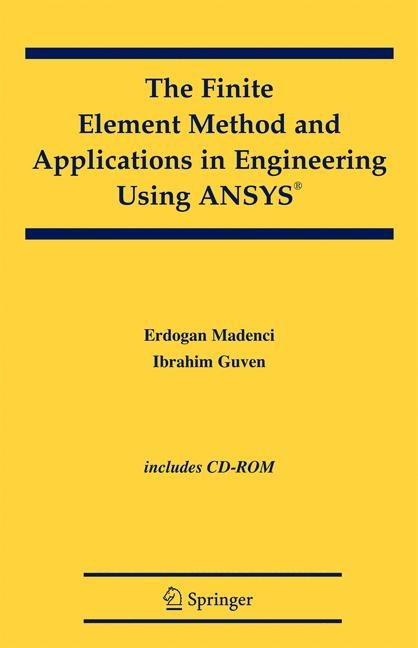
The Finite Element Method and Applications in Engineering Using ANSYS® (eBook)
XVI, 686 Seiten
Springer US (Verlag)
978-0-387-28290-9 (ISBN)

The finite element method (FEM) has become a staple for predicting and simulating the physical behavior of complex engineering systems. The commercial finite element analysis (FEA) programs have gained common acceptance among engineers in industry and researchers at universities and government laboratories. Therefore, academic engineering departments include graduate or undergraduate senior-level courses that cover not only the theory of FEM but also its applications using the commercially available FEA programs. The goal of this book is to provide students with a theoretical and practical knowledge of the finite element method and the skills required to analyze engineering problems with ANSYS®, a commercially available FEA program. This book, designed for seniors and first-year graduate students, as well as practicing engineers, is introductory and self-contained in order to minimize the need for additional reference material. In addition to the fundamental topics in finite element methods, it presents advanced topics concerning modeling and analysis with ANSYS®. These topics are introduced through extensive examples in a step-by-step fashion from various engineering disciplines. The book focuses on the use of ANSYS® through both the Graphics User Interface (GUI) and the ANSYS® Parametric Design Language (APDL). Furthermore, it includes a CD-ROM with the "inpuf files for the example problems so that the students can regenerate them on their own computers. Because of printing costs, the printed figures and screen shots are all in gray scale. However, color versions are provided on the accompanying CD-ROM.
Preface.- List of Problems Solved.- Introduction: Concept.- Nodes.- Elements.- Direct Approach.- Linear Spring.- Heat Flow.- Assembly of the Global System of Equations.- Solution of the Global System of Equations.- Boundary Conditions.- Fundamentals Of ANSYS®: Useful Definitions.- Before an ANSYS® Session.- Analysis Discipline.- Time Dependence.- Nonlinearity.- Practical Modeling Considerations.- Organization of ANSYS® Software.- ANSYS® Analysis Approach.- ANSYS® Preprocessor.- ANSYS® Solution Processor.- ANSYS® General Postprocessor.- ANSYS® Time History Postprocessor.- ANSYS® File Structure.- Database File.- Log File.- Error File.- Results Files.- Description of ANSYS® Menus and Windows.- Utility Menu.- Main Menu.- Toolbar.- Input Field.- Graphics Window.- Output Window.- Using the ANSYS® Help System.- Help Contents.- Help Index.- Search in Help.- Verification Manual.- Fundamentals of Discretization: Local and Global Numbering.- Approximation Functions.- Coordinate Systems.- Generalized Coordinates.- Global Coordinates.- Local Coordinates.- Natural Coordinates.- Shape Functions.- Linear Line Element with Two Nodes.- Quadratic Line Element with Three Nodes:
Centroidal Coordinate.- Linear Triangular Element with Three Nodes:
Global Coordinate.- Quadratic Triangular Element with Six Nodes.- Linear Quadrilateral Element with Four Nodes: Centroidal Coordinate.- Isoparametric Elements: Curved Boundaries.- Numerical Evaluation of Integrals.- Line Integrals.- Triangular Area Integrals.- Quadrilateral Area Integrals.- Problems.- ANSYS® Preprocessor: Fundamentals of Modeling.- Modeling Operations.- Title.- Elements.- Real Constants.- Material Properties.- Element Attributes.- Interaction with the Graphics Window:
Picking Entities.- Coordinate Systems.- Working Plane.- Solid Modeling.- Bottom-up Approach: Entities.- Top-down Approach: Primitives.- Boolean Operators.- Adding.-Subtracting.- Overlap.- Gluing.- Dividing.- Additional Operations.- Extrusion and Sweeping.- Moving and Copying.- Keeping/Deleting Original Entities.- Listing Entities.- Deleting Entities.- Viewing a Model.- Plotting: Pan, Zoom, and Rotate Functions.- Plotting/Listing Entities.- Numbers in the Graphics Window.- Meshing.- Automatic Meshing.- Manipulation of the Mesh.- Selecting and Components.- Selecting Operations.- Components.- ANSYS® Solution And Postprocessing: Overview.- Solution.- Analysis Options/Solution Controls.- Boundary Conditions.- Initial Conditions.- Body Loads.- Solution in Single and Multiple Load Steps.- Failure to Obtain Solution.- Postprocessing.- General Postprocessor.- Time History Postprocessor.- Read Results.- Plot Results.- Element Tables.- List Results.- Example: One-dimensional Transient Heat Transfer.- Finite Element Equations: Method of Weighted Residuals.-Example: One-dimensional Differential.- Equation with Line Elements.- Example: Two-dimensional Differential.- Equation with Linear Triangular Elements.- Example: Two-dimensional Differential Equation with Linear Quadrilateral Elements.- Principle of Minimum Potential Energy.- Example: One-dimensional Analysis with Line Elements.- Two-dimensional Structural Analysis.- Problems.- Use of Commands in ANSYS®: Basic ANSYS® Commands.- Operators and Functions.- Defining Parameters.- A Typical Input File.- Selecting Operations.-Extracting Information from ANSYS®.- Programming with ANSYS®.- DO Loops.- IF Statements.- /OUTPUT and *VWRITE Commands.- Macro Files.- Useful Resources.- Using the Log File for Programming.- Using the Verification Problems for Programming.- Linear Structural Analysis: Static Analysis.- Trusses.- Beams.- Three-dimensional Problems.-.- Plates and Shells.- Linear Buckling Analysis.- Thermomechanical Analysis.- Fracture Mechanics Analysis.- Dynamic Analysis.- Modal Analysis.- Harmonic Analysis.-
| Erscheint lt. Verlag | 26.4.2007 |
|---|---|
| Verlagsort | Boston |
| Sprache | englisch |
| Themenwelt | Technik ► Maschinenbau |
| Schlagworte | Approximation • Calculus • Design • Finite-Elemente-Methode • Finite Element Method • Finite-Element-Methode • heat transfer • Linearity • linear optimization • Mechanics • Model • Modeling • Operator • programming • verification |
| ISBN-10 | 0-387-28290-4 / 0387282904 |
| ISBN-13 | 978-0-387-28290-9 / 9780387282909 |
| Informationen gemäß Produktsicherheitsverordnung (GPSR) | |
| Haben Sie eine Frage zum Produkt? |
 PDF (Adobe DRM)
Kopierschutz: Adobe-DRM
Adobe-DRM ist ein Kopierschutz, der das eBook vor Mißbrauch schützen soll. Dabei wird das eBook bereits beim Download auf Ihre persönliche Adobe-ID autorisiert. Lesen können Sie das eBook dann nur auf den Geräten, welche ebenfalls auf Ihre Adobe-ID registriert sind.
Details zum Adobe-DRM
Dateiformat: PDF (Portable Document Format)
Mit einem festen Seitenlayout eignet sich die PDF besonders für Fachbücher mit Spalten, Tabellen und Abbildungen. Eine PDF kann auf fast allen Geräten angezeigt werden, ist aber für kleine Displays (Smartphone, eReader) nur eingeschränkt geeignet.
Systemvoraussetzungen:
PC/Mac: Mit einem PC oder Mac können Sie dieses eBook lesen. Sie benötigen eine
eReader: Dieses eBook kann mit (fast) allen eBook-Readern gelesen werden. Mit dem amazon-Kindle ist es aber nicht kompatibel.
Smartphone/Tablet: Egal ob Apple oder Android, dieses eBook können Sie lesen. Sie benötigen eine
Geräteliste und zusätzliche Hinweise
Buying eBooks from abroad
For tax law reasons we can sell eBooks just within Germany and Switzerland. Regrettably we cannot fulfill eBook-orders from other countries.
aus dem Bereich