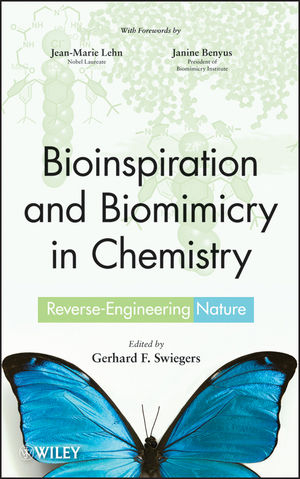
Bioinspiration and Biomimicry in Chemistry (eBook)
512 Seiten
John Wiley & Sons (Verlag)
978-1-118-31006-9 (ISBN)
Through billions of years of evolution, Nature has generated some remarkable systems and substances that have made life on earth what it is today. Increasingly, scientists are seeking to mimic Nature's systems and processes in the lab in order to harness the power of Nature for the benefit of society.
Bioinspiration and Biomimicry in Chemistry explores the chemistry of Nature and how we can replicate what Nature does in abiological settings. Specifically, the book focuses on wholly artificial, man-made systems that employ or are inspired by principles of Nature, but which do not use materials of biological origin.
Beginning with a general overview of the concept of bioinspiration and biomimicry in chemistry, the book tackles such topics as:
* Bioinspired molecular machines
* Bioinspired catalysis
* Biomimetic amphiphiles and vesicles
* Biomimetic principles in macromolecular science
* Biomimetic cavities and bioinspired receptors
* Biomimicry in organic synthesis
Written by a team of leading international experts, the contributed chapters collectively lay the groundwork for a new generation of environmentally friendly and sustainable materials, pharmaceuticals, and technologies. Readers will discover the latest advances in our ability to replicate natural systems and materials as well as the many impediments that remain, proving how much we still need to learn about how Nature works.
Bioinspiration and Biomimicry in Chemistry is recommended for students and researchers in all realms of chemistry. Addressing how scientists are working to reverse engineer Nature in all areas of chemical research, the book is designed to stimulate new discussion and research in this exciting and promising field.
GERHARD F. SWIEGERS, PhD, is a professor of chemistry at the University of Wollongong in Australia. His research focuses on taking inspiration from and learning from Nature in fields including self-assembly and catalysis. He has authored widely cited works that highlight the similarity of self-assembly in chemistry and biology. He has also been responsible for illuminating important fundamental aspects of chemical and biological catalysis, with significant implications for the rational design of bio-inspired catalysts.
The Contributors
Chapter 1. Introduction: The Concept of Biomimicry and Bioinspiration in Chemistry
Timothy W. Hanks and Gerhard F. Swiegers
Chapter 2. Bioinspired Self-Assembly I: Self-Assembled Structures
Leonard F. Lindoy, Christopher Richardson, and Jack K. Clegg
Chapter 3. Bioinspired Self-Assembly II: Principles of Cooperativity in Bioinspired Self-Assembling Systems
Gianfranco Ercolani and Luca Schiaffino
Chapter 4. Bioinspired Molecular Machines
Christopher R. Benson, Andrew I. Share, and Amar H. Flood
Chapter 5. Bioinspired Materials Chemistry I: Organic-Inorganic Nanocomposites
Pilar Aranda, Francisco M. Fernandes, Bernd Wicklein, Eduardo Ruiz-Hitzky, Jonathan P. Hill and Katsuhiko Ariga
Chapter 6. Bioinspired Materials Chemistry II: Biomineralization as Inspiration for Materials Chemistry
Fabio Nudelman and Nico A. J. Sommerdijk
Chapter 7. Bioinspired Catalysis
Gerhard F. Swiegers, Jun Chen and Pawel Wagner
Chapter 8. Biomimetic Amphiphiles and Vesicles
Sabine Himmelein and Bart Jan Ravoo
Chapter 9. Bioinspired Surfaces I: Gecko-Foot Mimetic Adhesion
Liangti Qu, Yan Li and Liming Dai
Chapter 10. Bioinspired Surfaces II: Bioinspired Photonic Materials
Cun Zhu and Zhong-Ze Gu
Chapter 11. Biomimetic Principles in Macromolecular Science
Wolfgang H. Binder, Marlen Schunack, Florian Herbst and Bhanuprathap Pulamagatta
Chapter 12. Biomimetic Cavities and Bioinspired Receptors
Stéphane Le Gac, Ivan Jabin and Olivia Reinaud
Chapter 13. Bioinspired Dendritic Light Harvesting Systems
Andrea M. Della Pelle and S. Thayumanavan
Chapter 14. Biomimicry in Organic Synthesis
Reinhard W. Hoffmann
Chapter 15. Conclusion and Future Perspective: Drawing Inspiration from the Complex System that is Nature
Clyde W. Cady, David M. Robinson. Paul F. Smith, and Gerhard F. Swiegers
Index
"As a resource for chemists, the main advantage of this
book is this diversity, which makes it stand out from more specific
discussions of e.g. biomimetic materials chemistry. In this sense,
the book would provide a good reference to someone new to the field
or as part of a reading list for a course on biomimetics and
bioinspiration in chemistry. In addition, for readers who have
worked in one area of biomimetic chemistry for some time, this book
is broad enough to give some interesting insight into some very
different chemistries." (Angew. Chem. Int. Ed, 1
August 2013)
"As such, it holds a unique place in the literature, and
would be best suited for advanced students or researchers
interested in this area. Summing Up: Recommended. Graduate
students, researchers/faculty, and
professionals/practitioners." (Choice, 1 August
2013)
| Erscheint lt. Verlag | 15.10.2012 |
|---|---|
| Vorwort | Jean-Marie Lehn, Janine Benyus |
| Sprache | englisch |
| Themenwelt | Naturwissenschaften ► Chemie ► Organische Chemie |
| Naturwissenschaften ► Chemie ► Technische Chemie | |
| Technik ► Maschinenbau | |
| Technik ► Umwelttechnik / Biotechnologie | |
| Schlagworte | Biochemie • Biochemie u. Chemische Biologie • Biochemistry (Chemical Biology) • Biomaterial • Biomaterialien • biomaterials • biomedical engineering • Biomedizintechnik • Chemie • Chemistry • Nanotechnologie • nanotechnology |
| ISBN-10 | 1-118-31006-3 / 1118310063 |
| ISBN-13 | 978-1-118-31006-9 / 9781118310069 |
| Informationen gemäß Produktsicherheitsverordnung (GPSR) | |
| Haben Sie eine Frage zum Produkt? |
 PDF (Adobe DRM)
Kopierschutz: Adobe-DRM
Adobe-DRM ist ein Kopierschutz, der das eBook vor Mißbrauch schützen soll. Dabei wird das eBook bereits beim Download auf Ihre persönliche Adobe-ID autorisiert. Lesen können Sie das eBook dann nur auf den Geräten, welche ebenfalls auf Ihre Adobe-ID registriert sind.
Details zum Adobe-DRM
Dateiformat: PDF (Portable Document Format)
Mit einem festen Seitenlayout eignet sich die PDF besonders für Fachbücher mit Spalten, Tabellen und Abbildungen. Eine PDF kann auf fast allen Geräten angezeigt werden, ist aber für kleine Displays (Smartphone, eReader) nur eingeschränkt geeignet.
Systemvoraussetzungen:
PC/Mac: Mit einem PC oder Mac können Sie dieses eBook lesen. Sie benötigen eine
eReader: Dieses eBook kann mit (fast) allen eBook-Readern gelesen werden. Mit dem amazon-Kindle ist es aber nicht kompatibel.
Smartphone/Tablet: Egal ob Apple oder Android, dieses eBook können Sie lesen. Sie benötigen eine
Geräteliste und zusätzliche Hinweise
Buying eBooks from abroad
For tax law reasons we can sell eBooks just within Germany and Switzerland. Regrettably we cannot fulfill eBook-orders from other countries.
aus dem Bereich