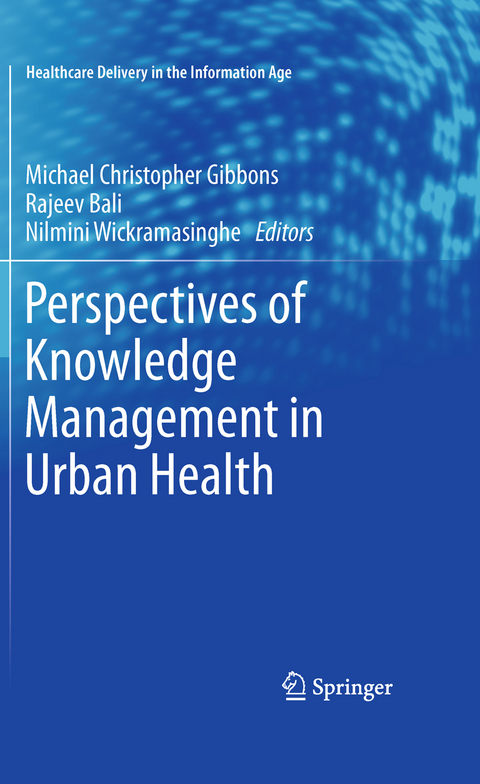
Perspectives of Knowledge Management in Urban Health
Springer-Verlag New York Inc.
978-1-4614-2658-5 (ISBN)
•Analyze key aspects of KM and explains their applicability to urban health.
•Introduce the KM tools and technologies most relevant to health care delivery.
•Offer evidence of the role of KM in improving clinical efficacy and executive decision-making.
•Provide extended case examples of KM-based programs used in Washington, D.C. (child health), South Africa (HIV/AIDS), and Australia (health inequities).
•Apply KM principles to urban health needs in developing countries.
•Discuss new approaches to managing, evaluating, and improving delivery systems in the book’s “Measures and Metrics” section.
Urban health professionals, as well as health care executives and administrators, will find Urban Health Knowledge Management a significant resource for bringing service delivery up to speed at a time of great advancement and change.
M. Chris Gibbons is Associate Director of the Johns Hopkins Urban Health Institute, Director of the Center for Community HEALTH and Assistant Professor of Public Health and Medicine at Johns Hopkins University. He is currently President of the International Society for Urban Health. Rajeev K. Bali is a Reader in Healthcare Knowledge Management at Coventry University (UK). He is a Visiting Professor in Knowledge and Healthcare Management at the Illinois Institute of Technology (Chicago, USA). Nilmini Wickramasingh is the professor of Business IT & Logistics at RMIT University, Australia. In addition, Dr Wickramasinghe is the editor-in-chief of two scholarly journals: International Journal of Networking and Virtual Organisations and International Journal of Biomedical Engineering and Technology.
KM and Urban Health.- Knowledge Management for the Urban Health Context.- Healthcare Knowledge Management: Incorporating the Tools Technologies Strategies and Process of KM to Effect Superior Healthcare Delivery.- Knowledge Management in the Urban Health Context: Moving Towards Tacit-to-Tacit Knowledge Transfer.- Incorporating KM Principles into Urban Health Contexts.- A Childhood/Adolescent Knowledge Management System for Urban Area Health Programs in the District of Columbia.- Urban Health in Developing Countries.- A Pervasive Wireless Knowledge Management Solution to Address Urban Health Inequalities with Indigenous Australians.- The Development of a Framework to Evaluate the Management of HIV/AIDS Programmes in Rural and Urban South Africa.- The Potential of Serious Games for Improving Health and Reducing Urban Health Inequalities.- Measures and Metrics for KM and Urban Health.- A Scalable and Viable Strategy for Managing Organization: Typology of Intervening into Complex Healthcare Environment for Enhancing Its Continual Development.- Amplifying Resonance in Organizational Learning Process: Knowledge Sharing for Overcoming Cognitive Barriers and for Assuring Positive Action.- Developing New Urban Health Metrics to Reduce the Know-Do Gap in Public Health.- Recommendations on Evaluation and Development of Useful Metrics for Urban Health.- Making Sense of Urban Health Knowledge.
| Reihe/Serie | Healthcare Delivery in the Information Age ; 1 |
|---|---|
| Zusatzinfo | XXXII, 220 p. |
| Verlagsort | New York, NY |
| Sprache | englisch |
| Maße | 155 x 235 mm |
| Themenwelt | Mathematik / Informatik ► Informatik |
| Medizin / Pharmazie ► Allgemeines / Lexika | |
| Medizin / Pharmazie ► Gesundheitswesen | |
| Technik ► Medizintechnik | |
| Schlagworte | Electronic Health Record • healthcare delivery • Health Informatics • km • knowledge management • Medical Decision Making • urban health |
| ISBN-10 | 1-4614-2658-8 / 1461426588 |
| ISBN-13 | 978-1-4614-2658-5 / 9781461426585 |
| Zustand | Neuware |
| Informationen gemäß Produktsicherheitsverordnung (GPSR) | |
| Haben Sie eine Frage zum Produkt? |
aus dem Bereich