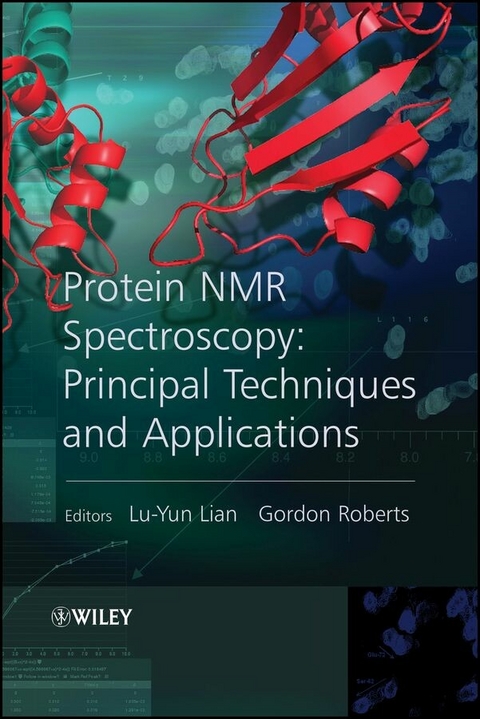
NMR can be used to determine detailed three-dimensional structures of proteins in solution. Furthermore, it provides information about conformational or chemical exchange, internal mobility and dynamics at timescales varying from pcoseconds to seconds. It is the primary technique used to obtain information on intrinsically disordered (unfolded) proteins, since these proteins will not crystallize easily. NMR is also a very powerful method for the study of interactions of protein with other molecules, whether small molecules (including drugs), nuclear acids or other proteins.
This up-to-date volume covers NMR techiniques and their application to proteins, with a focus on practical details. This book will provide a newcomer to NMR with the practical guidance in order to carry out successful experiments with proteins and to analyze the resulting spectra. Those who are familiar with the chemical applications of NMR will also find is useful in understanding the special requirements of protien NMR.
Professor Gordon Roberts is Head of the School of Biological Sciences, University of Leicester.
Dr Christina Redfield is Reader, Oxford Centre for Molecular Sciences, University of Oxford.
Nuclear Magnetic Resonance (NMR) spectroscopy, a physical phenomenon based upon the magnetic properties of certain atomic nuclei, has found a wide range of applications in life sciences over recent decades. This up-to-date volume covers NMR techniques and their application to proteins, with a focus on practical details. Providing newcomers to NMR with practical guidance to carry out successful experiments with proteins and analyze the resulting spectra, those familiar with the chemical applications of NMR will also find it useful in understanding the special requirements of protein NMR.
Professor Gordon Roberts is Head of the School of Biological Sciences, University of Leicester. Dr Christina Redfield is Reader, Oxford Centre for Molecular Sciences, University of Oxford.
List of Contributors xiii
Introduction 1
Lu-Yun Lian and Gordon Roberts
References 4
1 Sample Preparation, Data Collection and Processing
5
Frederick W. Muskett
1.1 Introduction 5
1.2 Sample Preparation 5
1.3 Data Collection 11
1.4 Data Processing 17
2 Isotope Labelling 23
Mitsuhiro Takeda and Masatsune Kainosho
2.1 Introduction 23
2.2 Production Methods for Isotopically Labelled Proteins 24
2.3 Uniform Isotope Labelling of Proteins 29
2.4 Selective Isotope Labelling of Proteins 32
2.5 Segmental Labelling 37
2.6 SAIL Methods 38
2.7 Concluding Remarks 45
3 Resonance Assignments 55
Lu-Yun Lian and Igor L. Barsukov
3.1 Introduction 55
3.2 Resonance Assignment of Unlabelled Proteins 56
3.3 15N-Edited Experiments 60
3.4 Triple Resonance 62
3.5 Side-Chain Assignments 77
4 Measurement of Structural Restraints 83
Geerten W. Vuister, Nico Tjandra, Yang Shen, Alex Grishaev and
Stephan Grzesiek
4.1 Introduction 83
4.2 NOE-Based Distance Restraints 84
4.3 Dihedral Restraints Derived from J-Couplings 96
4.4 Hydrogen Bond Restraints 103
4.5 Orientational Restraints 107
4.6 Chemical Shift Structural Restraints 129
4.7 Solution Scattering Restraints 137
5 Calculation of Structures from NMR Restraints 159
Peter Guntert
5.1 Introduction 159
5.2 Historical Development 161
5.3 Structure Calculation Algorithms 164
5.4 Automated NOE Assignment 173
5.5 Nonclassical Approaches 178
5.6 Fully Automated Structure Analysis 181
6 Paramagnetic Tools in Protein NMR 193
Peter H.J. Keizers and Marcellus Ubbink
6.1 Introduction 193
6.2 Types of Restraints 194
6.3 What Metals to Use? 200
6.4 Paramagnetic Probes 203
6.5 Examples 209
6.6 Conclusions and Perspective 212
7 Structural and Dynamic Information on Ligand Binding
221
Gordon Roberts
7.1 Introduction 221
7.2 Fundamentals of Exchange Effects on NMR Spectra 222
7.3 Measurement of Equilibrium and Rate Constants 229
7.4 Detecting Binding - NMR Screening 238
7.5 Mechanistic Information 241
7.6 Structural Information 246
8 Macromolecular Complexes 269
Paul C. Driscoll
8.1 Introduction 269
8.2 Spectral Simplification through Differential Isotope
Labelling 270
8.3 Basic NMR Characterisation of Complexes 273
8.4 3D Structure Determination of Macromolecular
Protein-Ligand Complexes 277
8.5 Literature Examples 297
9 Studying Partially Folded and Intrinsically Disordered
Proteins Using NMR Residual Dipolar Couplings 319
Malene Ringkjøbing Jensen, Valery Ozenne, Loic Salmon,
Gabrielle Nodet, Phineus Markwick, Pau Bernado´ and Martin
Blackledge
9.1 Introduction 319
9.2 Ensemble Descriptions of Unfolded Proteins 320
9.3 Experimental Techniques for the Characterisation of IDPs
320
9.4 NMR Spectroscopy of Intrinsically Disordered Proteins
321
9.5 Residual Dipolar Couplings 323
9.6 Conclusions 340
References 340
Index 347
"This is a must for anyone interested in using solution NMR to study proteins. Summing Up: Highly recommended. Graduate students, researchers/faculty, and professionals/practitioners." (Choice, 1 April 2012)
| Erscheint lt. Verlag | 1.6.2011 |
|---|---|
| Sprache | englisch |
| Themenwelt | Naturwissenschaften ► Biologie ► Biochemie |
| Naturwissenschaften ► Chemie ► Analytische Chemie | |
| Naturwissenschaften ► Physik / Astronomie | |
| Technik | |
| Schlagworte | Ability • Advances • Applications • Atomic • Biochemie u. Chemische Biologie • Biochemistry (Chemical Biology) • Biowissenschaften • Cell & Molecular Biology • certain • Chemie • Chemistry • corresponding • decades • dramatic • Life • Life Sciences • Magnetic • NMR • NMR Spectroscopy / MRI / Imaging • NMR-Spektroskopie • NMR-Spektroskopie / MRT / Bildgebende Verfahren • Nuclear magnetic • nuclei • phenomenon • Physical • Properties • Proteine • Range • resonance • Sciences • spectroscopy • Structure • Study • techniques • wide • Zell- u. Molekularbiologie |
| ISBN-13 | 9781119972013 / 9781119972013 |
| Informationen gemäß Produktsicherheitsverordnung (GPSR) | |
| Haben Sie eine Frage zum Produkt? |
 PDF (Adobe DRM)
Kopierschutz: Adobe-DRM
Adobe-DRM ist ein Kopierschutz, der das eBook vor Mißbrauch schützen soll. Dabei wird das eBook bereits beim Download auf Ihre persönliche Adobe-ID autorisiert. Lesen können Sie das eBook dann nur auf den Geräten, welche ebenfalls auf Ihre Adobe-ID registriert sind.
Details zum Adobe-DRM
Dateiformat: PDF (Portable Document Format)
Mit einem festen Seitenlayout eignet sich die PDF besonders für Fachbücher mit Spalten, Tabellen und Abbildungen. Eine PDF kann auf fast allen Geräten angezeigt werden, ist aber für kleine Displays (Smartphone, eReader) nur eingeschränkt geeignet.
Systemvoraussetzungen:
PC/Mac: Mit einem PC oder Mac können Sie dieses eBook lesen. Sie benötigen eine
eReader: Dieses eBook kann mit (fast) allen eBook-Readern gelesen werden. Mit dem amazon-Kindle ist es aber nicht kompatibel.
Smartphone/Tablet: Egal ob Apple oder Android, dieses eBook können Sie lesen. Sie benötigen eine
Geräteliste und zusätzliche Hinweise
Buying eBooks from abroad
For tax law reasons we can sell eBooks just within Germany and Switzerland. Regrettably we cannot fulfill eBook-orders from other countries.
aus dem Bereich