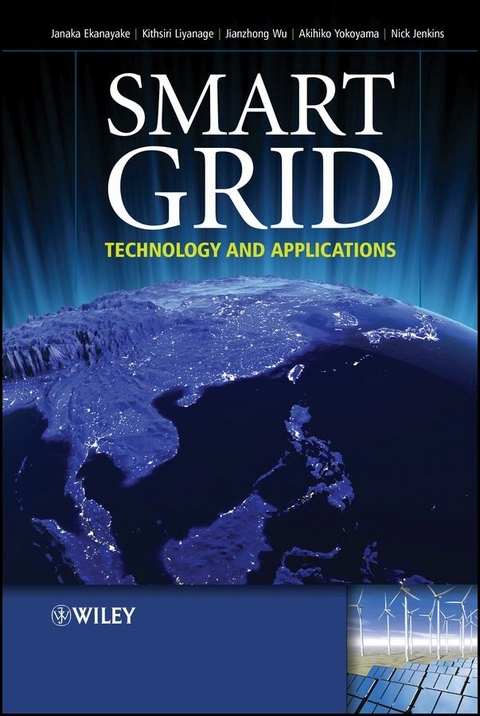
Smart Grid (eBook)
320 Seiten
John Wiley & Sons (Verlag)
978-1-119-96909-9 (ISBN)
with the need to decarbonise electricity supply, replace ageing
assets and harness new information and communication technologies
(ICT). The Smart Grid uses advanced ICT to control next generation
power systems reliably and efficiently. This authoritative guide
demonstrates the importance of the Smart Grid and shows how ICT
will extend beyond transmission voltages to distribution networks
and customer-level operation through Smart Meters and Smart
Homes.
Smart Grid Technology and Applications:
* Clearly unravels the evolving Smart Grid concept with extensive
illustrations and practical examples.
* Describes the spectrum of key enabling technologies required
for the realisation of the Smart Grid with worked examples to
illustrate the applications.
* Enables readers to engage with the immediate development of the
power system and take part in the debate over the future Smart
Grid.
* Introduces the constituent topics from first principles,
assuming only a basic knowledge of mathematics, circuits and power
systems.
* Brings together the expertise of a highly experienced and
international author team from the UK, Sri Lanka, China and
Japan.
Electrical, electronics and computer engineering researchers,
practitioners and consultants working in inter-disciplinary Smart
Grid RD&D will significantly enhance their knowledge through
this reference. The tutorial style will greatly benefit final year
undergraduate and master's students as the curriculum
increasing focuses on the breadth of technologies that contribute
to Smart Grid realisation.
Professor Janaka Ekanayake, Cardiff University, UK Professor Ekanayake is currently at the Institute of Energy at Cardiff University. As module leader on an MSc course, he teaches intelligent electronic devices, their applications and automation. He also teaches power electronic applications to power systems, flexible ac transmission systems and HVDC.Previous to this he was a Research Fellow at the University of Manchester. He was promoted to Professor in Electrical and Electronic Engineering at the University of Peradeniya, Sri Lanka in 2003. Professor Ekanayake has published over 25 papers in refereed journals and has co-authored three books in the area of wind integration. Dr Kithsiri Liyanage, University of Peradeniya, Sri Lanka Dr Liyanage is Senior Lecturer in the Department of Electrical and Electronic Engineering, University of Peradeniya. Prior to this he served as Dean of the Faculty of Engineering, University of Ruhuna and as Director of the Information Technology Centre, University of Peradenyia. He has been with the University of Tokyo as a Visiting Research Fellow since 2008. He has served as coordinator of and consultant to several ICT and power generation projects. Dr Jianzhong Wu, Cardiff University, UK Dr Wu is a lecturer at the Institute of Energy, School of Engineering, Cardiff University. Privious to this he was a research fellow at the University of Manchester and Associate Professor at Tianjin University, China. He has been involved in several Chinese national research programmes, developing advanced software tools for distribution network operation, planning, for on-line security monitoring, assessment and optimisation for transmission networks. Professor Akihiko Yokoyama, University of Tokyo, Japan Professor Yokoyama is based at the Department of Engineering at the University of Tokyo. He is alsoProfessor in the Department of Advanced Energy at the Graduate School of Frontier Sciences He has co-authored two books, and is Chairman of PES Council of IEEE Japan. He is Vice Chair- man of the Japanese National Committee of CIGRE, and Vice President of Central Research Institute of Electric Power Industry of Japan. Professor Nicholas Jenkins, Cardiff University, UK Professor Jenkins moved to Cardiff University in 2008 after ten years as a professor at the University of Manchester. He has contributed to ten books and is a Fellow of the IET, IEEE and the Royal Academy of Engineering. He was a member of Advisory Council of the CEU SmartGrid Technology Platform. Professor Jenkins is presently the Shimizu Visiting Professor at Stanford University.
About the authors xi
Preface xiii
Acknowledgements xv
List of abbreviations xvii
1 The Smart Grid 1
1.1 Introduction 1
1.2 Why implement the Smart Grid now? 2
1.3 What is the Smart Grid? 6
1.4 Early Smart Grid initiatives 7
1.5 Overview of the technologies required for the Smart Grid12
References 14
Part I INFORMATION AND COMMUNICATION TECHNOLOGIES
2 Data communication 19
2.1 Introduction 19
2.2 Dedicated and shared communication channels 19
2.3 Switching techniques 23
2.4 Communication channels 25
2.5 Layered architecture and protocols 35
References 43
3 Communication technologies for the Smart Grid 45
3.1 Introduction 45
3.2 Communication technologies 46
3.3 Standards for information exchange 62
References 66
4 Information security for the Smart Grid 69
4.1 Introduction 69
4.2 Encryption and decryption 70
4.3 Authentication 76
4.4 Digital signatures 77
4.5 Cyber security standards 79
References 80
Part II SENSING, MEASUREMENT, CONTROL AND AUTOMATIONTECHNOLOGIES
5 Smart metering and demand-side integration 83
5.1 Introduction 83
5.2 Smart metering 84
5.3 Smart meters: An overview of the hardware used 86
5.4 Communications infrastructure and protocols for smartmetering 96
5.5 Demand-side integration 99
References 111
6 Distribution automation equipment 113
6.1 Introduction 113
6.2 Substation automation equipment 114
6.3 Faults in the distribution system 125
6.4 Voltage regulation 135
References 139
7 Distribution management systems 141
7.1 Introduction 141
7.2 Data sources and associated external systems 142
7.3 Modelling and analysis tools 144
7.4 Applications 165
References 171
8 Transmission system operation 173
8.1 Introduction 173
8.2 Data sources 173
8.3 Energy management systems 177
8.4 Wide area applications 179
8.5 Visualisation techniques 183
References 186
Part III POWER ELECTRONICS AND ENERGY STORAGE
9 Power electronic converters 189
9.1 Introduction 189
9.2 Current source converters 191
9.3 Voltage source converters 195
References 203
10 Power electronics in the Smart Grid 205
10.1 Introduction 205
10.2 Renewable energy generation 206
10.3 Fault current limiting 213
10.4 Shunt compensation 217
10.5 Series compensation 228
References 231
11 Power electronics for bulk power flows 233
11.1 Introduction 233
11.2 FACTS 234
11.3 HVDC 248
References 257
12 Energy storage 259
12.1 Introduction 259
12.2 Energy storage technologies 263
12.3 Case study 1: Energy storage for wind power 271
12.4 Case study 2: Agent-based control of electrical vehiclebattery charging 273
References 277
Index 279
| Erscheint lt. Verlag | 23.2.2012 |
|---|---|
| Sprache | englisch |
| Themenwelt | Technik ► Elektrotechnik / Energietechnik |
| Schlagworte | Computer Science • Control Systems Technology • Electrical & Electronics Engineering • Elektrotechnik u. Elektronik • Energie • Energietechnik • Energy • Informatik • Leistungselektronik • Parallel and Distributed Computing • Paralleles u. Verteiltes Rechnen • Power Electronics • Regelungstechnik • Smart Grid |
| ISBN-10 | 1-119-96909-3 / 1119969093 |
| ISBN-13 | 978-1-119-96909-9 / 9781119969099 |
| Informationen gemäß Produktsicherheitsverordnung (GPSR) | |
| Haben Sie eine Frage zum Produkt? |
 EPUB (Adobe DRM)
Kopierschutz: Adobe-DRM
Adobe-DRM ist ein Kopierschutz, der das eBook vor Mißbrauch schützen soll. Dabei wird das eBook bereits beim Download auf Ihre persönliche Adobe-ID autorisiert. Lesen können Sie das eBook dann nur auf den Geräten, welche ebenfalls auf Ihre Adobe-ID registriert sind.
Details zum Adobe-DRM
Dateiformat: EPUB (Electronic Publication)
EPUB ist ein offener Standard für eBooks und eignet sich besonders zur Darstellung von Belletristik und Sachbüchern. Der Fließtext wird dynamisch an die Display- und Schriftgröße angepasst. Auch für mobile Lesegeräte ist EPUB daher gut geeignet.
Systemvoraussetzungen:
PC/Mac: Mit einem PC oder Mac können Sie dieses eBook lesen. Sie benötigen eine
eReader: Dieses eBook kann mit (fast) allen eBook-Readern gelesen werden. Mit dem amazon-Kindle ist es aber nicht kompatibel.
Smartphone/Tablet: Egal ob Apple oder Android, dieses eBook können Sie lesen. Sie benötigen eine
Geräteliste und zusätzliche Hinweise
Buying eBooks from abroad
For tax law reasons we can sell eBooks just within Germany and Switzerland. Regrettably we cannot fulfill eBook-orders from other countries.
aus dem Bereich