
Data Analysis in Vegetation Ecology (eBook)
John Wiley & Sons (Verlag)
978-1-119-96563-3 (ISBN)
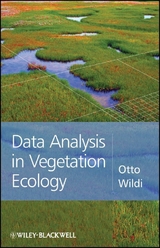
The book lays out the basic operations involved in the analysis, the underlying hypotheses, aims and points of views. It conveys the message that each step in the calculations has a specific, straightforward meaning and that patterns and processes known by ecologists often find their counterpart in mathematical operations and functions. The first chapters introduce the elementary concepts and operations and relate them to real-world phenomena and problems. Later chapters concentrate on combinations of methods to reveal surprising features in data sets. Showing how to find patterns in time series, how to generate simple dynamic models, how to reveal spatial patterns and related occurrence probability maps.
Evolving from years of teaching experience by one of the top experts in vegetation ecology, Data Analysis in Vegetation Ecology aims to explain the background and basics of mathematical (mainly multivariate) analysis of vegetation data. The book lays out the basic operations involved in the analysis, the underlying hypotheses, aims and points of views. It conveys the message that each step in the calculations has a specific, straightforward meaning and that patterns and processes known by ecologists often find their counterpart in mathematical operations and functions. The first chapters introduce the elementary concepts and operations and relate them to real-world phenomena and problems. Later chapters concentrate on combinations of methods to reveal surprising features in data sets. Showing how to find patterns in time series, how to generate simple dynamic models, how to reveal spatial patterns and related occurrence probability maps.
Dr Otto Wildi, Head of Research Unit Community Ecology, Switzerland.
Preface.
List of Figures.
List of Tables.
1 Introduction.
2 Patterns in Vegetation Ecology.
2.1 Pattern recognition.
2.2 Interpretation of patterns.
2.3 Sampling for pattern recognition.
3 Transformation.
3.1 Data types.
3.2 Scalar transformation and the species enigma.
3.3 Vector transformation.
3.4 Example: Transformation of plant cover data.
4 Multivariate Comparison.
4.1 Resemblance in multivariate space.
4.2 Geometric approach.
4.3 Contingency testing.
4.4 Product moments.
4.5 The resemblance matrix.
4.6 Assessing the quality of classifications.
5 Ordination.
5.1 Why ordination?
5.2 Principal component analysis (PCA).
5.3 Principal coordinates analysis (PCOA).
5.4 Correspondence analysis (CA).
5.5 The horseshoe or arch effect.
5.6 Ranking by orthogonal components.
6 Classification.
6.1 Group structures.
6.2 Linkage clustering.
6.3 Minimum-variance clustering.
6.4 Average-linkage clustering: UPGMA, WPGMA, UPGMC and
WPGMC.
6.5 Forming groups.
6.6 Structured synoptic tables.
7 Joining Ecological Patterns.
7.1 Pattern and ecological response.
7.2 Analysis of variance.
7.3 Correlating resemblance matrices.
7.4 Contingency tables.
7.5 Constrained ordination.
8 Static Explanatory Modelling.
8.1 Predictive or explanatory?
8.2 The Bayes probability model.
8.3 Predicting wetland vegetation (example).
9 Assessing Vegetation Change in Time.
9.1 Coping with time.
9.2 Rate of change and trend.
9.3 Markov models.
9.4 Space-for-time substitution.
9.5 Dynamics in pollen diagrams (example).
10 Dynamic Modelling.
10.1 Simulating time processes.
10.2 Including space processes.
10.3 Processes in the Swiss National Park (SNP).
11 Large Data Sets: Wetland Patterns.
11.1 Large data sets differ.
11.2 Phytosociology revisited.
11.3 Suppressing outliers.
11.4 Replacing species with new attributes.
11.5 Large synoptic tables?
12 Swiss Forests: A Case Study.
12.1 Aim of the study.
12.2 Structure of the data set.
12.3 Methods.
12.4 Selected questions.
12.5 Conclusions.
Appendix A On using software.
A.1 Spreadsheets.
A.2 Databases.
A.3 Software for multivariate analysis.
Appendix B Data Sets Used.
References.
Index.
"All students sampling vegetation data should be aware that this
is a really nice book summarizing the approaches used in vegetation
ecology . . . I enjoyed reading this book and can recommend it for
students of botany or
general ecology. It is also well suited teaching
material." (Folia Geobot, 1 December
2011)
"This book will be a valuable addition to the shelves of
early postgraduate candidates and postdoctoral
researchers." (Austral Ecology, 1
November 2012)
| Erscheint lt. Verlag | 9.9.2011 |
|---|---|
| Sprache | englisch |
| Themenwelt | Naturwissenschaften ► Biologie ► Botanik |
| Naturwissenschaften ► Biologie ► Ökologie / Naturschutz | |
| Technik | |
| Schlagworte | Ãkologie / Pflanzen • Analysis • Background • basic processes • Basics • Biowissenschaften • Book • calculations • Data • Ecology • evolving • Experience • Experts • hypotheses • Life Sciences • mainly • Mathematical • Message • multivariate • Ökologie / Pflanzen • plant ecology • specific • STEP • Subject • Top • Vegetation • Vegetationsökologie • Vegetationsökologie • years |
| ISBN-10 | 1-119-96563-2 / 1119965632 |
| ISBN-13 | 978-1-119-96563-3 / 9781119965633 |
| Informationen gemäß Produktsicherheitsverordnung (GPSR) | |
| Haben Sie eine Frage zum Produkt? |
 EPUB (Adobe DRM)
Kopierschutz: Adobe-DRM
Adobe-DRM ist ein Kopierschutz, der das eBook vor Mißbrauch schützen soll. Dabei wird das eBook bereits beim Download auf Ihre persönliche Adobe-ID autorisiert. Lesen können Sie das eBook dann nur auf den Geräten, welche ebenfalls auf Ihre Adobe-ID registriert sind.
Details zum Adobe-DRM
Dateiformat: EPUB (Electronic Publication)
EPUB ist ein offener Standard für eBooks und eignet sich besonders zur Darstellung von Belletristik und Sachbüchern. Der Fließtext wird dynamisch an die Display- und Schriftgröße angepasst. Auch für mobile Lesegeräte ist EPUB daher gut geeignet.
Systemvoraussetzungen:
PC/Mac: Mit einem PC oder Mac können Sie dieses eBook lesen. Sie benötigen eine
eReader: Dieses eBook kann mit (fast) allen eBook-Readern gelesen werden. Mit dem amazon-Kindle ist es aber nicht kompatibel.
Smartphone/Tablet: Egal ob Apple oder Android, dieses eBook können Sie lesen. Sie benötigen eine
Geräteliste und zusätzliche Hinweise
Buying eBooks from abroad
For tax law reasons we can sell eBooks just within Germany and Switzerland. Regrettably we cannot fulfill eBook-orders from other countries.
aus dem Bereich