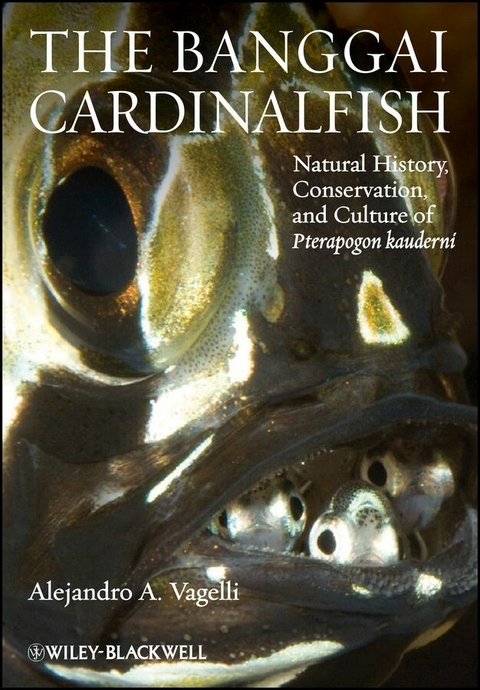
The Banggai Cardinalfish (eBook)
John Wiley & Sons (Verlag)
978-1-119-95036-3 (ISBN)
This book is divided into three main parts: a general introduction to the fish, including a historical synopsis with an overview of the Banggai Archipelago; a comprehensive treatment of the species’ natural history (distribution, morphology, reproduction, embryology, ecology, genetics, systematics and evolution); an account of the conservation of the species, including descriptions of its fishery, attempts to protect it under CITES, and introduction programmes. The book also includes an appendix offering information on captive breeding, juvenile mortality reduction, and common diseases.
This book is a unique resource for ichthyology students and researchers working on fish biology, ecology and conservation, and for marine ornamental fish hobbyists and aquarium professionals.
Visit www.wiley.com/go/vagelli/cardinalfish to access the figures and tables from the book.
Dr Alejandro A. Vagelli is the Director of Science and Conservation at the New Jersey Academy for Aquatic Sciences, and as adjunct professor teaches Marine Biology, Ichthyology, and Marine Conservation at Rutgers University. He is the world’s leading authority on the Banggai cardinalfish, Pterapogon kauderni , and was one of the first people to breed the species successfully in captivity. He has published numerous scientific articles on its biology, ecology, and conservation, and his fieldwork in
The Banggai cardinalfish, Pterapogon kauderni, is a fascinating species that possesses a series of remarkable biological characteristics making it unique among coral reef fishes. It has been the focus of studies in reproduction, ecology, population genetics and evolution. In addition, since its rediscovery in the late 1990s, it has become tremendously popular in the international ornamental fish trade, and indiscriminate collecting has led to its inclusion in the 2007 IUCN Red List as an endangered species. This book is divided into three main parts: a general introduction to the fish, including a historical synopsis with an overview of the Banggai Archipelago; a comprehensive treatment of the species natural history (distribution, morphology, reproduction, embryology, ecology, genetics, systematics and evolution); an account of the conservation of the species, including descriptions of its fishery, attempts to protect it under CITES, and introduction programmes. The book also includes an appendix offering information on captive breeding, juvenile mortality reduction, and common diseases. This book is a unique resource for ichthyology students and researchers working on fish biology, ecology and conservation, and for marine ornamental fish hobbyists and aquarium professionals. Visit www.wiley.com/go/vagelli/cardinalfish to access the figures and tables from the book.
Dr Alejandro A. Vagelli is the Director of Science and Conservation at the New Jersey Academy for Aquatic Sciences, and as adjunct professor teaches Marine Biology, Ichthyology, and Marine Conservation at Rutgers University. He is the world's leading authority on the Banggai cardinalfish, Pterapogon kauderni , and was one of the first people to breed the species successfully in captivity. He has published numerous scientific articles on its biology, ecology, and conservation, and his fieldwork in Indonesia led to the inclusion of the species in the IUCN Red List.
Preface x
Acknowledgments xiii
Part I Introduction 1
1 Introduction 3
1.1 The Banggai cardinalfish and a long rewarding experience 3
2 Historic Review 6
2.1 The improbable first encounter 6
2.2 Rediscovering the "King of the Cardinalfishes," and a prophecy realized 8
2.3 Other field studies 9
3 The Banggai Archipelago 11
4 Field Research in the Banggai Islands 21
4.1 Introduction 21
4.2 A challenging first expedition 22
Part II Natural History 29
5 Geographic Distribution 31
5.1 Introduction 31
5.2 The geographic distribution of Pterapogon kauderni within its natural range 33
5.3 The Luwuk population 36
5.4 The north Sulawesi populations 38
5.5 Other exotic populations 39
5.6 Discussion 40
6 General Survey of Morphology 46
6.1 Introduction and some particulars of the soft anatomy 46
6.2 Main osteological characteristics (Figure 6.2a, see Tables 6.1, 6.2 for selected body proportions and counts) 49
7 Reproductive Biology 58
7.1 General aspects of reproduction in Apogonidae 58
7.2 The reproductive biology of Pterapogon kauderni 75
8 Ecology 94
8.1 Main ecological aspects of Apogonidae 94
8.2 Habitat and microhabitat preference of Pterapogon kauderni 95
8.3 Common fish assemblages including Pterapogon kauderni 101
8.4 Group structure 102
8.5 Reproductive ecology 104
8.6 Trophic habits 109
8.7 Likely predators of Pterapogon kauderni 119
8.8 Natural occurrence of parasites in Pterapogon kauderni 120
9 Genetics 123
9.1 Introduction 123
9.2 Genetic structure in Pterapogon kauderni 124
9.3 Possible spot polymorphism 125
10 Systematics and Evolution 128
10.1 Introduction 128
10.2 Taxonomy of Pterapogon kauderni 130
10.3 Recent phylogenetic studies and intergeneric relationships of Pterapogon 131
10.4 Direct development and the Banggai-Australian connection: Could ontogeny and paleogeography provide hints about the origin and intergeneric relationships of Pterapogon? 132
10.5 Evolution of Apogonidae. The case for a freshwater-origin of the family 138
Part III Conservation 145
11 The Fishery of Pterapogon kauderni 147
11.1 Introduction: Pterapogon kauderni, a species particularly susceptible to high collection pressure 147
11.2 The history of the trade 149
11.3 Field surveys and a bleak conservation situation 150
11.4 The capture, handling and shipping of Pterapogon kauderni: high mortality explained 152
12 Conservation of Pterapogon kauderni, a Challenge Still Ahead 158
12.1 The unsuccessful proposal for regulating the capture and trade of Pterapogon kauderni 158
12.2 The real significance of Pterapogon kauderni in the local economy. Why the livelihood of the Banggai
people should not be used as an excuse to prevaricate the protection of this species 160
12.3 The potential benefits of and resistance to regulate the capture and trade of Pterapogon kauderni 161
13 The Lembeh Conundrum, from a Careless Action to a Grave Conservation Situation 166
13.1 The "Lembeh population" and its impact in the Lembeh Strait 166
13.2 A word for the hobbyists 170
Part IV Appendix 173
14 Captive Breeding and Rearing of Pterapogon kauderni 175
14.1 Introduction 175
14.2 Reproduction 176
14.3 Nutritional aspects 181
14.4 Diseases: a new viral infection 183
References 186
Index 198
COMPANION WEBSITE
This book has a companion website: www.wiley.com/go/vagelli/cardinalfish
with Figures and Tables from the book for downloading
"An authoritative synthesis of everything we know about
this important yet endangered ornamental fish that also plays an
important ecological role on Indonesian coral reefs."
(Bulletin of the British Ecological Society, 1 June
2012)
2
Historic Review
2.1 The improbable first encounter
At the end of his remarkable 1917–1920 expedition to the Celebes Islands (Sulawesi), Swedish zoologist Walter A. Kaudern collected two juvenile specimens of a beautiful silver and black striped fish at the shore of Banggai Island, and sent them to the Leiden Museum of Natural History (Figure 2.1). These were the first two specimens of Pterapogon kauderni ever collected, but as we will see, this collection was an unlikely event.
Although Kaudern earned his Ph.D. in zoology, he was a naturalist with ample knowledge and training in geology, botany, geography and anthropology. He traveled to Celebes with the idea of conducting zoological studies, and to a lesser extent, to carry out anthropological surveys. He wrote, “in order to contribute to the solving of the zoo-geographical questions connected with the island of Celebes in the Dutch East Indies, I went in December 1916 to this island.” “Besides the zoological work, I intended to study the natives of the country as far as time would allow,” and “I preferably intended to go to districts not yet visited by any naturalist, or to which some naturalist or other had only paid a short visit” (Kaudern, 1925). However, he ended up focusing mainly on ethnographical research: “We took more and more interest in the natives, and at last the study of them became the principal part of our work” (Kaudern, 1925).
Thus, after spending three years conducting groundbreaking ethnographic studies in virtually all areas of Sulawesi, Kaudern made his only trip to the Banggai region on January 23, 1920. He departed from Luwuk in a Dutch steamer, crossed the Peleng Strait, and set up his headquarters in Oeliasan (Banggai Island). He made two excursions to the southern-central-west areas of Peleng Island, and at some point in February, he collected the two specimens of cardinalfish. Then, on February 23, Kaudern crossed back to central Sulawesi and traveled south, continuing his voyage to Java and the Philippines, and finally returning definitively to Sweden in February, 1921, where he later became curator of the geological department of the Gothenburg Museum.
Figure 2.1 Syntypes of Pterapogon kauderni. Some time in February 1920, Kaudern collected these two specimens in Banggai Island and sent them to the National Museum of Natural History in Leiden, Netherlands. In 1933, Koumans found the fish and described them as a new genus and species.
It seems that Kaudern did not collect any other fishes during his stay in the Banggai region.1 Although he most likely did not know it, had he missed or neglected to collect the two specimens while in Banggai, he would have never encountered this species again. As renowned expert in apogonid taxonomy Tom Fraser recently told me, “Kaudern collected many biological specimens from Sulawesi and Madagascar. We are fortunate that he did so in Banggai. Most ichthyologists would have passed over this region, assuming a broader distribution for species in the general region.”
The specimens at the Leiden Museum were forgotten for 13 years. By the time ichthyologist Frederick Koumans found them, they still had conserved their general living color patterns, which he was able to depict in his description of P. kauderni. Although he referred to it as “this nice species,” in his drawing some details are missing, and while the details were irrelevant for the description (no other cardinalfish can be confused with it), it reveals that the specimens had lost some of their original appearance. Thus, although Koumans recognized its attractiveness, he probably did not realize the true splendor of the species he was describing. Koumans created the new genus Pterapogon (“Apogon with long fins”), because the presence of 14 rays in the second dorsal fin distinguished it from all other apogonids (Koumans, 1933). He named the species in honor of its collector.
About 40 years later, Tomas Fraser (1972) studied the original specimens by using x-rays as part of his comprehensive osteological analysis and groundbreaking taxonomic revision of Apogonidae. However, the absence of more specimens and virtually any other data, including information on its geographic distribution, soft tissues, and biology, excluded P. kauderni from being part of any further studies. Thus, the Banggai cardinalfish was forgotten again.
2.2 Rediscovering the “King of the Cardinalfishes,” and a prophecy realized
In 1992, world authority in Indopacific fishes Gerald Allen received an underwater photograph showing a group of unknown cardinalfish. The photograph was taken by dive-guidebook author Kal Muller during a recent visit to the Banggai Island. Allen first thought that this “incredible beautiful fish” (Allen, 1996) was a new species. Two years later, he finally had the opportunity to go and find them. While at a conference in Manado (north Sulawesi), he and underwater photographer Roger Steene traveled to southwest Banggai Island. Following Mr. Muller’s directions, they found P. kauderni close to a jetty at an oyster pearl farm in a small bay (Allen & Steene, 1995; Allen, 1996). Interestingly, years later this “pearl farm” population became of fundamental importance for the assessment of P. kauderni’s conservation status, given that it is the only population within the Banggai Archipelago that has been off limits to all fishing–collecting activities since before the capture of P. kauderni began, and it is located in a site where no human-induced habitat degradation has occurred. Thus, Gerald Allen was the first scientist to encounter P. kauderni in the wild and to publish observations on its environment, as well as on some of its behavioral aspects. He was the first to report the production of large eggs, as well as the oral incubation of post-hatched embryos (Allen & Steene, 1995).
In Allen’s 1996 article, aimed at marine fish hobbyists, he stated, “it seems hard to believe that Pterapogon kauderni, with its exquisite shape and bold color pattern, has escaped the attention of collectors, considering that Indonesia is a leading exporter of marine fishes for the international aquarium trade.” Allen attributed this to what he correctly assumed to be “an extremely restricted geographic distribution.” He predicted that it was “only a matter of time before this fish makes a big splash on the world aquarium scene … I am sure the King of the Cardinals will soon claim its rightful place near the top of everyone’s list of aquarium favorites” (Allen, 1996).
However, at the time he wrote these lines, Allen probably did not foresee that only a few years later he would witness the beginning of tremendous collecting pressure over his “king.” In November 1998, Allen went back to the Banggai Archipelago as the Ichthyology and Science team leader of Conservation International’s Marine Rapid Assessment Program (RAP) in collaboration with the Indonesian Institute of Sciences. He found Pterapogon kauderni in five localities, and observed it in association with several living substrates in different habitats. Also, he noticed that it was “being harvested at an alarming rate,” and saw thousands of specimens in holding cages waiting to be sold. Allen stated that such a level of collecting pressure combined with the species’ low productivity and extremely limited geographic distribution “seriously threatens the species’ survival” (Allen, 2001). Thus, just four years after he predicted the “big splash on the world aquarium scene,” he recommended its protection in CITES2 and pled its inclusion in the IUCN2 Red List (Allen, 2000, 2001).
2.3 Other field studies
In 2001, Kristin Lunn and Marie-Annick Moreau (McGill University, Canada) conducted a detailed trade survey of Pterapogon kauderni, including its origin and extent, routes of local trade, capture practices, and volumes in the Banggai Archipelago (Banggai, Labobo, Bangkulu, Peleng, Bokan, Kokudan, Telopo, and BuangBuang Islands) and in north Sulawesi (including Luwuk, Bitung, Tumback and Manado). Also, they conducted observations on group structure, density and microhabitat associations at the “pearl farm” site, in the southwest Banggai Island, the only site within the Banggai region in which all fishing, including capture of P. kauderni, has not been allowed since before the beginning of its trade (Lunn & Moreau, 2002, 2004).
In 2000 and 2002, Niclas Kolm and Andres Berglund (Uppsala University, Sweden) visited the Banggai region (Banggai, Bangkulu and Peleng Islands) and conducted field experiments on reproductive territorial behavior, familiarity, and homing behavior. They studied the effect of capture on group size and density. Additionally, by analyzing genetic samples collected during these fieldworks, they carried out studies on possible kin group formation, and genetic structure (Kolm & Berglund, 2003, 2004; Kolm et al., 2005; Hoffman et al., 2005).
In 2004, an NGO based in Sulawesi carried out a study on the ornamental fish trade, particularly focusing on P. kauderni, and its relation to impoverished people’s livelihoods. It was funded by the European Community – Poverty Reduction Effectiveness Programme (EC-PREP), and it took place on several sites of Banggai, Peleng, Telopo, and Bokan Islands. The main project aim was to...
| Erscheint lt. Verlag | 11.7.2011 |
|---|---|
| Sprache | englisch |
| Themenwelt | Naturwissenschaften ► Biologie ► Limnologie / Meeresbiologie |
| Naturwissenschaften ► Biologie ► Ökologie / Naturschutz | |
| Naturwissenschaften ► Biologie ► Zoologie | |
| Technik | |
| Schlagworte | Ãkologie / Salzwasser • Biowissenschaften • Fische • Life Sciences • Marine Ecology • Ökologie / Salzwasser • Pterapogon kauderni, coral reef fish, Banggai cardinalfish and reproduction, Banggai cardinalfish and ecology, Banggai cardinalfish and population, Banggai cardinalfish and genetics, Banggai cardinalfish and evolution. |
| ISBN-10 | 1-119-95036-8 / 1119950368 |
| ISBN-13 | 978-1-119-95036-3 / 9781119950363 |
| Informationen gemäß Produktsicherheitsverordnung (GPSR) | |
| Haben Sie eine Frage zum Produkt? |
 EPUB (Adobe DRM)
Kopierschutz: Adobe-DRM
Adobe-DRM ist ein Kopierschutz, der das eBook vor Mißbrauch schützen soll. Dabei wird das eBook bereits beim Download auf Ihre persönliche Adobe-ID autorisiert. Lesen können Sie das eBook dann nur auf den Geräten, welche ebenfalls auf Ihre Adobe-ID registriert sind.
Details zum Adobe-DRM
Dateiformat: EPUB (Electronic Publication)
EPUB ist ein offener Standard für eBooks und eignet sich besonders zur Darstellung von Belletristik und Sachbüchern. Der Fließtext wird dynamisch an die Display- und Schriftgröße angepasst. Auch für mobile Lesegeräte ist EPUB daher gut geeignet.
Systemvoraussetzungen:
PC/Mac: Mit einem PC oder Mac können Sie dieses eBook lesen. Sie benötigen eine
eReader: Dieses eBook kann mit (fast) allen eBook-Readern gelesen werden. Mit dem amazon-Kindle ist es aber nicht kompatibel.
Smartphone/Tablet: Egal ob Apple oder Android, dieses eBook können Sie lesen. Sie benötigen eine
Geräteliste und zusätzliche Hinweise
Buying eBooks from abroad
For tax law reasons we can sell eBooks just within Germany and Switzerland. Regrettably we cannot fulfill eBook-orders from other countries.
aus dem Bereich