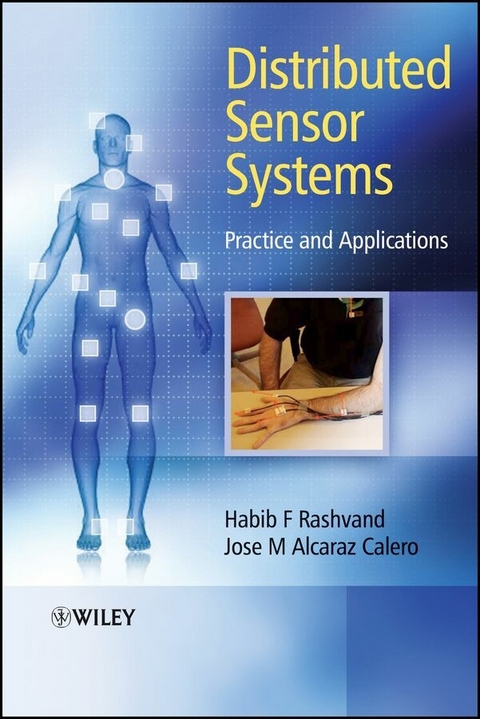
Distributed Sensor Systems (eBook)
416 Seiten
John Wiley & Sons (Verlag)
978-1-119-94198-9 (ISBN)

areas of development for distributed sensing systems
In this book, the authors discuss the technological developments
lead by sensor technology, addressing viable new applications to
inspire a technological evolution. Under the advanced and visionary
approach of distributed intelligence, the authors focus on three
distinct but tightly inter-related areas of developments for
distributed sensing systems (DSS): firstly, the sensor technology
embracing the conversion of the phenomena of interest into
desirable form of signal such as electric, secondly, the
interaction process between sensing points which requires immense
intelligence loosely called networking, and finally, the adoption
of useful maturing systems through potential applications for right
impacts for a better life and a brighter economy. Furthermore, the
book contains a number of case studies and typical applications
illustrating the technical details, features and functions of the
systems, as well as demonstrating their benefits and
limitations.
Key Features:
* Discusses the technological developments lead by sensor
technology
* Addresses viable new applications
* Contains a number of case studies and typical applications
illustrating the technical details, features and functions of the
systems
* Demonstrates the benefits and limitations of distributed
sensing
* Written by experts with vast experience in the field (both in
academia and industry)
This book will be an invaluable reference for postgraduates
studying related courses (communication engineering, engineering
management, computer systems, industrial process, automation,
design, environmental, urban, surveillance), R&D engineers,
system and application designers, researchers, industrial project
managers and engineers, and technical and strategic managers
planning new products.
Professor Habib F. Rashvand, University of Warwick, UK Habib F. Rashvand is a Full European Professor of Networks, Systems & Protocols at the University of Warwick. Over the past 20 years, Habib has worked in a number of positions for a variety of industrial research and innovative developments with Racal, Vodafone, Nokia and Cable & Wireless plc in collaboration with Portsmouth University, Southampton University, Reading University, Warwick University and Coventry University. He gained his engineering qualifications from the University of Tehran in 1970s, a degree in coding in1980 from the University of Kent, and a professorship in 1998.
List of Figures xi
List of Tables xxi
Preface xxiii
Acknowledgements xxvii
List of Abbreviations xxix
1 Distributed Sensors 1
1.1 Primary Objectives 1
1.1.1 User-Based Category 2
1.1.2 Sector-Based Category 5
1.1.3 Primary Objectives 5
1.2 Historical Development 8
1.2.1 Sensing 8
1.2.2 Historical Sensor Generations 8
1.3 Trends and Technology 10
1.3.1 Market Development Trends 10
1.3.2 Technological Developments 12
1.4 Distributed Intelligence 15
1.4.1 Innovation 16
1.4.2 Dis-Invention 19
1.4.3 Intelligent Agent 19
1.4.4 Deployment Factor 20
1.4.5 Overlay Network 21
1.4.6 Deployment Algorithm 21
1.5 Classifying Application Areas 25
1.5.1 Domain-Based Classification 26
1.5.2 Mobility-Based Classification 26
1.5.3 Intelligence-Based Classification 27
2 Smart Sensing Devices 31
2.1 Specification and Classification 31
2.2 Elementary Sensing Circuits and Devices 36
2.2.1 Elementary Electrical Sensors 37
2.2.2 Low Energy Integration 39
2.3 Actuator Interface Structures 41
2.4 Physical Phenomena Sensing Devices 45
2.4.1 Optical Sensors 45
2.4.2 Image Sensing 46
2.5 Biological and Chemical Phenomena Sensing Devices 48
2.6 Other Sensors and Actuators 54
3 Smart Sensing Architectures 59
3.1 Smart Sensor Nodes 60
3.1.1 Hardware 62
3.1.2 Software 62
3.2 Embedded Operating Systems 67
3.3 Network Formation 70
3.3.1 Node Placement 76
3.4 Networking Protocols 77
3.4.1 Location-Based Protocols 79
3.4.2 Data-Centric Protocols 83
3.4.3 Hierarchical Routing 86
3.4.4 Mobility-Based Routing Protocols 90
3.4.5 Other Routing Protocols 93
3.5 Cross-Layer Optimisation 95
3.6 Inference and Aggregation 99
3.7 Case Study: Smart Camera Networks 103
3.8 Case Study: Collaborative Beamforming 107
4 Monitoring Well Being 115
4.1 Measuring Health 116
4.2 Managing Chronic Diseases 125
4.3 Case Study: Smart Shirts 132
4.4 Case Study: Geriatric Care 136
4.5 Case Study: Outpatient Care 141
5 Clinical Applications 149
5.1 Surgical Applications 150
5.2 Dental Applications 161
5.3 Scalp Applications 165
5.4 Post-Operative Applications 171
5.5 Emergency Case Studies 181
6 Smart Home, Smart Office 189
6.1 Application Requirements 190
6.2 Energy and Resource Optimisation 198
6.3 Smart Home Case Studies 203
6.4 Smart Office Case Studies 212
7 Public Safety Applications 221
7.1 Monitoring Airborne Toxins 223
7.2 Monitoring Forest Fires 228
7.3 Monitoring Structural Health 233
7.4 Monitoring Traffic 242
7.5 Case Study: Sink Location 250
7.6 Case Study: Congestion Avoidance 254
7.7 Case Study: Target Tracking and Surveillance 257
8 Geographical Applications 261
8.1 Farming Industry 261
8.2 Mining Industry 270
8.3 Transportation 274
8.4 Remote Sensing and Imaging 279
8.5 Earth Resources Observation 282
8.6 Underwater Sensing 287
Appendix A Further Details on Potential Devices and Systems 293
A.1 Accelerometers 293
A.2 Equipment 295
A.2.1 Tomography 296
A.2.2 Gadgets 300
A.3 Smart Sensors Devices 302
A.3.1 Mica2 and Mica2Dot 302
A.3.2 MicaZ 307
A.3.3 Telos and TMote Sky 308
A.3.4 Fleck3 and FleckNano 310
A.3.5 3Mate! 312
A.3.6 IMote 2 312
A.3.7 System-on-Chip CC2510 313
A.3.8 System-on-Chip CC2530 314
A.4 Networks and Protocols 315
A.4.1 ZigBee 315
A.4.2 RFID and Wireless Sensor Integration 318
A.4.3 Wireless Sensors for Industrial Environments 319
A.5 Systems 321
References 325
Index 337
| Erscheint lt. Verlag | 21.2.2012 |
|---|---|
| Sprache | englisch |
| Themenwelt | Technik ► Elektrotechnik / Energietechnik |
| Technik ► Nachrichtentechnik | |
| Schlagworte | Communication Technology - Networks • Computer Science • Electrical & Electronics Engineering • Elektrotechnik u. Elektronik • Informatik • Kommunikationsnetz • Kommunikationsnetze • Networking • Netzwerke |
| ISBN-10 | 1-119-94198-9 / 1119941989 |
| ISBN-13 | 978-1-119-94198-9 / 9781119941989 |
| Informationen gemäß Produktsicherheitsverordnung (GPSR) | |
| Haben Sie eine Frage zum Produkt? |
 EPUB (Adobe DRM)
Kopierschutz: Adobe-DRM
Adobe-DRM ist ein Kopierschutz, der das eBook vor Mißbrauch schützen soll. Dabei wird das eBook bereits beim Download auf Ihre persönliche Adobe-ID autorisiert. Lesen können Sie das eBook dann nur auf den Geräten, welche ebenfalls auf Ihre Adobe-ID registriert sind.
Details zum Adobe-DRM
Dateiformat: EPUB (Electronic Publication)
EPUB ist ein offener Standard für eBooks und eignet sich besonders zur Darstellung von Belletristik und Sachbüchern. Der Fließtext wird dynamisch an die Display- und Schriftgröße angepasst. Auch für mobile Lesegeräte ist EPUB daher gut geeignet.
Systemvoraussetzungen:
PC/Mac: Mit einem PC oder Mac können Sie dieses eBook lesen. Sie benötigen eine
eReader: Dieses eBook kann mit (fast) allen eBook-Readern gelesen werden. Mit dem amazon-Kindle ist es aber nicht kompatibel.
Smartphone/Tablet: Egal ob Apple oder Android, dieses eBook können Sie lesen. Sie benötigen eine
Geräteliste und zusätzliche Hinweise
Buying eBooks from abroad
For tax law reasons we can sell eBooks just within Germany and Switzerland. Regrettably we cannot fulfill eBook-orders from other countries.
aus dem Bereich