


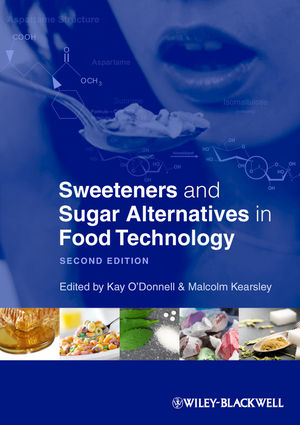
Sweeteners and Sugar Alternatives in Food Technology (eBook)
John Wiley & Sons (Verlag)
978-1-118-37397-2 (ISBN)
Now in a revised and updated new edition which contains seven new chapters, part I of this volume addresses relevant digestive and dental health issues as well as nutritional considerations. Part II covers non-nutritive, high-potency sweeteners and, in addition to established sweeteners, includes information to meet the growing interest in naturally occurring sweeteners. Part III deals with the bulk sweeteners which have now been used in foods for over 20 years and are well established both in food products and in the minds of consumers. In addition to the 'traditional' polyol bulk sweeteners, newer products such as isomaltulose are discussed. These are seen to offer many of the advantages of polyols (for example regarding dental heath and low glycaemic response) without the laxative side effects if consumed in large quantity. Part IV provides information on the sweeteners which do not fit into the above groups but which nevertheless may offer interesting sweetening opportunities to the product developer. Finally, Part V examines bulking agents and multifunctional ingredients which can be beneficially used in combination with all types of sweeteners and sugars.
Kay O’Donnell has worked in the food industry for over 20 years, in a variety of senior R&D and commercial roles, for companies including Forum Bioscience, Cadbury, Kraft, GSK and Mars.
Malcolm W. Kearsley was most recently a Principal Scientist with Cadbury at their research centre in Reading, UK. After a career in teaching, research and technical sales in the food industry, he is now retired.
This book provides a comprehensive and accessible source of information on all types of sweeteners and functional ingredients, enabling manufacturers to produce low sugar versions of all types of foods that not only taste and perform as well as sugar-based products, but also offer consumer benefits such as calorie reduction, dental health benefits, digestive health benefits and improvements in long term disease risk through strategies such as dietary glycaemic control. Now in a revised and updated new edition which contains seven new chapters, part I of this volume addresses relevant digestive and dental health issues as well as nutritional considerations. Part II covers non-nutritive, high-potency sweeteners and, in addition to established sweeteners, includes information to meet the growing interest in naturally occurring sweeteners. Part III deals with the bulk sweeteners which have now been used in foods for over 20 years and are well established both in food products and in the minds of consumers. In addition to the "e;traditional"e; polyol bulk sweeteners, newer products such as isomaltulose are discussed. These are seen to offer many of the advantages of polyols (for example regarding dental heath and low glycaemic response) without the laxative side effects if consumed in large quantity. Part IV provides information on the sweeteners which do not fit into the above groups but which nevertheless may offer interesting sweetening opportunities to the product developer. Finally, Part V examines bulking agents and multifunctional ingredients which can be beneficially used in combination with all types of sweeteners and sugars.
Kay O'Donnell has worked in the food industry for over 20 years, in a variety of senior R&D and commercial roles, for companies including Forum Bioscience, Cadbury, Kraft, GSK and Mars. Malcolm W. Kearsley was most recently a Principal Scientist with Cadbury at their research centre in Reading, UK. After a career in teaching, research and technical sales in the food industry, he is now retired.
"This second edition is a successfully revised and updated
new version containing also seven new chapters. The authors
have been assisted by an excellent team of co-workers, especially
experienced in the field of food sweetness."
(Advances in Food Sciences, 1 October 2013)
| Erscheint lt. Verlag | 13.7.2012 |
|---|---|
| Sprache | englisch |
| Themenwelt | Technik ► Lebensmitteltechnologie |
| Weitere Fachgebiete ► Land- / Forstwirtschaft / Fischerei | |
| Schlagworte | Alternatives • Beyond • Book • consumption • contribution • criticized • Dental • Food • Food Marketing & Product Development • Food Processing, Production & Manufacture • Foods • Food Science & Technology • Fructose • Herstellung u. Verarbeitung von Lebensmitteln • Human • indulgence • ingredients • Lebensmittelforschung u. -technologie • Lebensmitteltechnik • Lebensmittel-Vermarktung u. -Produktentwicklung • many • Obesity • Problems • relieving • Remain • Süssstoff • Subject • sucrose • Sugar • Süssstoff • Sweet • Sweetener • syrups • Technology • Value • World • years • Zuckeraustauschstoffe • Zusatzstoffe |
| ISBN-10 | 1-118-37397-9 / 1118373979 |
| ISBN-13 | 978-1-118-37397-2 / 9781118373972 |
| Informationen gemäß Produktsicherheitsverordnung (GPSR) | |
| Haben Sie eine Frage zum Produkt? |
 EPUB (Adobe DRM)
Kopierschutz: Adobe-DRM
Adobe-DRM ist ein Kopierschutz, der das eBook vor Mißbrauch schützen soll. Dabei wird das eBook bereits beim Download auf Ihre persönliche Adobe-ID autorisiert. Lesen können Sie das eBook dann nur auf den Geräten, welche ebenfalls auf Ihre Adobe-ID registriert sind.
Details zum Adobe-DRM
Dateiformat: EPUB (Electronic Publication)
EPUB ist ein offener Standard für eBooks und eignet sich besonders zur Darstellung von Belletristik und Sachbüchern. Der Fließtext wird dynamisch an die Display- und Schriftgröße angepasst. Auch für mobile Lesegeräte ist EPUB daher gut geeignet.
Systemvoraussetzungen:
PC/Mac: Mit einem PC oder Mac können Sie dieses eBook lesen. Sie benötigen eine
eReader: Dieses eBook kann mit (fast) allen eBook-Readern gelesen werden. Mit dem amazon-Kindle ist es aber nicht kompatibel.
Smartphone/Tablet: Egal ob Apple oder Android, dieses eBook können Sie lesen. Sie benötigen eine
Geräteliste und zusätzliche Hinweise
Buying eBooks from abroad
For tax law reasons we can sell eBooks just within Germany and Switzerland. Regrettably we cannot fulfill eBook-orders from other countries.
aus dem Bereich


