


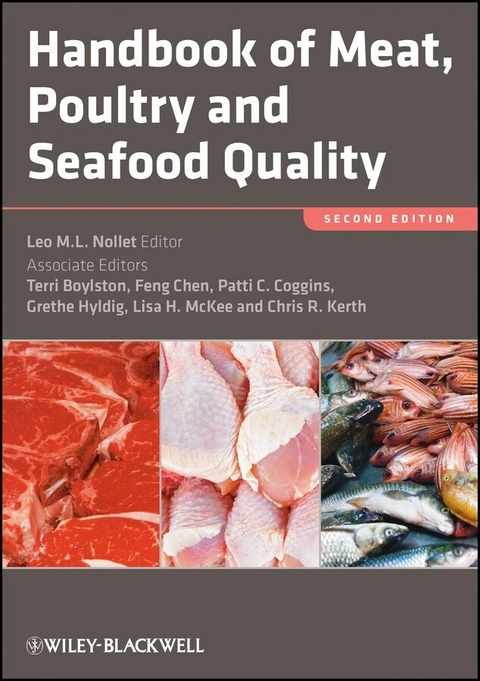
Handbook of Meat, Poultry and Seafood Quality (eBook)
John Wiley & Sons (Verlag)
978-1-118-35245-8 (ISBN)
The Editor
Dr. Leo M. L. Nollet, Professor of Biotechnology, Department of Engineering Science, Ghent, Belgium
Associate Editors
Dr. Terri Boylston, Department of Food Science and Human Nutrition, Iowa State University, Ames, Iowa, USA
Dr. Feng Chen, Department of Food, Nutrition, and Packaging Sciences, Clemson University, Clemson, South Carolina, USA
Dr. Patti C. Coggins, Food Science, Nutrition, and Health Promotion, Mississippi State University, Starkville, Mississippi, USA
Dr. Grethe Hyldig, Division of Industrial Food Research, National Food Institute, Technical University of Denmark, Kongens Lyngby, Denmark
Professor Lisa McKee, Human Nutrition and Food Science, College of Agricultural, Consumer and Environmental Sciences, New Mexico State University, Las Cruces, New Mexico, USA
Dr. Chris R. Kerth, Department of Animal Science, College of Agriculture and Life Sciences, Texas A&M University, College Station, Texas, USA
A great need exists for valuable information on factors affecting the quality of animal related products. The second edition of Handbook of Meat, Poultry and Seafood Quality, focuses exclusively on quality aspects of products of animal origin, in depth discussions and recent developments in beef, pork, poultry, and seafood quality, updated sensory evaluation of different meat products, revised microbiological aspects of different meat products. Also, included are new chapters on packaging, new chapters and discussion of fresh and frozen products, new aspects of shelf life and recent developments in research of meat tainting. This second edition is a single source for up-to-date and key information on all aspects of quality parameters of muscle foods is a must have. The reader will have at hand in one focused volume covering key information on muscle foods quality.
The Editor Dr. Leo M. L. Nollet, Professor of Biotechnology, Department of Engineering Science, Ghent, Belgium Associate Editors Dr. Terri Boylston, Department of Food Science and Human Nutrition, Iowa State University, Ames, Iowa, USA Dr. Feng Chen, Department of Food, Nutrition, and Packaging Sciences, Clemson University, Clemson, South Carolina, USA Dr. Patti C. Coggins, Food Science, Nutrition, and Health Promotion, Mississippi State University, Starkville, Mississippi, USA Dr. Grethe Hyldig, Division of Industrial Food Research, National Food Institute, Technical University of Denmark, Kongens Lyngby, Denmark Professor Lisa McKee, Human Nutrition and Food Science, College of Agricultural, Consumer and Environmental Sciences, New Mexico State University, Las Cruces, New Mexico, USA Dr. Chris R. Kerth, Department of Animal Science, College of Agriculture and Life Sciences, Texas A&M University, College Station, Texas, USA
Preface viii
Contributors x
PART ONE: QUALITY ASPECTS OF PRODUCTS OF ANIMAL ORIGIN
1
1 Chemical and Biochemical Aspects of Color in Muscle Foods
3
José Ángel Pérez-Alvarez and Juana
Fernández-López
2 Sensory Methodology of Muscle Foods 25
Patti C. Coggins
3 Attributes of Muscle Foods: Color, Texture, Flavor 35
Patti C. Coggins
4 Recent Developments in Flavor Measurements 45
Jean-Luc Le Quéré
PART TWO: FLAVOR 63
5 Sensory Characterization 65
Karen L. Bett-Garber
6 Chemical Characterization 76
Neil C. Da Costa and Sanja Eri
7 Process Flavors 91
Hyung Hee Baek
8 Savory Flavors 105
Christoph Cerny
9 Off Flavors and Rancidity in Foods 127
Ronald B. Pegg and Fereidoon Shahidi
10 Land Animal Products 140
Terri Boylston
11 Marine Animal and Plant Products 156
Narendra Narain and Maria Lúcia Nunes
PART THREE: BEEF QUALITY 173
12 Sensory Evaluation of Beef Flavor 175
Rhonda K. Miller
13 Beef Quality and Tainting 192
Leo M.L. Nollet
14 Microbiological and Sensory Properties of Beef 199
Jack Thomas
15 Quality Measurements in Beef 208
Susan Brewer
16 Shelf Life of Meats 232
Leo M.L. Nollet
17 Packaging and Freezing of Beef as Related to Sensory
Properties 246
Leo M.L. Nollet
PART FOUR: PORK QUALITY 255
18 Sensory Evaluation of Pork Flavor 257
Veronika Válková
19 Pork Taint 280
William Benjy Mikel
20 Microbiological and Sensory Properties of Fresh and Frozen
Pork Products 292
Lisa McKee
21 Shelf Life of Fresh and Frozen Pork 308
Sancho Bañon Arias
22 Packaging of (Fresh and Frozen) Pork 321
Maurice O'Sullivan and Joseph P. Kerry
PART FIVE: POULTRY QUALITY 341
23 Poultry Meat Flavor 343
Paul L. Dawson and Nick Spinelli
24 Poultry Quality and Tainting 360
María de Lourdes Pérez-Chabela and Alfonso
Totosaus
25 Microbiological and Sensory Properties of Fresh and Frozen
Poultry 373
Lisa McKee
26 Quality Indicators in Poultry Products 390
Lisa Mckee, Elizabeth Cobb, and Sarah Padilla
27 Shelf Life of Fresh and Frozen Poultry 410
María de Lourdes Pérez-Chabela
28 Packaging of Fresh and Frozen Poultry 423
Alfonso Totosaus and V. Kuri
PART SIX: SEAFOOD QUALITY 435
29 Quality Index Methods 437
Grethe Hyldig, Allan Bremner, Emilia Martinsdóttir, and
Rian Schelvis
30 Sensory Quality of Fish 459
Grethe Hyldig
31 Quality of Frozen Fish 479
Alex Augusto Gonçalves, Jette Nielsen, and Flemming
Jessen
32 Packaging for Chilled and Frozen Seafood 510
Alex Augusto Gonçalves
Index 546
1 Chemical and Biochemical Aspects of Color in Muscle Foods
José Ángel Pérez-Alvarez and Juana Fernández-López
Abstract: Color is the main aspect that defines a food’s quality and that most influences consumer choice. Sensorial quality, especially color and appearance of meat, can be affected by both internal and external factors.
Chromoproteins, carotenes, and carotenoproteins are important in meat color. Carotenes are responsible for the color of beef fat, poultry meat and skin, fish, and shellfish. Of the hemoglobins present postmortem in the muscle, myoglobin is the one mainly responsible for color. Cytochromes are metalloproteins with a heme group with a role in meat coloration. The principal role of fat is in the brightness of meat products.
The color of meat may be altered by several factors, including exposure to light, microbial growth, rancidity, and exposure to oxygen.
Keywords: Muscle-based food color, carotenes, hemoproteins, myoglobin, cytochromes, fat color, melanosis, discoloration, premature browning, shelf life
1.1 GENERAL ASPECTS OF MUSCLE-BASED FOOD COLOR
The first impression that a consumer receives concerning a food product is established visually, and among the properties observed are color, form, and surface characteristics. Color is the main aspect that defines a food’s quality, and a product may be rejected simply because of its color, even before other properties, such as aroma, texture, and taste, can be evaluated. This is why the appearance (optical properties, physical form, and presentation) of muscle-based products at the sales point is of such importance (Lanari et al. 2002).
Regarding the specific characteristics that contribute to the physical appearance of meat, color is the quality that most influences consumer choice (Krammer 1994). The relationship between meat color and quality has been the subject of study since the 1950s, indeed, since Urbain (1952) described how consumers had learned through experience that the color of fresh meat is bright red, and any deviation from this color (nonuniform or anomalous coloring) is unacceptable (Diestre 1992). The color of fresh meat and associated adipose tissue is, then, of great importance for its commercial acceptability, especially in the cases of beef and lamb (Cornforth 1994), and in certain countries, for example, the USA and Canada, there have been many studies to identify the factors controlling its stability. Adams and Huffman (1972) affirmed that consumers relate the color of meat to its freshness. In poultry, the consumers of many countries also associate meat color with the way in which the animal was raised (intensive or extensive) and fed (cereals, animal feed, etc.).
Color as a quality factor for meat can be appreciated in different ways in different countries; for example, in Denmark, pork meat color holds fifth place among qualities that affect consumers’ purchase decisions (Bryhni et al. 2002). The sensorial quality, especially color and appearance (Brewer & Mckeith 1999), of meat can be affected by both internal and external factors. In the case of internal factors, in fish, for example, a particular problem that has been encountered in rearing some Pargus species is the darkening of the body after the capture of wild fish and during farming. During farming and marketing, the skin color (silver-red) turns dark gray (especially the tail and fins) (Kentouri et al. 1995; Lin et al. 1998). In the case of farmed salmon, too, feeding fish with carotenoid pigments is regarded as the most important management practice for marketing (Moe 1990), because without them, flesh and skin color would be less visually attractive, and therefore would be less valued as a food (Baker 2002).
Food technologists, especially those concerned with the meat industry, have a special interest in the color of food for several reasons—first, because of the need to maintain a uniform color throughout processing; second, to prevent any external or internal agent from acting on the product during its processing, storage, and display; third, to improve or optimize a product’s color and appearance; and, lastly, to attempt to bring the product’s color into line with what the consumer expects. Put simply, the color of meat is determined by the pigments present in it. These can be classified into four types: (1) biological pigments (carotenes and hemopigments), which are accumulated or synthesized in the organism antemortem (Lanari et al. 2002); (2) pigments produced as a result of damage during manipulation or inadequate processing conditions; (3) pigments produced postmortem (through enzymatic or nonenzymatic reactions) (Montero et al. 2001; Klomklao et al. 2006); and (4) pigments resulting from the addition of natural or artificial colorants (Fernández-López et al. 2002).
As a quality parameter, color has been widely studied in fresh meat (MacDougall 1982; Cassens et al. 1995; Faustman et al. 1996) and cooked products (Anderson et al. 1990; Fernández-Ginés et al. 2003; Fernández-López et al. 2003). However, dry-cured meat products have received less attention (Pérez-Alvarez 1996; Pagán-Moreno et al. 1998; Aleson et al. 2003) because in this type of product, color formation takes place during different processing stages (Pérez-Alvarez et al. 1997; Fernández-López et al. 2000); recently, a new heme pigment has been identified in this type of product (Parolari et al. 2003; Wakamatsu et al. 2004a, b). From a practical point of view, color plays a fundamental role in the animal production sector, especially in meat production (beef and poultry, basically) (Zhou et al. 1993; Esteve 1994; Verdoes et al. 1999; Irie 2001), since in many countries of the European Union (e.g., Spain and Holland) paleness receives a wholesale premium.
For fish, skin and flesh discoloration is a very important problem, especially in highly appreciated species. Since the skin and flesh color must be very vivid, many efforts have been directed at improving color, mainly through dietary control (carotene-enriched diets) (Fujita et al. 1983; Mori 1993). Without these pigments, the aquaculture industry would find it hard to undertake the production of some species because fish demand is driven through consumer demand for quality products (Baker 2002). In fish, consumer preference is often influenced by body pigmentation. Fish flesh color is an important quality parameter for most farmed fish, especially with salmonids (salmon, rainbow trout), (Francis 1995; Hyun et al. 1999), in which the pink or red color of fillets is an important feature (Sigurgisladottir et al. 1994; Sigurgisladottir et al. 1997). For example, a uniform red color in rainbow trout is considered to indicate a high-quality product and is a reason for its acceptability, while for the tuna fish industry, it is very important to avoid discoloration in fresh and processed meat and to increase its shelf life (Goodrick et al. 1991; Tze et al. 2001). Fish nutrition has an important impact on several parameters that directly influence the quality of fish, some of which are color and appearance. The color of salmonid flesh is one of the most important quality parameters, because consumers have a preference for red- or pink-colored products in the case of salmonids. This is the reason for using carotenoids in aquaculture.
1.2 CHEMICAL AND BIOCHEMICAL ASPECTS OFMUSCLE-BASEDFOOD COLOR
Of the major components of meat, proteins are the most important since they are only provided by essential amino acids, which are very important for the organism’s correct functioning; proteins also make a technological contribution during processing, and some are responsible for such important attributes as color. These are the so-called chromoproteins, and they are mainly composed of a porphyrinic group conjugated with a transition metal, principally iron metalloporphyrin, which forms conjugation complexes (heme groups) (Whitaker 1972) that are responsible for color. However, carotenes and carotenoproteins (organic compounds with isoprenoid-type conjugated systems) exist alongside chromoproteins and also play an important part in meat color. There are also some enzymatic systems whose coenzymes or prosthetic groups possess chromophoric properties (peroxidases, cytochromes, and flavins) (Faust-man et al. 1996). However, their contribution to meat color is slight. Below, the principal characteristics of the major compounds that impart color to meat are described.
1.3 CAROTENES
Carotenes are responsible for the color of beef fat, poultry meat and skin, fish, and shellfish; in the last two cases, these are of great economic importance. The color of the fat is also important in carcass grading. Furthermore, carotenoids can be used as muscle-based food coloring agents (Verdoes et al. 1999). An important factor to be taken into account with these compounds is that they are not synthesized by the live animal but are obtained by assimilation (Pérez-Alvarez et al. 2000), for instance, in the diet. Salmonids, for example, obtain carotenes in the wild in their preys, but in intensive fish culture, carotenoids must be added to the diet. Farmed fish, especially colored fish (e.g., salmon and rainbow trout), are now a major industry. For example, Norway exports a great part...
| Erscheint lt. Verlag | 29.5.2012 |
|---|---|
| Mitarbeit |
Stellvertretende Herausgeber: Terri Boylston, Feng Chen, Patti Coggins, Grethe Hydlig, L. H. McKee, Chris Kerth |
| Sprache | englisch |
| Themenwelt | Technik ► Lebensmitteltechnologie |
| Weitere Fachgebiete ► Land- / Forstwirtschaft / Fischerei | |
| Schlagworte | Fleisch, Fisch, Geflügel • Fleisch, Fisch, Geflügel • Food Processing, Production & Manufacture • Food Quality Assurance • Food Science & Technology • Herstellung u. Verarbeitung von Lebensmitteln • Lebensmittelforschung u. -technologie • Lebensmittel / Qualitätskontrolle • Lebensmittel / Qualitätskontrolle • Lebensmitteltechnik • Meat, Fish & Poultry • Quality factors of animal products, quality of pork, quality of poultry, quality of seafood, Quality factors of al muscle foods, meat and moisture, packaging meat, shelf-life of meat, texture of meat, aroma of meat, flavors of meat, meat safety, meat color, meat microbiology, frozen meat, recent research developments of meat tainting |
| ISBN-10 | 1-118-35245-9 / 1118352459 |
| ISBN-13 | 978-1-118-35245-8 / 9781118352458 |
| Informationen gemäß Produktsicherheitsverordnung (GPSR) | |
| Haben Sie eine Frage zum Produkt? |
 EPUB (Adobe DRM)
Kopierschutz: Adobe-DRM
Adobe-DRM ist ein Kopierschutz, der das eBook vor Mißbrauch schützen soll. Dabei wird das eBook bereits beim Download auf Ihre persönliche Adobe-ID autorisiert. Lesen können Sie das eBook dann nur auf den Geräten, welche ebenfalls auf Ihre Adobe-ID registriert sind.
Details zum Adobe-DRM
Dateiformat: EPUB (Electronic Publication)
EPUB ist ein offener Standard für eBooks und eignet sich besonders zur Darstellung von Belletristik und Sachbüchern. Der Fließtext wird dynamisch an die Display- und Schriftgröße angepasst. Auch für mobile Lesegeräte ist EPUB daher gut geeignet.
Systemvoraussetzungen:
PC/Mac: Mit einem PC oder Mac können Sie dieses eBook lesen. Sie benötigen eine
eReader: Dieses eBook kann mit (fast) allen eBook-Readern gelesen werden. Mit dem amazon-Kindle ist es aber nicht kompatibel.
Smartphone/Tablet: Egal ob Apple oder Android, dieses eBook können Sie lesen. Sie benötigen eine
Geräteliste und zusätzliche Hinweise
Buying eBooks from abroad
For tax law reasons we can sell eBooks just within Germany and Switzerland. Regrettably we cannot fulfill eBook-orders from other countries.
aus dem Bereich


