Basic Maths Practice Problems For Dummies, UK Edition (eBook)
John Wiley & Sons (Verlag)
978-1-118-35161-1 (ISBN)
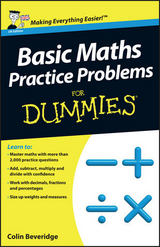
Learn to:
- Master maths with more than 2,000 practice questions
- Add, subtract, multiply and divide with confidence
- Work with decimals, fractions and percentages
- Size up weights and measures
Fun, friendly coaching and all the practice you need to tackle maths problems with confidence and ease
In his popular Basic Maths For Dummies, professional maths tutor Colin Beveridge proved that he could turn anyone - even the most maths-phobic person - into a natural-born number cruncher, In this book he supplies more of his unique brand of maths-made-easy coaching, plus 2,000 practice problems to help you master what you learn, Whether you're prepping for a numeracy test or an employability exam, thinking of returning to school, or you'd just like to be one of those know-it-alls who says, 'Oh, that's easy!' about any maths problem that comes your way, this book is for you,
- Master basic arithmetic, fast - in no time, solving addition, subtraction, multiplication and division problems will seem as easy as tying your shoes
- Face down fractions - you'll never again feel shy around fractions, decimals, percentages and ratios
- Juggle weights and measures like a pro - whether it's a question of how much it weighs, how long (or far) it is, or how much it costs, you'll never be at a loss for an answer
- Make shapes your playthings - circles, squares, triangles and rectangles - you'll measure them, draw them and manipulate them with ease
Open the book and find:
- 2,000 pencil-and-paper practice problems
- The keys to mastering addition, subtraction, multiplication and division
- The lowdown on fractions, decimals and percentages
- Basic geometry made easy
- How to handle weights, measures and money problems
- How to read charts, tables and graphs at a glance
Colin Beveridge holds a doctorate in mathematics from the University of St Andrews, He gave up a position as a researcher at Montana State University (working with NASA, among other projects) to become a full-time maths tutor, helping adults, GCSE, A-level and university students overcome their fear of maths - a position he finds far more enjoyable than real work,
Learn to: Master maths with more than 2,000 practice questions Add, subtract, multiply and divide with confidence Work with decimals, fractions and percentages Size up weights and measures Fun, friendly coaching and all the practice you need to tackle maths problems with confidence and ease In his popular Basic Maths For Dummies, professional maths tutor Colin Beveridge proved that he could turn anyone even the most maths-phobic person into a natural-born number cruncher. In this book he supplies more of his unique brand of maths-made-easy coaching, plus 2,000 practice problems to help you master what you learn. Whether you're prepping for a numeracy test or an employability exam, thinking of returning to school, or you'd just like to be one of those know-it-alls who says, 'Oh, that's easy!' about any maths problem that comes your way, this book is for you. Master basic arithmetic, fast in no time, solving addition, subtraction, multiplication and division problems will seem as easy as tying your shoes Face down fractions you'll never again feel shy around fractions, decimals, percentages and ratios Juggle weights and measures like a pro whether it's a question of how much it weighs, how long (or far) it is, or how much it costs, you'll never be at a loss for an answer Make shapes your playthings circles, squares, triangles and rectangles you'll measure them, draw them and manipulate them with ease Open the book and find: 2,000 pencil-and-paper practice problems The keys to mastering addition, subtraction, multiplication and division The lowdown on fractions, decimals and percentages Basic geometry made easy How to handle weights, measures and money problems How to read charts, tables and graphs at a glance
Colin Beveridge holds a doctorate in mathematics from the University of St Andrews. He gave up a position as a researcher at Montana State University (working with NASA, among other projects) to become a full-time maths tutor, helping adults, GCSE, A-level and university students overcome their fear of maths - a position he finds far more enjoyable than real work.
Introduction 1
Part I: The Building Blocks of Maths 7
Chapter 1: Getting Started 9
Chapter 2: Introducing the Basics: Addition and Subtraction 17
Chapter 3: Equal Piles: Multiplying and Dividing 35
Chapter 4: Are We Nearly There Yet? Estimating and Rounding 53
Part II: Working with Parts of the Whole 67
Chapter 5: Facing Fractions without Fear 69
Chapter 6: What's the Point? Dealing with Decimals 91
Chapter 7: It's All Relative: Tackling Ratio and Proportion 107
Chapter 8: Working Out Perfect Percentages, 100% of the Time 127
Part III: Real-life Maths 147
Chapter 9: Clocking Time 149
Chapter 10: Counting the Cash: Dealing with Money 171
Chapter 11: Working with Weights 189
Chapter 12: Feeling the Heat: Getting to Grips with Temperature 203
Chapter 13: Sizing Up Shapes 219
Chapter 14: Sharpening Your Knowledge of Shapes 241
Part IV: Speaking Statistically 259
Chapter 15: Mining Data (No Hard Hat Required) 261
Chapter 16: Grappling with Graphs 289
Chapter 17: Average Joe: Sussing Out Statistics 299
Chapter 18: What Are the Chances? Playing with Probability 313
Part V: The Part of Tens 325
Chapter 19: Ten (Or So) Ways to Check Your Work 327
Chapter 20: Ten Tips for Remembering Your Number Facts 333
Chapter 21: Ten Top Tips for Getting Things Right 341
Index 347
Chapter 1
Getting Started
In This Chapter
Becoming better at maths
Handling whole numbers and fiddling with fractions
Managing measurements and speaking statistically
You can do this.
Before you start, sit up straight, breathe in and take a minute to reassure yourself that you’re smart and that you do maths all the time without realising it.
Every time you cycle to work, you perform feats of mathematics that would require supercomputers to work out in anything like the timescale your brain can do them in – from deciding which path to take to avoid the lorry, to figuring out exactly when to brake for the traffic lights, and even to remembering the combination for your bike lock.
Okay, maybe you don’t need a supercomputer for the last one, but the point stands: you’re much better at maths than you realise. Maybe you don’t yet have a handle on the kind of maths you need to do well in exams, but that’s just a matter of time.
In this chapter, I show you how to get better at that other kind of maths, the sort you need to get qualifications, and I take you quickly through the topics I cover in the rest of the book.
Covering the Basics
You may have a mental image of a mathematician – enormous forehead, crazy hair, thick glasses, tweed jacket over a tasteless shirt with pens neatly arranged in the breast pocket, gesticulating madly at a blackboard covered in crazy equations.
Actually, I do know mathematicians like that – but we’re not all so poorly adjusted. Being good at maths doesn’t automatically turn you into a socially awkward egghead.
That’s not the only good news, though: you’re also excused from having to understand all those crazy equations. Virtually no algebra is covered in the numeracy curriculum (just a few simple formulas). All you need to be able to do is:
Add, take away, divide and multiply confidently: If you can use all of these maths tools, you’ll probably find the chapters in Part I relatively easy to work through. If you can’t, Chapters 2 to 4 help you build a solid foundation to work from.
Figure out the right sum to do: Working out which tool to use to answer a question can be tricky, but if you keep a clear head and think through what the question is asking, it will make sense in the end. Promise.
Make sense of measures: ‘Measure’ doesn’t just mean being able to use a ruler, although that’s a good starting point. It’s also about weighing, taking temperatures, telling the time and working with shapes. For dealing with shapes, you just need to know a few simple formulas for area and volume.
Read and understand graphs and basic statistics: Once you ‘get’ graphs, the answers start to jump off the page. You only need to care about a mere handful of types of graph, and you just need to figure out where each of them is hiding the information. Until you know that, graphs can be a bit confusing – but don’t worry, I take you through them as gently as I can!
Talking Yourself Up
The stories you tell yourself are extraordinarily powerful. I used to tell myself I was useless and stupid, despite some evidence to the contrary. I was miserable, prone to panic attacks and generally conformed to what I’d told myself.
Eventually I made some changes to my life and told myself I was capable and intelligent instead. It was astonishing how quickly things got better – I still have the odd bad day, but at least I’m a functioning human being these days.
Unfortunately, the stories most people tell themselves about maths are just as poisonous as the stories I used to tell myself. So, before you get started, please do one thing for me: look at the stories you tell yourself. If you say things like ‘I don’t have a maths brain’ or ‘I’m rubbish at maths’, you’re digging a hole for yourself. Try telling yourself these stories instead:
‘I used to struggle with maths – but I’m putting that right now.’
‘I’m much better at maths than I thought!’
‘I’m working on my maths skills.’
You don’t need to tell yourself that you’re going to win the next series of Countdown (although practising with games is a great way of honing your mental arithmetic), just give yourself a good name to live up to!
Collecting the tools you need
A very popular joke among mathematicians states that maths is the second-cheapest subject to study because all you need is a pencil, some paper and a bin. Philosophy, of course, is cheaper because you don’t need the bin.
For this book, you can do an awful lot with just the pencil, paper and bin, but you may also find a few other bits and pieces useful, too:
A calculator: While you don’t need a calculator for working through this book, it’s quite a useful thing to have around. Most numeracy tests are non-calculator papers, but you’re allowed to study however you like. If you want to use a calculator, go ahead – just don’t rely on it!
A dedicated notebook or folder: This advice falls into the ‘do as I say, not as I do’ category – my notes are scattered all over my flat. The upshot is that I can never find anything I’m working on – and I don’t want that to happen to you! Keeping your notes in one place makes reviewing them a lot easier.
A geometry set: A ruler and a protractor may prove very useful – and if you’re going to have those, why not a compass, a set square and the stencil nobody ever uses?
A comfortable, quiet place in which to work: Working through maths problems is harder if you’re distracted. If at all possible, find a space in which you can sit comfortably without anyone bothering you for a while and work there.
Handling Whole Numbers
Whole numbers are the building blocks of maths. Pretty much anything you do in basic maths requires you to have a good handle on them. You need to be good at three sets of tools:
Adding and taking away: Adding up is probably the first thing you learn in maths after counting; taking away is a little more difficult, but not by much. If you can count, you can add and take away – and I show you how in Chapter 2.
Multiplying and dividing: These tools are slightly more difficult than adding and taking away; most people find multiplying (‘timesing’) a bit easier than dividing. I give you simple, reliable methods that make both of them straightforward in Chapter 3.
Rounding and estimating: In some ways, these tools are the most important. They stop you being overcharged in the supermarket and getting run over as you cross the road. I show you how to get rough answers and how to round off in Chapter 4.
Dealing with Parts of Numbers Basic maths involves some work on things smaller than whole numbers. That means . . . yes, fractions and decimals. Oh, and percentages, too. Look, don’t blame me, I’m just the messenger. And fortunately I have some good news: I introduce you to the Table of Joy, which makes ratios and percentages (and all manner of conversions) as easy as pie.
The chapters in Part II cover the following methods for dealing with part numbers:
Fractions: In basic maths you only need to find fractions of a whole number, cancel fractions down (and up) and add and subtract fractions. Chapter 5 covers all of these concepts. Once you get the trick, dealing with fractions is easy – honestly.
Decimals: You’re probably a bit more familiar with decimals – after all, most prices contain decimal points. The rules of arithmetic are no different for decimals than for whole numbers; you just need to keep your eye on the dot! I run you through the methods for working with decimals in Chapter 6.
Ratios and percentages: Dealing with ratios (Chapter 7) and percentages (Chapter 8) is a big favourite of maths examiners, presumably because they sometimes come up in real life. I show you how to use the Table of Joy to figure out which sum to do for both of these – soon you’ll be doing them in your sleep!
Managing Measurements
By measurements, I don’t just mean using a tape measure, although measuring distance is part of this subject. ‘Measurements’ could just as easily be called ‘real-life maths’ because it deals mainly with using your knowledge from Parts I and II to solve problems in the outside world. In more detail, I cover:
Time: You probably have a decent idea of how time works but, all the same, I take you through the different ways of telling time and working with timetables and other time sums in Chapter 9.
Money: Money is probably the bit of basic maths you use most in your everyday life. In Chapter 10, I show you how to deal with money sums – which work just like normal sums – and deal with more complicated things such as deposit schemes and exchanging currencies.
Weight: There’s not all that much to say about weight in Chapter 11, except that the sums you do work just like any other kind of sum. The only tricky bit might be converting between different units, but you have the Table of Joy for that!
Temperature: Temperature, which you read about in Chapter 12, is where things can get a bit tricky. You have to deal with negative numbers and possibly some...
| Erscheint lt. Verlag | 10.8.2012 |
|---|---|
| Sprache | englisch |
| Themenwelt | Mathematik / Informatik ► Mathematik ► Allgemeines / Lexika |
| Mathematik / Informatik ► Mathematik ► Mathematische Spiele und Unterhaltung | |
| Technik | |
| Schlagworte | adult numeracy test prep • all the maths you'll ever need • basic maths • basic maths made easy • basic maths practice • basic maths practice problems • basic maths problems • basic maths skills • basic maths workbook • better maths skills • get to grips with decimals • get to grips with long division • get to grips with maths • get to grips with percentages • get to grip with fractions • Grundlagen der Mathematik • guide to basic maths • guide to improving maths skills • how to do basic maths • learn basic maths • Mathematics • Mathematik • maths for everyday life |
| ISBN-10 | 1-118-35161-4 / 1118351614 |
| ISBN-13 | 978-1-118-35161-1 / 9781118351611 |
| Informationen gemäß Produktsicherheitsverordnung (GPSR) | |
| Haben Sie eine Frage zum Produkt? |
 EPUB (Adobe DRM)
Kopierschutz: Adobe-DRM
Adobe-DRM ist ein Kopierschutz, der das eBook vor Mißbrauch schützen soll. Dabei wird das eBook bereits beim Download auf Ihre persönliche Adobe-ID autorisiert. Lesen können Sie das eBook dann nur auf den Geräten, welche ebenfalls auf Ihre Adobe-ID registriert sind.
Details zum Adobe-DRM
Dateiformat: EPUB (Electronic Publication)
EPUB ist ein offener Standard für eBooks und eignet sich besonders zur Darstellung von Belletristik und Sachbüchern. Der Fließtext wird dynamisch an die Display- und Schriftgröße angepasst. Auch für mobile Lesegeräte ist EPUB daher gut geeignet.
Systemvoraussetzungen:
PC/Mac: Mit einem PC oder Mac können Sie dieses eBook lesen. Sie benötigen eine
eReader: Dieses eBook kann mit (fast) allen eBook-Readern gelesen werden. Mit dem amazon-Kindle ist es aber nicht kompatibel.
Smartphone/Tablet: Egal ob Apple oder Android, dieses eBook können Sie lesen. Sie benötigen eine
Geräteliste und zusätzliche Hinweise
Buying eBooks from abroad
For tax law reasons we can sell eBooks just within Germany and Switzerland. Regrettably we cannot fulfill eBook-orders from other countries.
aus dem Bereich