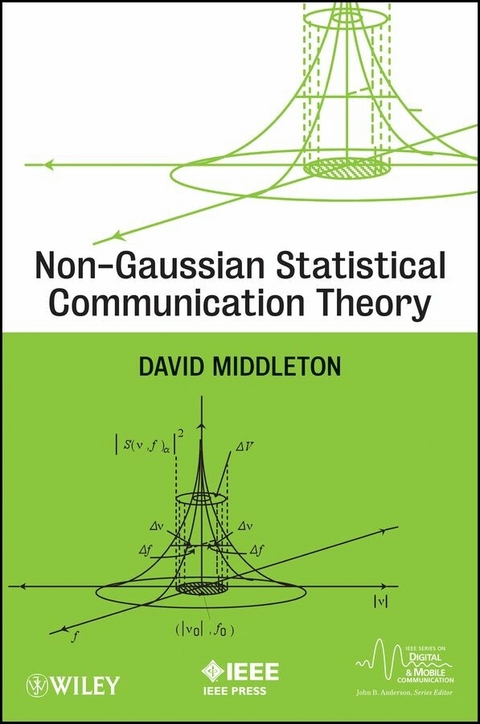
Non-Gaussian Statistical Communication Theory (eBook)
664 Seiten
John Wiley & Sons (Verlag)
978-1-118-16195-1 (ISBN)
the central operation of discovery in all the sciences. In its
"active mode" we use it to "interrogate" the physical world,
sending appropriate "signals" and receiving nature's "reply". In
the "passive mode" we receive nature's signals directly. Since we
never know a prioriwhat particular return signal will be
forthcoming, we must necessarily adopt a probabilistic model of
communication. This has developed over the approximately seventy
years since it's beginning, into a Statistical Communication Theory
(or SCT). Here it is the set or ensemble of possible
results which is meaningful. From this ensemble we attempt to
construct in the appropriate model format, based on our
understanding of the observed physical data and on the associated
statistical mechanism, analytically represented by suitable
probability measures.
Since its inception in the late '30's of the last century, and
in particular subsequent to World War II, SCT has grown into a
major field of study. As we have noted above, SCT is applicable to
all branches of science. The latter itself is inherently and
ultimately probabilistic at all levels. Moreover, in the natural
world there is always a random background "noise" as well as an
inherent a priori uncertainty in the presentation of
deterministic observations, i.e. those which are specifically
obtained, a posteriori.
The purpose of the book is to introduce Non-Gaussian statistical
communication theory and demonstrate how the theory improves
probabilistic model. The book was originally planed to include 24
chapters as seen in the table of preface. Dr. Middleton completed
first 10 chapters prior to his passing in 2008. Bibliography which
represents remaining chapters are put together by the author's
close colleagues; Drs. Vincent Poor, Leon Cohen and John
Anderson.
email href="mailto:pressbooks@ieee.org">pressbooks@ieee.org to
request Ch.10
David Middleton, PhD, graduated from Harvard University where he began his career at the institution's Radio Research Laboratory--working on radar countermeasures as well as passive and active jamming during World War II--before teaching there. A recipient of numerous prizes and awards related to his work on communication theory, Dr. Middleton was a fellow of the IEEE, the American Physical Society, the Acoustical Society of America, and the American Association for the Advancement of Science.
Foreword by Vincent Poor.
Foreword by Blake Middleton.
Introduction.
Chapter 1. Reception as a Statistical Decision Problem.
Chapter 2. Space-Time Covariances, and Wave-Number Frequency Spectra.
Chapter 3. Optimum Detection, Space-Time Mathed Filters, and Beam Forming, in Gaussian Noise Fields.
Chapter 4. Multiple Alternative Detection.
Chapter 5. Bayes Extraction Systems: Signal Estimation and Analysis.
Chapter 6. Joint Detection and Estimation, I. Foundations.
Chapter 7. Joint Detection and Estimation Under Uncertainty, II. Multiple Hypotheses and Sequential Observations.
Chapter 8. The Canonical Channel I: Scalar Field Propagation in a Deterministic Medium.
Chapter 9. The Canonical Channel II: Scattering in Random Media.
Chapter 10. Non-Gaussian Noise: Probability Distributions and the Scatter Channel.
Appendix A.
| Erscheint lt. Verlag | 11.5.2012 |
|---|---|
| Reihe/Serie | IEEE Press Series on Digital & Mobile Communication | IEEE Press Series on Digital & Mobile Communication |
| Sprache | englisch |
| Themenwelt | Technik ► Elektrotechnik / Energietechnik |
| Technik ► Nachrichtentechnik | |
| Schlagworte | Drahtlose Kommunikation • Electrical & Electronics Engineering • Elektrotechnik u. Elektronik • Mobile & Wireless Communications • Sensoren, Instrumente u. Messung • Sensors, Instrumentation & Measurement • Signal Processing • Signalverarbeitung |
| ISBN-10 | 1-118-16195-5 / 1118161955 |
| ISBN-13 | 978-1-118-16195-1 / 9781118161951 |
| Informationen gemäß Produktsicherheitsverordnung (GPSR) | |
| Haben Sie eine Frage zum Produkt? |
 EPUB (Adobe DRM)
Kopierschutz: Adobe-DRM
Adobe-DRM ist ein Kopierschutz, der das eBook vor Mißbrauch schützen soll. Dabei wird das eBook bereits beim Download auf Ihre persönliche Adobe-ID autorisiert. Lesen können Sie das eBook dann nur auf den Geräten, welche ebenfalls auf Ihre Adobe-ID registriert sind.
Details zum Adobe-DRM
Dateiformat: EPUB (Electronic Publication)
EPUB ist ein offener Standard für eBooks und eignet sich besonders zur Darstellung von Belletristik und Sachbüchern. Der Fließtext wird dynamisch an die Display- und Schriftgröße angepasst. Auch für mobile Lesegeräte ist EPUB daher gut geeignet.
Systemvoraussetzungen:
PC/Mac: Mit einem PC oder Mac können Sie dieses eBook lesen. Sie benötigen eine
eReader: Dieses eBook kann mit (fast) allen eBook-Readern gelesen werden. Mit dem amazon-Kindle ist es aber nicht kompatibel.
Smartphone/Tablet: Egal ob Apple oder Android, dieses eBook können Sie lesen. Sie benötigen eine
Geräteliste und zusätzliche Hinweise
Buying eBooks from abroad
For tax law reasons we can sell eBooks just within Germany and Switzerland. Regrettably we cannot fulfill eBook-orders from other countries.
aus dem Bereich