Molten Salts and Ionic Liquids (eBook)
John Wiley & Sons (Verlag)
978-0-470-94776-0 (ISBN)
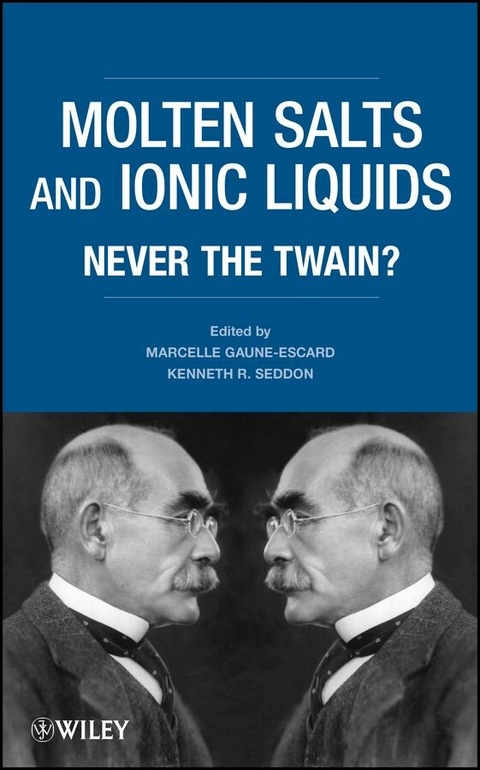
The editors of this book, recognising that there was so much knowledge, both empirical and theoretical, which can be passed from the molten salt community to the ionic liquid community, and vice versa, organised a landmark meeting in Tunisia, designed to bridge the gap and heal the rift. Leaders from both communities met for a week for a mutual exchange, with a high tutorial content intermixed with cutting edge findings. This volume is a condensate of the principal offerings of that week, and emphasises the success which was achieved. Indeed, four future biannual meetings, under the title of “EUCHEM Conferences on Molten Salts and Ionic Liquids”, have now been planned as a direct result of this meeting of minds.
Topics discussed in this volume include structure, dynamics, electrochemistry, interfacial and thermodynamic properties, spectroscopy, synthesis, and theoretical studies. Experimental and theoretical methods for investigating these data are elaborated, as are techniques for data collection and analysis. This book represents the first serious discussion on the transfer of these methods and techniques between the differing temperature regimes, and is a major contribution to the future of both fields.
For many years, the related fields of molten salts and ionic liquids have drifted apart, to their mutual detriment. Both molten salts and ionic liquids are liquid salts containing only ions - all that is different is the temperature! Both fields involve the study of Coulombic fluids for academic and industrial purposes; both employ the same principles; both require skilled practitioners; both speak the same language; all then that is truly different is their semantics, and how superficial is that? The editors of this book, recognising that there was so much knowledge, both empirical and theoretical, which can be passed from the molten salt community to the ionic liquid community, and vice versa, organised a landmark meeting in Tunisia, designed to bridge the gap and heal the rift. Leaders from both communities met for a week for a mutual exchange, with a high tutorial content intermixed with cutting edge findings. This volume is a condensate of the principal offerings of that week, and emphasises the success which was achieved. Indeed, four future biannual meetings, under the title of EUCHEM Conferences on Molten Salts and Ionic Liquids , have now been planned as a direct result of this meeting of minds. Topics discussed in this volume include structure, dynamics, electrochemistry, interfacial and thermodynamic properties, spectroscopy, synthesis, and theoretical studies. Experimental and theoretical methods for investigating these data are elaborated, as are techniques for data collection and analysis. This book represents the first serious discussion on the transfer of these methods and techniques between the differing temperature regimes, and is a major contribution to the future of both fields.
Kenneth R. Seddon is a professor in the School of Chemistry at the Queen's University of Belfast, Northern Ireland, since 1993. Professor Seddon is Chair of Inorganic Chemistry since 1993 and director of QUILL (Queen's University Ionic Liquid Laboratories) since 1999. Professor Seddon's Research Interests include green chemistry, crystal engineering, ionic liquids for clean technology, phosgene, coordination chemistry and conservation of pre-tenth Century Chinese paper.?He holds a B.Sc. (1970) and Ph.D. (1973) in Chemistry from the University of Liverpool, UK and MA (1974) from the University of Oxford, UK.
"The book is sure to appeal to researchers already in the field of ionic liquids/molten salts, and those new to the area will likely find the review articles contained within enlightening and the philosophy behind this work, namely the unifcation of the field, a good position to begin their investigations into these fascinating materials." (Chemistry World, 1 February 2011)
| Erscheint lt. Verlag | 2.7.2012 |
|---|---|
| Sprache | englisch |
| Themenwelt | Naturwissenschaften ► Chemie ► Organische Chemie |
| Technik | |
| Schlagworte | Anorganische Chemie • Chapters • Chemie • Chemische Synthese • Chemistry • contributed • differences • Experts • Fields • important • indepth • Inorganic Chemistry • Materials • Methods - Synthesis & Techniques • molten • Nachhaltige u. Grüne Chemie • Nachhaltige u. Grüne Chemie • New • Organische Chemie / Methoden, Synthesen, Verfahren • Panel • physicochemical • Properties • respective • similarities • solid • Structure • Sustainable Chemistry & Green Chemistry • Terms • Thermodynamic properties • Twentysix • two • work presents |
| ISBN-10 | 0-470-94776-4 / 0470947764 |
| ISBN-13 | 978-0-470-94776-0 / 9780470947760 |
| Informationen gemäß Produktsicherheitsverordnung (GPSR) | |
| Haben Sie eine Frage zum Produkt? |
 PDF (Adobe DRM)
Kopierschutz: Adobe-DRM
Adobe-DRM ist ein Kopierschutz, der das eBook vor Mißbrauch schützen soll. Dabei wird das eBook bereits beim Download auf Ihre persönliche Adobe-ID autorisiert. Lesen können Sie das eBook dann nur auf den Geräten, welche ebenfalls auf Ihre Adobe-ID registriert sind.
Details zum Adobe-DRM
Dateiformat: PDF (Portable Document Format)
Mit einem festen Seitenlayout eignet sich die PDF besonders für Fachbücher mit Spalten, Tabellen und Abbildungen. Eine PDF kann auf fast allen Geräten angezeigt werden, ist aber für kleine Displays (Smartphone, eReader) nur eingeschränkt geeignet.
Systemvoraussetzungen:
PC/Mac: Mit einem PC oder Mac können Sie dieses eBook lesen. Sie benötigen eine
eReader: Dieses eBook kann mit (fast) allen eBook-Readern gelesen werden. Mit dem amazon-Kindle ist es aber nicht kompatibel.
Smartphone/Tablet: Egal ob Apple oder Android, dieses eBook können Sie lesen. Sie benötigen eine
Geräteliste und zusätzliche Hinweise
Buying eBooks from abroad
For tax law reasons we can sell eBooks just within Germany and Switzerland. Regrettably we cannot fulfill eBook-orders from other countries.
aus dem Bereich