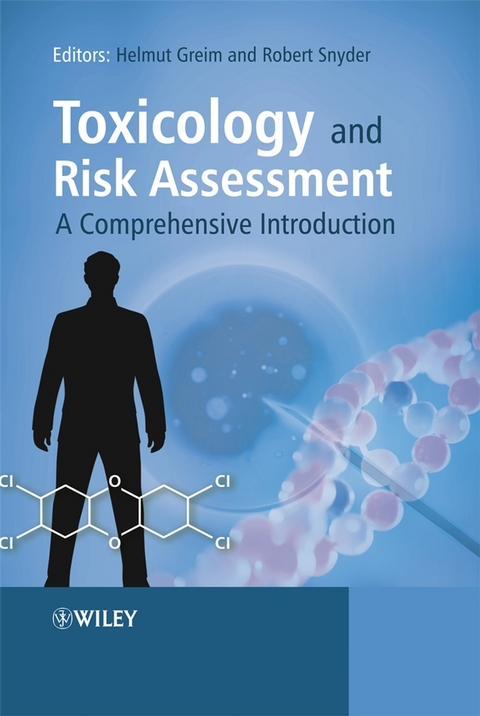
Toxicology and Risk Assessment (eBook)
John Wiley & Sons (Verlag)
978-0-470-86894-2 (ISBN)
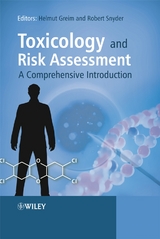
In addition to the introductory chapters the book will offer the following systematic information, presented in six special sections:
- Principles in Toxicology
- Organ Toxicology
- Methods in Toxicology
- Risk Assessment
- Risk Management
- Toxicity of Chemicals
Fulfilling a demand for such a book, this will be a welcomed introductory text for students and non-experts alike to focus on and understand the principles of hazard identification and risk assessment of toxicants. Relevant to all those studying toxicology, biochemistry, biology, medicine and chemistry, as well as toxicologists in hospitals, universities and in industry.
Prof. Dr. Helmut Greim, Institut für Toxikologie und Umwelthygiene Technische Universität München, Germany
This new book, written by two outstanding scientists in the field, describes the basic principles of toxic mechanisms and organ toxicity, providing detailed information on specific mechanisms or chemicals for exemplification. The goal is to provide sufficient information that the reader becomes familiar with the basic concepts in toxicology to enable him or her to understand the basic principles in toxicology and to evaluate the risks at given exposures. With this basic understanding the reader also will be able to critically evaluate the available information on a chemical and to identify data gaps. In addition to the introductory chapters the book will offer the following systematic information, presented in six special sections: Principles in Toxicology Organ Toxicology Methods in Toxicology Risk Assessment Risk Management Toxicity of Chemicals Fulfilling a demand for such a book, this will be a welcomed introductory text for students and non-experts alike to focus on and understand the principles of hazard identification and risk assessment of toxicants. Relevant to all those studying toxicology, biochemistry, biology, medicine and chemistry, as well as toxicologists in hospitals, universities and in industry.
Prof. Dr. Helmut Greim, Institut für Toxikologie und Umwelthygiene Technische Universität München, Germany
Preface.
List of Contributors.
1 Introduction to the Discipline of
Toxicology (Helmut Greim and Robert Snyder).
1.1 Introduction.
1.2 The Risk-Assessment Process.
1.3 Toxicological Evaluation of New and Existing Chemicals.
1.4 Summary.
2 Principles.
2.1 Toxicokinetics (Johannes G. Filser).
2.2A Phase I Metabolism (Jeroen T.M. Buters).
2.2B Drug Metabolism (Leslie Schwarz and John B. Watkins).
2.3 Toxicogenetics (Lesley Stanley).
2.4 Cytotoxicity (Leslie Schwarz and John B. Watkins).
2.5 Receptor-Mediated Mechanisms (Jens Schlossmann and Franz
Hofmann).
2.6 Mixtures and Combinations of Chemicals (Victor J. Feron and
Diana Jonker).
2.7 Chemical Carcinogenesis: Genotoxic and Nongenotoxic
Mechanisms (Thomas Efferth and Bernd Kaina).
2.8 Reproductive Toxicology (Horst Spielmann).
2.9 Ecotoxicology: Not just Wildlife Toxicology (Peter Calow and
Valery E. Forbes).
3 Organ Toxicology.
3.1 The Gastrointestinal Tract (Michael Schwenk).
3.2 The Liver (Leslie Schwarz and John B. Watkins).
3.3 The Respiratory System (Jurgen Pauluhn).
3.4 The Nervous System (Gunter P. Eckert and Walter E.
Mu¨ller).
3.5 Behavioral Neurotoxicology (Andreas Seeber).
3.6 The Skin (Tibor A. Rozman, Myriam Straube and Karl K.
Rozman).
3.7 The Kidney and Urinary Tract (Helmut Greim).
3.8 Toxicology of the Blood and Bone Marrow (Robert Snyder).
3.9 Immunotoxicology (Carol R. Gardner and Debra L. Laskin).
3.10 The Eye (Ines M. Lanzl).
3.11 The Cardiovascular System (Helmut Greim).
4 Methods in Toxicology.
4.1 OECD Test Guidelines for Toxicity Tests in vivo (Rudiger
Bartsch).
4.2A Mutagenicity Tests in vivo (Ilse-Dore Adler).
4.2B In vitro Tests for Genotoxicity (Ulrich Andrae and Gunter
Speit).
4.2.C Strategies for the Evaluation of Genotoxicity (Stephan
Madle, Peter Kasper, Ulrike Pabel and Gunter Speit).
4.3 Biomonitoring (Michael G. Bird).
4.4 Epidemiology (Kurt Ulm).
4.5 Omics in Toxicology (Laura Suter-Dick and Thomas
Singer).
4.6 Introduction to the Statistical Analysis of Experimental
Data (Gyorgy Csanady).
5 Risk Assessment.
5.1 Mathematical Models for Risk Extrapolation (Jurgen
Timm).
5.2 Regulations Regarding Chemicals and Radionuclides in the
Environment, Workplace, Consumer Products, Foods, and
Pharmaceuticals (Dennis J. Paustenbach and Pearl Moy).
6 Toxicity of Selected Chemicals.
6.1 Persistent Polyhalogenated Aromatic Hydrocarbons (Kristian
W. Fried and Karl K. Rozman).
6.2 Metals (Karl-Heinz Summer, Stefan Halbach, Herrmann Kappus
and Helmut Greim).
6.3 Toxicology of Fibers and Particles (Paul J.A. Borm).
6.4 Xenoestrogens and Xenoantiandrogens (Gisela H. Degen and J.
William Owens).
6.5 Toxicology of Solvents (Wolfgang Dekant and Marion W.
Anders).
6.6 Noxious Gases (Ladislaus Szinicz).
6.7 Animal and Plant Toxins (Thomas Zilker).
Index.
"Es gefallt das didaktisch-logische Konzept mit hervorgehobenen
Kernaussagen."
BIOspektrum
04.08
| Erscheint lt. Verlag | 15.4.2008 |
|---|---|
| Sprache | englisch |
| Themenwelt | Naturwissenschaften ► Chemie |
| Technik | |
| Schlagworte | adverse • Analytische Chemie / Forensik • Arbeitssicherheit u. Umweltschutz i. d. Chemie • Chemical and Environmental Health and Safety • chemicals • Chemie • Chemistry • Comprehensive • Effects • Forensics • Greim • Health • human exposure • Institute • Introduction • Jersey • New • Occupational Health • qualitative • Risks • Robert • Sense • State • Technische • Toxicology • Toxikologie • Umwelthygiene • University |
| ISBN-10 | 0-470-86894-5 / 0470868945 |
| ISBN-13 | 978-0-470-86894-2 / 9780470868942 |
| Informationen gemäß Produktsicherheitsverordnung (GPSR) | |
| Haben Sie eine Frage zum Produkt? |
 PDF (Adobe DRM)
Kopierschutz: Adobe-DRM
Adobe-DRM ist ein Kopierschutz, der das eBook vor Mißbrauch schützen soll. Dabei wird das eBook bereits beim Download auf Ihre persönliche Adobe-ID autorisiert. Lesen können Sie das eBook dann nur auf den Geräten, welche ebenfalls auf Ihre Adobe-ID registriert sind.
Details zum Adobe-DRM
Dateiformat: PDF (Portable Document Format)
Mit einem festen Seitenlayout eignet sich die PDF besonders für Fachbücher mit Spalten, Tabellen und Abbildungen. Eine PDF kann auf fast allen Geräten angezeigt werden, ist aber für kleine Displays (Smartphone, eReader) nur eingeschränkt geeignet.
Systemvoraussetzungen:
PC/Mac: Mit einem PC oder Mac können Sie dieses eBook lesen. Sie benötigen eine
eReader: Dieses eBook kann mit (fast) allen eBook-Readern gelesen werden. Mit dem amazon-Kindle ist es aber nicht kompatibel.
Smartphone/Tablet: Egal ob Apple oder Android, dieses eBook können Sie lesen. Sie benötigen eine
Geräteliste und zusätzliche Hinweise
Buying eBooks from abroad
For tax law reasons we can sell eBooks just within Germany and Switzerland. Regrettably we cannot fulfill eBook-orders from other countries.
aus dem Bereich