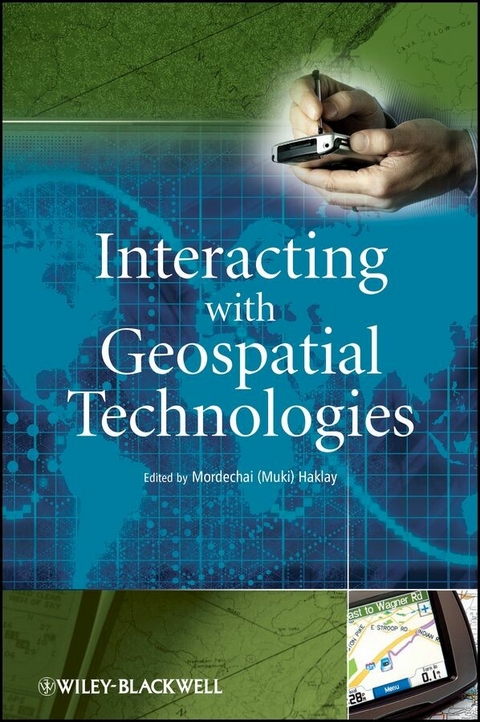
Interacting with Geospatial Technologies (eBook)
John Wiley & Sons (Verlag)
978-0-470-68982-0 (ISBN)
Geographical Information Systems and other applications of computerised mapping have gained popularity in recent years. Today, computer-based maps are common on the World Wide Web, mobile phones, satellite navigation systems and in various desktop computing packages. The more sophisticated packages that allow the manipulation and analysis of geographical information are used in location decisions of new businesses, for public service delivery for planning decisions by local and central government. Many more applications exist and some estimate the number of people across the world that are using GIS in their daily work at several millions. However, many applications of GIS are hard to learn and to master. This is understandable, as until quite recently, the main focus of software vendors in the area of GIS was on the delivery of basic functionality and development of methods to present and manipulate geographical information using the available computing resources. As a result, little attention was paid to usability aspects of GIS. This is evident in many public and private systems where the terminology, conceptual design and structure are all centred around the engineering of GIS and not on the needs and concepts that are familiar to the user.
This book covers a range of topics from the cognitive models of geographical representation, to interface design. It will provide the reader with frameworks and techniques that can be used and description of case studies in which these techniques have been used for computer mapping application.
Mordechai (Muki) Haklay is the author of Interacting with Geospatial Technologies, published by Wiley.
This book provides an introduction to HCI and usability aspects of Geographical Information Systems and Science. Its aim is to introduce the principles of Human-Computer Interaction (HCI); to discuss the special usability aspects of GIS which designers and developers need to take into account when developing such systems; and to offer a set of tried and tested frameworks, matrices and techniques that can be used within GIS projects. Geographical Information Systems and other applications of computerised mapping have gained popularity in recent years. Today, computer-based maps are common on the World Wide Web, mobile phones, satellite navigation systems and in various desktop computing packages. The more sophisticated packages that allow the manipulation and analysis of geographical information are used in location decisions of new businesses, for public service delivery for planning decisions by local and central government. Many more applications exist and some estimate the number of people across the world that are using GIS in their daily work at several millions. However, many applications of GIS are hard to learn and to master. This is understandable, as until quite recently, the main focus of software vendors in the area of GIS was on the delivery of basic functionality and development of methods to present and manipulate geographical information using the available computing resources. As a result, little attention was paid to usability aspects of GIS. This is evident in many public and private systems where the terminology, conceptual design and structure are all centred around the engineering of GIS and not on the needs and concepts that are familiar to the user. This book covers a range of topics from the cognitive models of geographical representation, to interface design. It will provide the reader with frameworks and techniques that can be used and description of case studies in which these techniques have been used for computer mapping application.
Mordechai (Muki) Haklay is the author of Interacting with Geospatial Technologies, published by Wiley.
| Erscheint lt. Verlag | 18.3.2010 |
|---|---|
| Sprache | englisch |
| Themenwelt | Naturwissenschaften ► Geowissenschaften ► Geografie / Kartografie |
| Naturwissenschaften ► Geowissenschaften ► Geologie | |
| Technik | |
| Schlagworte | Account • Aspects • Book • clear • discussion • earth sciences • Frameworks • Geodaten • Geographical information • Geographie • Geography • Geoinformationssystem • Geospatial • Geowissenschaften • GIS • GIS & Remote Sensing • GIS, Fernerkundung u. Kartographie • GIS, Remote Sensing & Cartography • GIS u. Fernerkundung • HCI • humancomputer • interacting • interaction • Introduction • Principles • Projects • SET • Special • technologies provides • Usability |
| ISBN-10 | 0-470-68982-X / 047068982X |
| ISBN-13 | 978-0-470-68982-0 / 9780470689820 |
| Informationen gemäß Produktsicherheitsverordnung (GPSR) | |
| Haben Sie eine Frage zum Produkt? |
 PDF (Adobe DRM)
Kopierschutz: Adobe-DRM
Adobe-DRM ist ein Kopierschutz, der das eBook vor Mißbrauch schützen soll. Dabei wird das eBook bereits beim Download auf Ihre persönliche Adobe-ID autorisiert. Lesen können Sie das eBook dann nur auf den Geräten, welche ebenfalls auf Ihre Adobe-ID registriert sind.
Details zum Adobe-DRM
Dateiformat: PDF (Portable Document Format)
Mit einem festen Seitenlayout eignet sich die PDF besonders für Fachbücher mit Spalten, Tabellen und Abbildungen. Eine PDF kann auf fast allen Geräten angezeigt werden, ist aber für kleine Displays (Smartphone, eReader) nur eingeschränkt geeignet.
Systemvoraussetzungen:
PC/Mac: Mit einem PC oder Mac können Sie dieses eBook lesen. Sie benötigen eine
eReader: Dieses eBook kann mit (fast) allen eBook-Readern gelesen werden. Mit dem amazon-Kindle ist es aber nicht kompatibel.
Smartphone/Tablet: Egal ob Apple oder Android, dieses eBook können Sie lesen. Sie benötigen eine
Geräteliste und zusätzliche Hinweise
Buying eBooks from abroad
For tax law reasons we can sell eBooks just within Germany and Switzerland. Regrettably we cannot fulfill eBook-orders from other countries.
aus dem Bereich