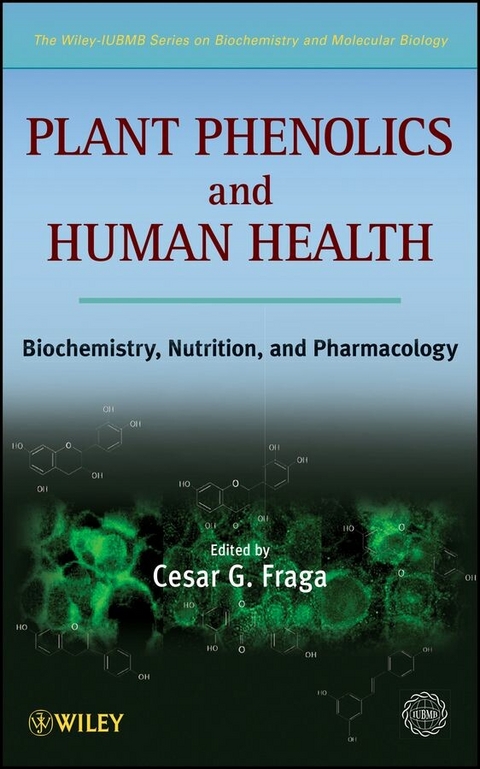
Plant Phenolics and Human Health (eBook)
John Wiley & Sons (Verlag)
978-0-470-53178-5 (ISBN)
Interest in phenolic phytochemicals has increased as scientific studies indicate these compounds exhibit potential health benefits. With contributions from world leaders in this research area, Plant Phenolics and Human Health: Biochemistry, Nutrition, and Pharmacology offers an essential survey of the current knowledge on the capacity of specific micronutrients present in ordinary diets to fight disease.
The coverage in this resource:
Explains the presence and biochemical properties of phenolics present in fruits and vegetables, as well as in foods derived from their plant sources
Provides biochemical explanations on how certain plant phenolics fight cardiovascular and neurodegenerative diseases, cancer, and other widespread pathologies
Focuses on certain phenolics, e.g., flavonoids, stilbenes, and curcuminoids, and provides insights on the biochemical bases used to define their significance in the diet as well as their recommended consumption requirements and toxicity
Appropriate for graduate and upper-level undergraduate courses in human and animal nutrition, basic nutritional biology, physiology, pharmacology, and other health-related disciplines, Plant Phenolics and Human Health: Biochemistry, Nutrition, and Pharmacology serves as both an invaluable supplementary classroom text and a self-teaching guide for professionals interested in defining the association between diet and health from classical, alternative, and complementary biomedical perspectives.
A collection of current knowledge of phytochemicals and health Interest in phenolic phytochemicals has increased as scientific studies indicate these compounds exhibit potential health benefits. With contributions from world leaders in this research area, Plant Phenolics and Human Health: Biochemistry, Nutrition, and Pharmacology offers an essential survey of the current knowledge on the capacity of specific micronutrients present in ordinary diets to fight disease. The coverage in this resource: Explains the presence and biochemical properties of phenolics present in fruits and vegetables, as well as in foods derived from their plant sources Provides biochemical explanations on how certain plant phenolics fight cardiovascular and neurodegenerative diseases, cancer, and other widespread pathologies Focuses on certain phenolics, e.g., flavonoids, stilbenes, and curcuminoids, and provides insights on the biochemical bases used to define their significance in the diet as well as their recommended consumption requirements and toxicity Appropriate for graduate and upper-level undergraduate courses in human and animal nutrition, basic nutritional biology, physiology, pharmacology, and other health-related disciplines, Plant Phenolics and Human Health: Biochemistry, Nutrition, and Pharmacology serves as both an invaluable supplementary classroom text and a self-teaching guide for professionals interested in defining the association between diet and health from classical, alternative, and complementary biomedical perspectives.
Cesar G. Fraga is Professor of Physical Chemistry at the University of Buenos Aires, Argentina, and is associated with the Department of Nutrition at the University of California at Davis. Dr. Fraga is the recipient of numerous awards, has served as guest editor of periodical publications, and has taken leadership roles in different scientific societies. He has an extensive record of publications on the biochemical and physiological effects of phenolic compounds and their potential effects on human health.
PREFACE.
CONTRIBUTORS.
1 Dietary Flavonoids and Phenolic Compounds (Indu B. Jaganath
and Alan Crozier).
2 Bioavailability of Flavanols and Phenolic Acids (Laure
Poquet, Michael N Clifford, and Gary Williamson).
3 Biochemical Actions of Plant Phenolics Compounds:
Thermodynamic and Kinetic Aspects (Cesar G. Fraga, Gulcin
Sagdicoglu Celep, and Monica Galleano).
4 Flavonoids-Membrane Interactions: Consequences for
Biological Actions (Sandra V. Verstraeten, Cesar G. Fraga, and
Patricia I. Oteiza).
5 The Biochemistry Behind the Potential Cardiovascular
Protection by Dietary Flavonoids (Wai Mun Loke, Jonathan M.
Hodgson, and Kevin D. Croft).
6 Dietary Flavanols: Biochemical Basis of Short-Term and
Longer-Term Vascular Responses (Tankred Schewe, Yvonne Steffen,
Elisabeth Kravets and Helmut Sies).
7 Green Tea Catechins: Anticancer Effects and Molecular Targets
(Naghma Khan and Hasan Mukhtar).
8 Flavonols: Metabolism, Bioavailability, and Health Impacts
(Junji Terao).
9 Flavonols: Biochemistry Behind Cardiovascular Effects
(Francisco Pérez-Vizcai´no and Juan
Duarte).
10 Metabolism, Bioavailability, and Analysis of Dietary
Isoflavones (Adrian A. Franke, Brunhild M. Halm, Kerry Kakazu
and Xingnan Li).
11 Phytoestrogens Up-regulate Antioxidant Genes (Consuelo
Borrás and Jose Viña).
12 Dietary Isoflavones: Cardiovascular Actions and Activation of
Cellular Signalling Pathways (Richard C. M. Siow and Giovanni E.
Mann).
13 Bioavailability and Metabolism of Resveratrol (Cristina
Andres-Lacueva, Mireia Urpi-Sarda, Raul Zamora-Ros, and Rosa M.
Lamuela-Raventos).
14 Resveratrol: Biochemistry and Functions (Samarjit Das,
Hannah R. Vasanthi, and Dipak K. Das).
15 Resveratrol: The Biochemistry Behind its Anticancer Effects
(Joydeb K. Kundu and Young-Joon Surh).
16 Curcumin: The Biochemistry Behind Its Anticancer Effects
(Preetha Anand, Ajaikumar B. Kunnumakkara, and Bharat B.
Aggarwal).
17 Plant Phenolic Compounds: Modulation of Cytoprotective
Enzymes and Nrf2/ARE Signaling (Siwang Yu, Ka Lung Cheung, Wenge
Li and Ah-Ng Kong).
18 Phenolics in Aging and Neurodegenerative Disorders
(Vittorio Calabrese, Marzia Perluigi, Carolin Cornelius,
Raffaella Coccia, Fabio Di Domenico, Giovanni Pennisi, Chiara Cini
and Albena T. Dinkova-Kostova).
19 Natural Phenolics and Metal Metabolism in Neurodegenerative
Diseases (Baolu Zhao).
20 Epidemiology behind Fruit and Vegetable Consumption and
Cancer Risk with Focus on Flavonoids (Marta Rossi, Eva Negri,
Cristina Bosetti, Claudio Pelucchi, and Carlo La Vecchia).
21 Phenylpropanoid Metabolism in Plants: Biochemistry,
Functional Biology, and Metabolic Engineering (Alberto B.
Landolino and Douglas R. Cook).
INDEX.
"Some 62 eminent researchers from 14 countries have contributed to
the book's 21 chapters, each offering a comprehensive account of
what is currently happening at the cutting edge of such
intersecting disciplines as food science, nutrition, medicine, and
pharmaceutical research. Learned updates to this topic of plant
phenolics will probably be forthcoming every five to ten years."
(CHOICE, 2010)
| Erscheint lt. Verlag | 22.10.2009 |
|---|---|
| Reihe/Serie | The Wiley - IUBMB Series on Biochemistry and Molecular Biology |
| The Wiley - IUBMB Series on Biochemistry and Molecular Biology | The Wiley-IUBMB Series on Biochemistry and Molecular Biology |
| Sprache | englisch |
| Themenwelt | Naturwissenschaften ► Biologie ► Biochemie |
| Naturwissenschaften ► Biologie ► Genetik / Molekularbiologie | |
| Naturwissenschaften ► Chemie ► Organische Chemie | |
| Technik | |
| Schlagworte | area • Biochemie • Biochemie u. Chemische Biologie • biochemistry • Biochemistry (Chemical Biology) • Biowissenschaften • Botanik • Capacity • Chemie • Chemistry • Collection • Contributions • Current • diets • essential survey • Food Science & Technology • Health • Knowledge • Lebensmittel • Lebensmittelforschung u. -technologie • Life Sciences • micronutrients present • Ordinary • Phenolic • Phenolics • Phytochemicals • plant science • Properties • Research • Scientific • specific • Studies • World |
| ISBN-10 | 0-470-53178-9 / 0470531789 |
| ISBN-13 | 978-0-470-53178-5 / 9780470531785 |
| Informationen gemäß Produktsicherheitsverordnung (GPSR) | |
| Haben Sie eine Frage zum Produkt? |
 PDF (Adobe DRM)
Kopierschutz: Adobe-DRM
Adobe-DRM ist ein Kopierschutz, der das eBook vor Mißbrauch schützen soll. Dabei wird das eBook bereits beim Download auf Ihre persönliche Adobe-ID autorisiert. Lesen können Sie das eBook dann nur auf den Geräten, welche ebenfalls auf Ihre Adobe-ID registriert sind.
Details zum Adobe-DRM
Dateiformat: PDF (Portable Document Format)
Mit einem festen Seitenlayout eignet sich die PDF besonders für Fachbücher mit Spalten, Tabellen und Abbildungen. Eine PDF kann auf fast allen Geräten angezeigt werden, ist aber für kleine Displays (Smartphone, eReader) nur eingeschränkt geeignet.
Systemvoraussetzungen:
PC/Mac: Mit einem PC oder Mac können Sie dieses eBook lesen. Sie benötigen eine
eReader: Dieses eBook kann mit (fast) allen eBook-Readern gelesen werden. Mit dem amazon-Kindle ist es aber nicht kompatibel.
Smartphone/Tablet: Egal ob Apple oder Android, dieses eBook können Sie lesen. Sie benötigen eine
Geräteliste und zusätzliche Hinweise
Buying eBooks from abroad
For tax law reasons we can sell eBooks just within Germany and Switzerland. Regrettably we cannot fulfill eBook-orders from other countries.
aus dem Bereich