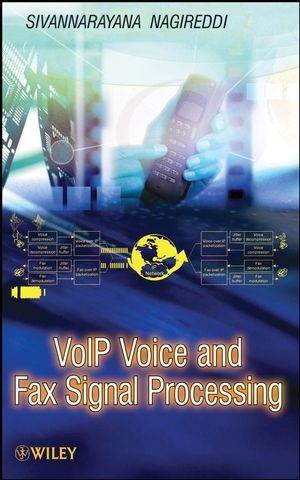
VoIP Voice and Fax Signal Processing (eBook)
John Wiley & Sons (Verlag)
978-0-470-37786-4 (ISBN)
This book presents a consolidated view and basic approach to signal processing for VoIP voice and fax solutions. It provides readers with complete coverage of the topic, from how things work in voice and fax modules, to signal processing aspects, implementation, and testing. Beginning with an overview of VoIP infrastructure, interfaces, and signals, the book systematically covers:
Voice compression
Packet loss concealment techniques
DTMF detection, generation, and rejection
Wideband voice modules operation
VoIP Voice-Network bit rate calculations
VoIP voice testing
Fax over IP and modem over IP
Country deviations of PSTN mapped to VoIP
VoIP on different processors and architectures
Generic VAD-CNG for waveform codecs
Echo cancellation
Caller ID features in VoIP
Packetization—RTP, RTCP, and jitter buffer
Clock sources for VoIP applications
Fax operation on PSTN, modulations, and fax messages
Fax over IP payload formats and bit rate calculations
Voice packets jitter with large data packets
VoIP voice quality
Over 100 questions and answers on voice and more than seventy questions and answers on fax are provided at the back of the book to reinforce the topics covered throughout the text. Additionally, several clarification, interpretation, and discussion sections are included in selected chapters to aide in readers' comprehension.
VoIP Voice and Fax Signal Processing is an indispensable resource for professional electrical engineers, voice and fax solution developers, product and deployment support teams, quality assurance and test engineers, and computer engineers. It also serves as a valuable textbook for graduate-level students in electrical engineering and computer engineering courses.
A complete and systematic treatment of signal processing for VoIP voice and fax This book presents a consolidated view and basic approach to signal processing for VoIP voice and fax solutions. It provides readers with complete coverage of the topic, from how things work in voice and fax modules, to signal processing aspects, implementation, and testing. Beginning with an overview of VoIP infrastructure, interfaces, and signals, the book systematically covers: Voice compression Packet loss concealment techniques DTMF detection, generation, and rejection Wideband voice modules operation VoIP Voice-Network bit rate calculations VoIP voice testing Fax over IP and modem over IP Country deviations of PSTN mapped to VoIP VoIP on different processors and architectures Generic VAD-CNG for waveform codecs Echo cancellation Caller ID features in VoIP Packetization RTP, RTCP, and jitter buffer Clock sources for VoIP applications Fax operation on PSTN, modulations, and fax messages Fax over IP payload formats and bit rate calculations Voice packets jitter with large data packets VoIP voice quality Over 100 questions and answers on voice and more than seventy questions and answers on fax are provided at the back of the book to reinforce the topics covered throughout the text. Additionally, several clarification, interpretation, and discussion sections are included in selected chapters to aide in readers' comprehension. VoIP Voice and Fax Signal Processing is an indispensable resource for professional electrical engineers, voice and fax solution developers, product and deployment support teams, quality assurance and test engineers, and computer engineers. It also serves as a valuable textbook for graduate-level students in electrical engineering and computer engineering courses.
Sivannarayana Nagireddi, PhD, is the architect of VoIP solutions at Ikanos Communications, Inc., and leads the DSP and VoIP team. Dr. Nagireddi and his team developed complete VoIP solutions including signal processing algorithms for voice-enabled residential gateway processors, which have been deployed by telecommunications providers. He is a member of the IEEE, a Fellow of IETE-India, and reviewer for the journal Medical Engineering & Physics.
Acknowledgments.
About the Author.
Preface.
Glossary.
1. PSTN Basic Infrastructure, Interfaces, and Signals.
2. VoIP Overview and Infrastructure.
3. Voice Compression.
4. Generic VAD/CNG for Waveform Codecs.
5. Packet Loss Concealment Techniques.
6. ECHO Cancellation.
7. DTMF Detection, Generation, and Rejection.
8. Caller ID Features in VoIP.
9. Wideband Voice Modules Operation.
10. Packetization-RTP, RTCP, and Jitter Buffer.
11. VoIP Voice-Network Bit Rate Calculations.
12. Clock Sources for VoIP Applications.
13. VoIP Voice Testing.
14. Fax Operation on PSTN, Modulations, and Fax Messages.
15. Fax Over IP and Modem Over IP.
16. Fax Over IP Payload Formats and Bit Rate Calculations.
17. Country Deviations of the PSTN Mapped to VoIP.
18. Voice Packets Jitter with Large Data Packets.
19. VoIP on Different Processors and Architectures.
20. VoIP Voice Quality.
21. VoIP Voice FAQs.
22. Basic Fax and Fax Over IP FAQs.
Index.
| Erscheint lt. Verlag | 20.8.2008 |
|---|---|
| Sprache | englisch |
| Themenwelt | Technik ► Elektrotechnik / Energietechnik |
| Technik ► Nachrichtentechnik | |
| Schlagworte | Computer Architecture • Computerarchitektur • Computer Science • Drahtlose Kommunikation • Electrical & Electronics Engineering • Elektrotechnik u. Elektronik • Informatik • Mobile & Wireless Communications • Signal Processing • Signalverarbeitung • VoIP, PSTN, IP Telephony, Internet telephony, Broadband telephone, Broadband Phone, Voice over Broadband, E.163/E.164, network convergence, next generation networks, next generation networking, digital signal processing, IP network, voice modules, fax modules, voice and fax modules, VoIP Fax calls, voice signal processing, fax signal processing, Voice over IP, VoIP protocols |
| ISBN-10 | 0-470-37786-0 / 0470377860 |
| ISBN-13 | 978-0-470-37786-4 / 9780470377864 |
| Informationen gemäß Produktsicherheitsverordnung (GPSR) | |
| Haben Sie eine Frage zum Produkt? |
 PDF (Adobe DRM)
Kopierschutz: Adobe-DRM
Adobe-DRM ist ein Kopierschutz, der das eBook vor Mißbrauch schützen soll. Dabei wird das eBook bereits beim Download auf Ihre persönliche Adobe-ID autorisiert. Lesen können Sie das eBook dann nur auf den Geräten, welche ebenfalls auf Ihre Adobe-ID registriert sind.
Details zum Adobe-DRM
Dateiformat: PDF (Portable Document Format)
Mit einem festen Seitenlayout eignet sich die PDF besonders für Fachbücher mit Spalten, Tabellen und Abbildungen. Eine PDF kann auf fast allen Geräten angezeigt werden, ist aber für kleine Displays (Smartphone, eReader) nur eingeschränkt geeignet.
Systemvoraussetzungen:
PC/Mac: Mit einem PC oder Mac können Sie dieses eBook lesen. Sie benötigen eine
eReader: Dieses eBook kann mit (fast) allen eBook-Readern gelesen werden. Mit dem amazon-Kindle ist es aber nicht kompatibel.
Smartphone/Tablet: Egal ob Apple oder Android, dieses eBook können Sie lesen. Sie benötigen eine
Geräteliste und zusätzliche Hinweise
Buying eBooks from abroad
For tax law reasons we can sell eBooks just within Germany and Switzerland. Regrettably we cannot fulfill eBook-orders from other countries.
aus dem Bereich