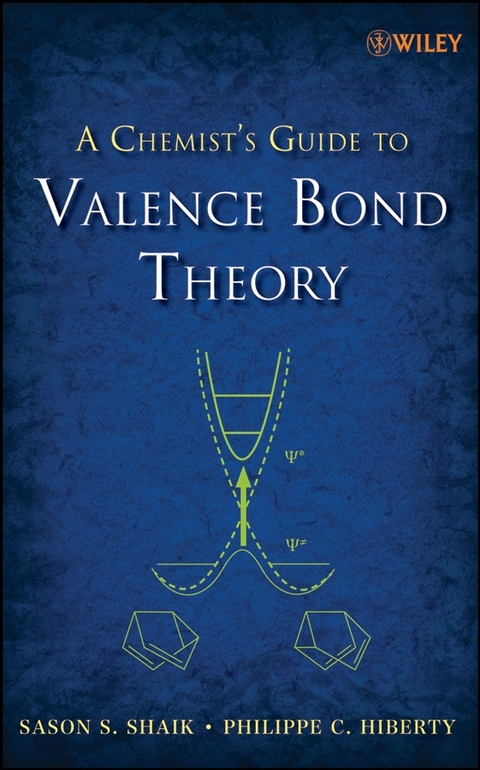
A Chemist's Guide to Valence Bond Theory (eBook)
336 Seiten
John Wiley & Sons (Verlag)
978-0-470-19258-0 (ISBN)
Since the 1980s, valence bond (VB) theory has enjoyed a renaissance characterized both in the qualitative application of the theory and in the development of new methods for its computer implementation. Written by leading authorities, this is the premier reference on current VB theory and applications in a pedagogical context, perhaps the first such attempt since Pauling's The Nature of the Chemical Bond. After an introduction, A Chemist's Guide to Valence Bond Theory pre-sents a practical system that can be applied to a variety of chemical problems in a uniform manner. Concise yet comprehensive, it includes:
* A tour of some VB outputs and terminology
* An explanation of basic VB theory
* A discussion of various applications of the VB method to chemical problems, encompassing bonding problems, aromaticity and antiaromaticity, the dioxygen molecule, polyradicals, excited states, organic reactions, inorganic/organometallic reactions, photochemical reactions, and catalytic reactions
* Samples of inputs/outputs and instructions for interpreting results
* A short programmable outline for converting molecular orbital wave functions to VB structures
* A guide for performing VB calculations
Complete with exercises and answers at the end of chapters, numerous solved problems, and a glossary of terms and symbols, this is the authoritative guide for computational chemists, chemical physicists, and research chemists in organic and organometallic/inorganic chemistry concerned with reactivity and molecular structure. It is also an excellent text for advanced undergraduate and graduate students.
Sason S. Shaik, PhD, is a Professor and the Director of the Lise Meitner-Minerva Center for Computational Quantum Chemistry in the Hebrew University in Jerusalem. He has been a Fulbright Fellow (1974-1979) and became a Fellow of the AAAS in 2005. Among his awards are the Israel Chemical Society Medal for the Outstanding Young Chemist (1987), the Alexander von Humboldt Senior Award in 1996-1999, the 2001 Kolthoff Award, the 2001 Israel Chemical Society Prize, and the 2007 Schrödinger Medal of WATOC. His research interests are in the use of quantum chemistry to develop paradigms that can pattern data and lead to the generation and solution of new problems. From 1981-1992, the main focus of his research was on valence bond theory and its relationship to MO theory, and during that time, he developed a general model of reactivity based on a blend of VB and MO elements. In 1994, he entered the field of oxidation and bond activation by metal oxo catalysts and enzymes, an area where he has contributed several seminal ideas (e.g., two-state reactivity) that led to resolution of major controversies and new predictions. Philippe C. Hiberty is Director of Research at the Centre National de la Recherche Scientifique (CNRS) and a member of the Theoretical Chemistry Group in the Laboratoire de Chimie Physique at the?University of Paris-Sud. He taught quantum chemistry for years at the Ecole Polytechique in Palaiseau. He received the Grand Prix Philippe A. Guye from the French Academy of Sciences in 2002. Under the supervision of Professor Lionel Salem, he devoted his PhD to building a bridge between MO and VB theories by devising a method for mapping MO wave functions to VB ones. In collaboration with Professor Sason Shaik, he applied VB theory to fundamental concepts of organic chemistry such as aromaticity, hypervalence, odd-electron bonds, prediction of reaction barriers from properties of reactants and products, and so on. He is the originator of the Breathing-Orbital Valence Bond method, which is aimed at combining the lucidity of compact VB wave functions with a good accuracy of the energetics.
Preface.
Chapter 1. A Brief Story of Valence Bond Theory, Its Rivalry With Molecular Orbital Theory, Its Demise, And Resurgence.
1.1. Roots of VB Theory.
1.2. Origins of MO Theory and the Roots of VB-MO Rivalry.
1.3. One Theory is Up the Other is Down..
1.4. Mythical Failures of VB Theory: More Ground is Gained by MO Theory.
1.5. Are the Failures of VB Theory Real?.
1.5.1. The O2 "Failure".
1.5.2. The C4H4 "Failure".
1.5.3. The C5H5+ "Failure".
1.5.4. The "Failure" Associated with the Photoelectron Spectroscopy (PES) of CH4 .
1.6. VB is a Legitimate Theory Alongside MO Theory.
1.7. Modern VB Theory: VB Theory is Coming of Age.
Chapter 2. A Brief Tour Through Some Valence Bond Outputs and Terminology.
2.1. VB Output for the H2 Molecule.
2.2. VB Mixing Diagrams.
2.3. VB Output for the HF Molecule.
Chapter 3. Basic Valence Bond Theory.
3.1. Writing and Representing VB Wave.
Chapter 4. Mapping Molecular Orbitals-Configuration Interaction to Valence Bond Wave Functions.
4.1. Generating a set of VB structures.
4.2. Mapping a Molecular Orbital-Configuration Interaction.
4.3. Using Half-Determinants to Calculate Overlaps between Valence Bond Structures.
5. Are the "Failures" of Valence Bond Theory Real?
5.1. Introduction.
5.2. The Triplet Ground State of Dioxygen.
5.3. Aromaticity-Antiaromaticity in Ionic Rings CnHn+/-
5.4. Aromaticity / Antiaromaticity in Neutral Rings.
5.5. The Valence Ionization Spectrum of CH4
5.6. The Valence Ionization Spectrum of H2O and the "Rabbit-Ear" Lone Pairs.
5.7. A Summary.
6. Valence Bond Diagrams for Chemical Reactivity.
6.1. Introduction.
6.2. Two Archetypal Valence Bond Diagrams.
6.3. The Valence Bond State Correlation Diagram Model and Its General Outlook on Reactivity.
6.4. Construction of Valance Bond State Correlation Diagram Model and Its General Outlook on Reactivity.
6.4. Construction of Valence Bond State Correlation Diagrams for Elementary Processes.
6.5. Barrier Expressions Based on the Valence Bond State Correlation Diagram Model.
6.6. Making Qualitative Reactivity Predictions with the Valence bond State correlation Diagram.
6.7. Valence Bond Configuration mixing Diagrams: General Features.
6.8. Valence Bond Configuration Mixing Diagram.
6.9. Valence Bond Configuration Mixing Diagram.
6.10. Valence Bond State Correlation Diagram: A General Model for Electronic Delocalization in Clusters.
6.11. Valence Bond State Correlation Diagram: Application to Photochemical Reactivity.
6.12. A Summary.
7. Using Valence Bond Theory to Compute and Conceptualize Excited States.
7.1. Excited States of a Single Bond.
7.2. Excited States of Molecules with conjugated Bonds.
7.3. A Summary.
8. Spin Hamiltonian Valence bond Theory and its Applications to Organic Radicals, Diradicals, and Polyradicals.
8.1. A Topological Semiempirical Hamiltonian.
8.2. Applications.
8.3. A Summary.
9. Currently Available AB Initio Valence Bond Computational Methods and their Principles.
9.1. Introduction.
9.2. Valence Bond Methods Based on Semilocalized Orbitals.
9.3. Valence Bond Methods Based on Localized Orbitals.
9.4. Methods for Getting Valence Bond Quantities.
9.5. A Valence Bond Methods with Polarizable Continuum Model.
10. Do Your Own Valence Bond Calculations-A Practical Guide.
10.1. Introduction.
10.2. Wave Functions and Energies for the Ground State of F2.
10.3. Valence Bond Calculations of Diabatic States and Resonance Energies.
10.4. Comments on Calculations of VBSCDs and VBCMDs.
Epilogue.
Glossary.
Index.
"The textbook provides a qualitative overview of the possibilities within the VB approach. As such, we strongly recommend it, both to interested chemists and to university libraries." (Angewandte Chemie International Edition, December 8, 2008)
| Erscheint lt. Verlag | 12.7.2008 |
|---|---|
| Sprache | englisch |
| Themenwelt | Naturwissenschaften ► Chemie ► Physikalische Chemie |
| Technik | |
| Schlagworte | Chemie • Chemische Bindung • Chemistry • Computational Chemistry & Molecular Modeling • Computational Chemistry u. Molecular Modeling • Physical Chemistry • Physics • Physik • Physikalische Chemie • Quantenphysik u. Feldtheorie • Quantum Physics & Field Theory |
| ISBN-10 | 0-470-19258-5 / 0470192585 |
| ISBN-13 | 978-0-470-19258-0 / 9780470192580 |
| Informationen gemäß Produktsicherheitsverordnung (GPSR) | |
| Haben Sie eine Frage zum Produkt? |
 PDF (Adobe DRM)
Kopierschutz: Adobe-DRM
Adobe-DRM ist ein Kopierschutz, der das eBook vor Mißbrauch schützen soll. Dabei wird das eBook bereits beim Download auf Ihre persönliche Adobe-ID autorisiert. Lesen können Sie das eBook dann nur auf den Geräten, welche ebenfalls auf Ihre Adobe-ID registriert sind.
Details zum Adobe-DRM
Dateiformat: PDF (Portable Document Format)
Mit einem festen Seitenlayout eignet sich die PDF besonders für Fachbücher mit Spalten, Tabellen und Abbildungen. Eine PDF kann auf fast allen Geräten angezeigt werden, ist aber für kleine Displays (Smartphone, eReader) nur eingeschränkt geeignet.
Systemvoraussetzungen:
PC/Mac: Mit einem PC oder Mac können Sie dieses eBook lesen. Sie benötigen eine
eReader: Dieses eBook kann mit (fast) allen eBook-Readern gelesen werden. Mit dem amazon-Kindle ist es aber nicht kompatibel.
Smartphone/Tablet: Egal ob Apple oder Android, dieses eBook können Sie lesen. Sie benötigen eine
Geräteliste und zusätzliche Hinweise
Buying eBooks from abroad
For tax law reasons we can sell eBooks just within Germany and Switzerland. Regrettably we cannot fulfill eBook-orders from other countries.
aus dem Bereich