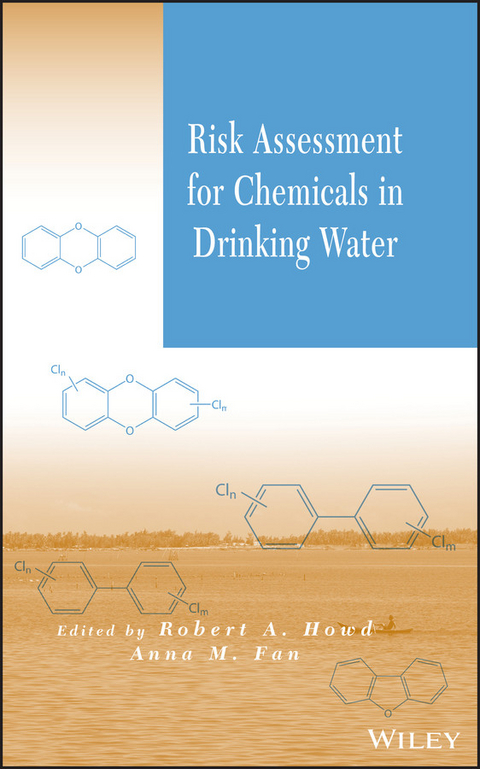
Risk Assessment for Chemicals in Drinking Water (eBook)
400 Seiten
John Wiley & Sons (Verlag)
9780470173374 (ISBN)
methodologies for drinking water
Risk Assessment for Chemicals in Drinking Water discusses
the major steps and goals in risk assessments and suggests ways to
improve the methodologies and accuracy, while consolidating
up-to-date information on the current principles and practices in
one authoritative reference. After an enlightening overview of risk
assessment practices and regulatory guidelines, it:
* Includes descriptions of the use of variability analysis,
exposure analysis, physiologically based pharmacokinetics, and
modeling for both cancer and non-cancer endpoints
* Describes the practices of major organizations, including the
U.S. EPA, Health Canada, World Health Organization, and California
Office of Environmental Health Hazard Assessment
* Includes complete chapters on risk assessment for essential
nutrients, arsenic, chloroform, and perchlorate
* Explains how to address susceptible sub-populations, including
the elderly and infants and children, in risk assessments
* Covers the potential of using genomic and proteomic
screens
* Addresses recent advances, emerging issues, and future
challenges
With contributions and perspectives from leading scientists, this
is the definitive resource for health and environmental scientists,
toxicologists, risk assessors and managers, regulators,
consultants, and other professionals responsible for the safety of
drinking water.
ROBERT A. HOWD is Chief of the Water Toxicology Section in the Office of Environmental Health Hazard Assessment of the California EPA, supervising the production of California Public Health Goals for chemicals in drinking water. Dr. Howd has authored or coauthored over fifty formal scientific publications and numerous government reports. ANNA M. FAN is Chief of the Pesticide and Environmental Toxicology Branch, Office of Environmental Health Hazard Assessment, California EPA. Dr. Fan has served on the U.S. EPA Science Advisory Board, Drinking Water Committee; the U.S. EPA Endocrine Disruptors Screening and Testing Advisory Committee; and other national advisory committees. She is an editor of the Journal of Environmental Science and Health, Part C: Environmental Carcinogenesis and Ecotoxicology Reviews.
Contributors.
Foreword.
Preface.
1 Introduction to Drinking Water Risk Assessment(Robert A. Howd).
Development of Drinking Water Regulations.
The Risk Assessment Process.
Public Perceptions and the Precautionary Principle.
2 Summary of the Development of Federal Drinking WaterRegulations and Health-Based Guidelines for ChemicalContaminants (Joyce Morrissey Donohue and Wynne MaynorMiller).
Selecting Candidates for Regulatory Consideration.
Key Components for Regulatory Development.
Development of Regulatory Values.
Nonregulatory Options.
3 Interpretation of Toxicologic Data for Drinking Water RiskAssessment (Robert A. Howd and Anna M. Fan).
Animal Toxicity Studies.
Human Toxicity Studies.
Conclusions.
4 Exposure Source and Multiroute Exposure Considerations forRisk Assessment of Drinking Water Contaminants(KannanKrishnan and Richard Carrier).
Exposure Source Considerations in Risk Assessment.
Routes of Exposure and Dose Calculations.
5 Toxicokinetics for Drinking Water Risk Assessment(John C. Lipscomb).
Evaluation of Toxicity Data.
Toxicokinetics: PBPK Modeling.
Risk Assessment.
Conclusions.
6 Health Risk Assessment of Chemical Mixtures in DrinkingWater (Richard C. Hertzberg, Glenn E. Rice, Linda K.Teuschler, J. Michael Wright, and Jane E. Simmons).
Drinking Water Mixture Concerns.
Estimating Exposures to Multiple Chemicals in DrinkingWater.
Toxicological Concepts for Joint Toxicity.
Chemical Mixtures Risk Assessment Methods.
New Approaches for Assessing Risk from Exposure to DrinkingWater Mixtures.
Conclusions.
References.
7 Protection of Infants, Children, and Other SensitiveSubpopulations (George V. Alexeeff and Melanie A.Marty).
Factors Influencing Differences in Susceptibility BetweenInfants and Children and Adults.
Critical Systems and Periods in Development.
Age at Exposure and Susceptibility to Carcinogens.
Drinking Water Standards Developed to Protect Sensitive.
Subpopulations.
References.
8 Risk Assessment for Essential Nutrients (JoyceMorrissey Donohue).
Assessment Approaches.
Comparison of Guideline Values.
Risk Assessment Recommendations.
References.
9 Risk Assessment for Arsenic in Drinking Water(Joseph P. Brown).
Occurrence and Exposure.
Metabolism.
Health Effects.
Risk Assessment.
Conclusions.
References.
10 Risk Assessment for Chloroform, Reconsidered(Richard Sedman).
Carcinogenic Effects.
Noncancer Toxic Effects.
Mechanisms of Carcinogenicity.
Regulation of Cancer Risk.
Discussion.
References.
11 Risk Assessment of a Thyroid Hormone Disruptor:Perchlorate (David Ting).
Background
Human Health Risk Assessment.
Risk Characterization and Conclusions.
References.
12 Emerging Contaminants in Drinking Water: A CaliforniaPerspective (Steven A. Book and David P. Spath).
Emerging Chemicals of the Recent Past.
Newer Emerging Contaminants.
Future Emerging Chemicals.
Conclusions.
References.
13 U.S. EPA Drinking Water Field Office Perspectives andNeeds for Risk Assessment (Bruce A. Macler).
The Nature of Regulatory Risk Assessments.
Use of Drinking Water Risk Information in EPA Field Offices.
Conclusions.
References.
14 Risk Assessment: Emerging Issues, Recent Advances, andFuture Challenges (Anna M. Fan and Robert A. Howd).
Emerging Issues.
Advances in Science, Approaches, and Methods.
Conclusions.
References.
Index.
Currently accepted for use as landscaping, it becomes clear that
recycled water will be injected into drinking water chain. That use
makes the material in the book more important. (Journal of
Hazardous Materials, January 31, 2008)
"Provides a comprehensive reference on state-of-the-art risk
assessment methodologies for drinking water." (International
Food Information Service, 2007)
| Erscheint lt. Verlag | 28.6.2008 |
|---|---|
| Sprache | englisch |
| Themenwelt | Naturwissenschaften ► Chemie |
| Technik ► Umwelttechnik / Biotechnologie | |
| Schlagworte | Angew. Wahrscheinlichkeitsrechn. u. Statistik / Modelle • Applied Probability & Statistics - Models • Arbeitssicherheit u. Umweltschutz i. d. Chemie • Chemical and Environmental Health and Safety • Chemie • Chemistry • Statistics • Statistik • Toxicology • Toxikologie |
| ISBN-13 | 9780470173374 / 9780470173374 |
| Informationen gemäß Produktsicherheitsverordnung (GPSR) | |
| Haben Sie eine Frage zum Produkt? |
 PDF (Adobe DRM)
Kopierschutz: Adobe-DRM
Adobe-DRM ist ein Kopierschutz, der das eBook vor Mißbrauch schützen soll. Dabei wird das eBook bereits beim Download auf Ihre persönliche Adobe-ID autorisiert. Lesen können Sie das eBook dann nur auf den Geräten, welche ebenfalls auf Ihre Adobe-ID registriert sind.
Details zum Adobe-DRM
Dateiformat: PDF (Portable Document Format)
Mit einem festen Seitenlayout eignet sich die PDF besonders für Fachbücher mit Spalten, Tabellen und Abbildungen. Eine PDF kann auf fast allen Geräten angezeigt werden, ist aber für kleine Displays (Smartphone, eReader) nur eingeschränkt geeignet.
Systemvoraussetzungen:
PC/Mac: Mit einem PC oder Mac können Sie dieses eBook lesen. Sie benötigen eine
eReader: Dieses eBook kann mit (fast) allen eBook-Readern gelesen werden. Mit dem amazon-Kindle ist es aber nicht kompatibel.
Smartphone/Tablet: Egal ob Apple oder Android, dieses eBook können Sie lesen. Sie benötigen eine
Geräteliste und zusätzliche Hinweise
Buying eBooks from abroad
For tax law reasons we can sell eBooks just within Germany and Switzerland. Regrettably we cannot fulfill eBook-orders from other countries.
aus dem Bereich